F minor series — 24 Paintings by Arnaud Quercy
ART-SER0012
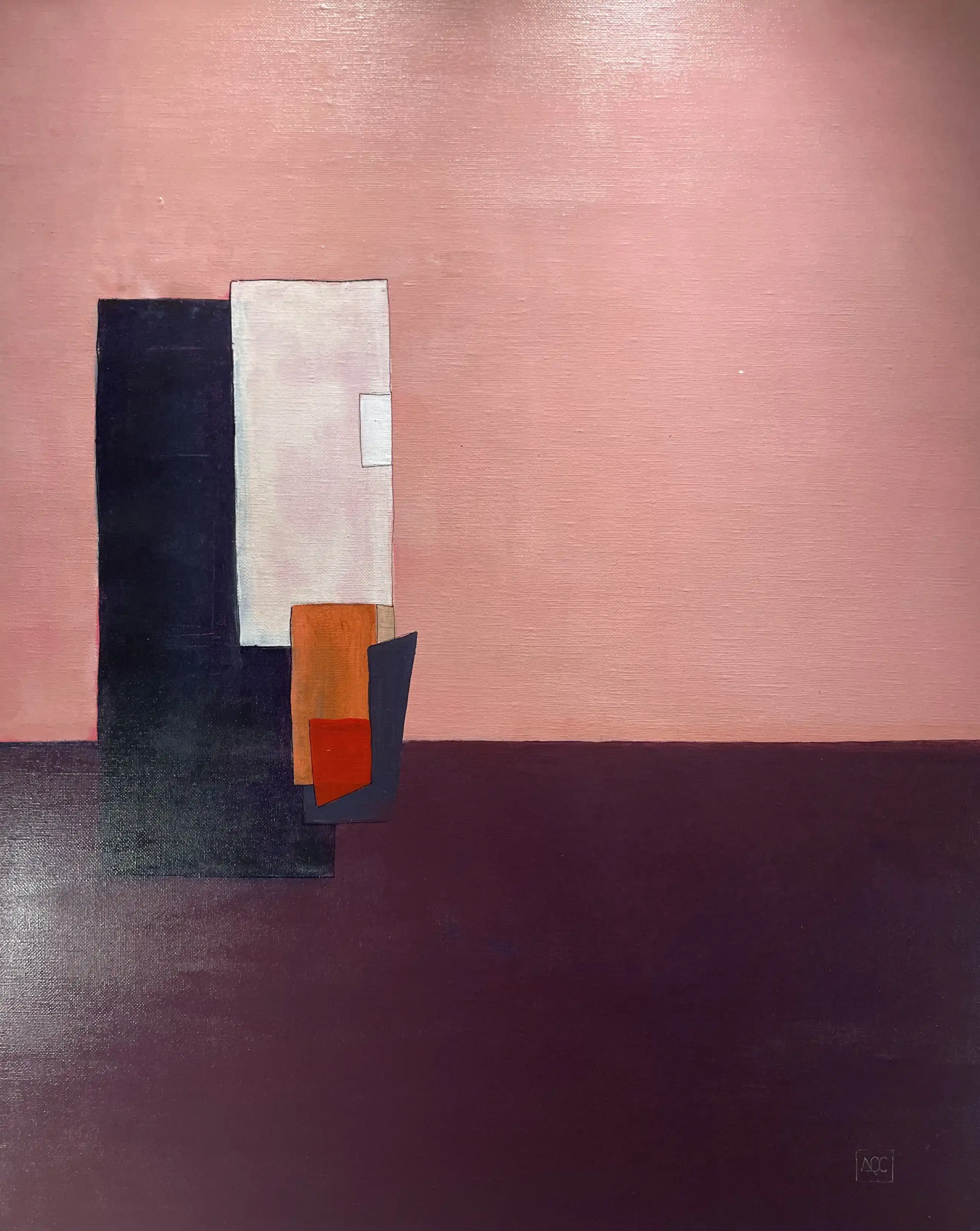
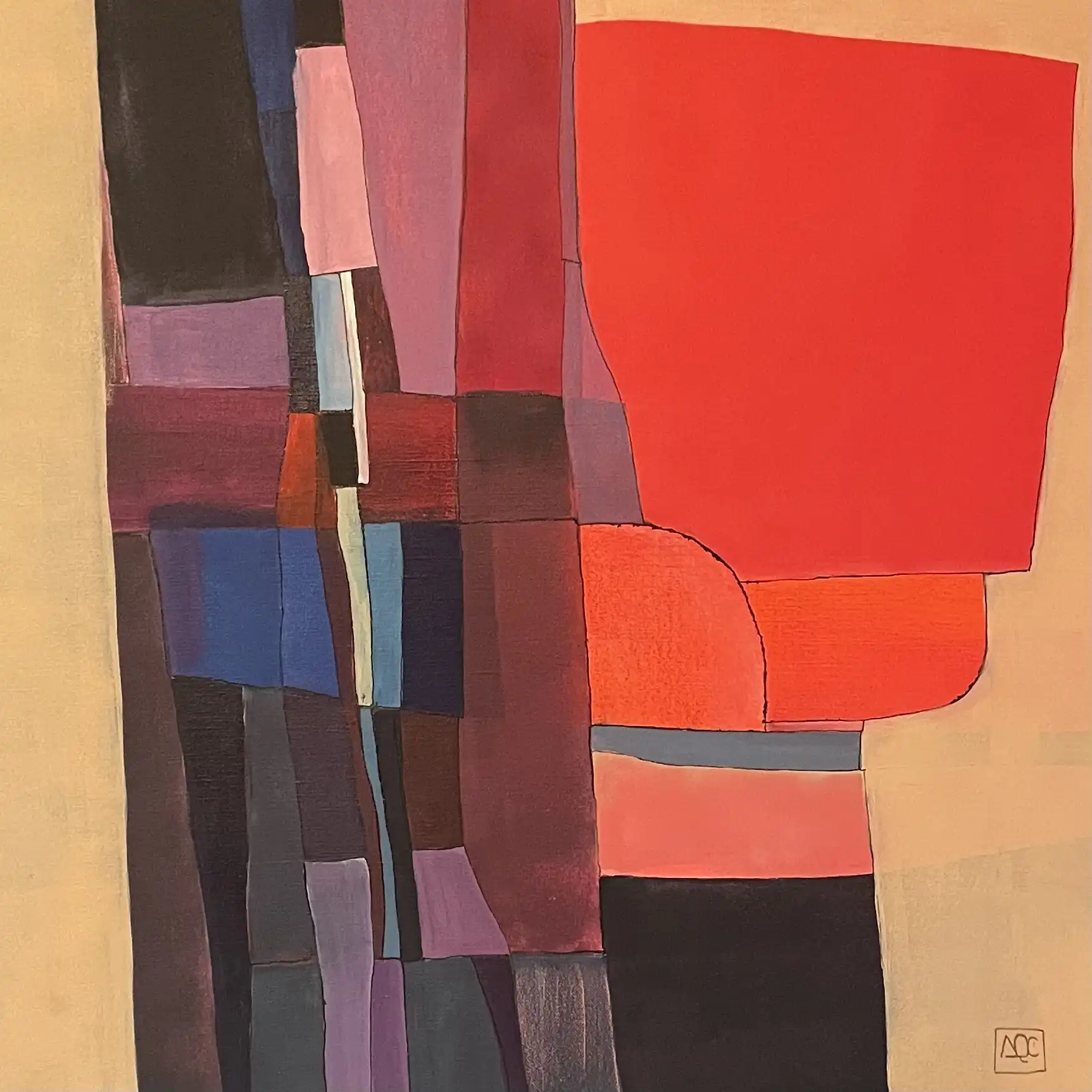
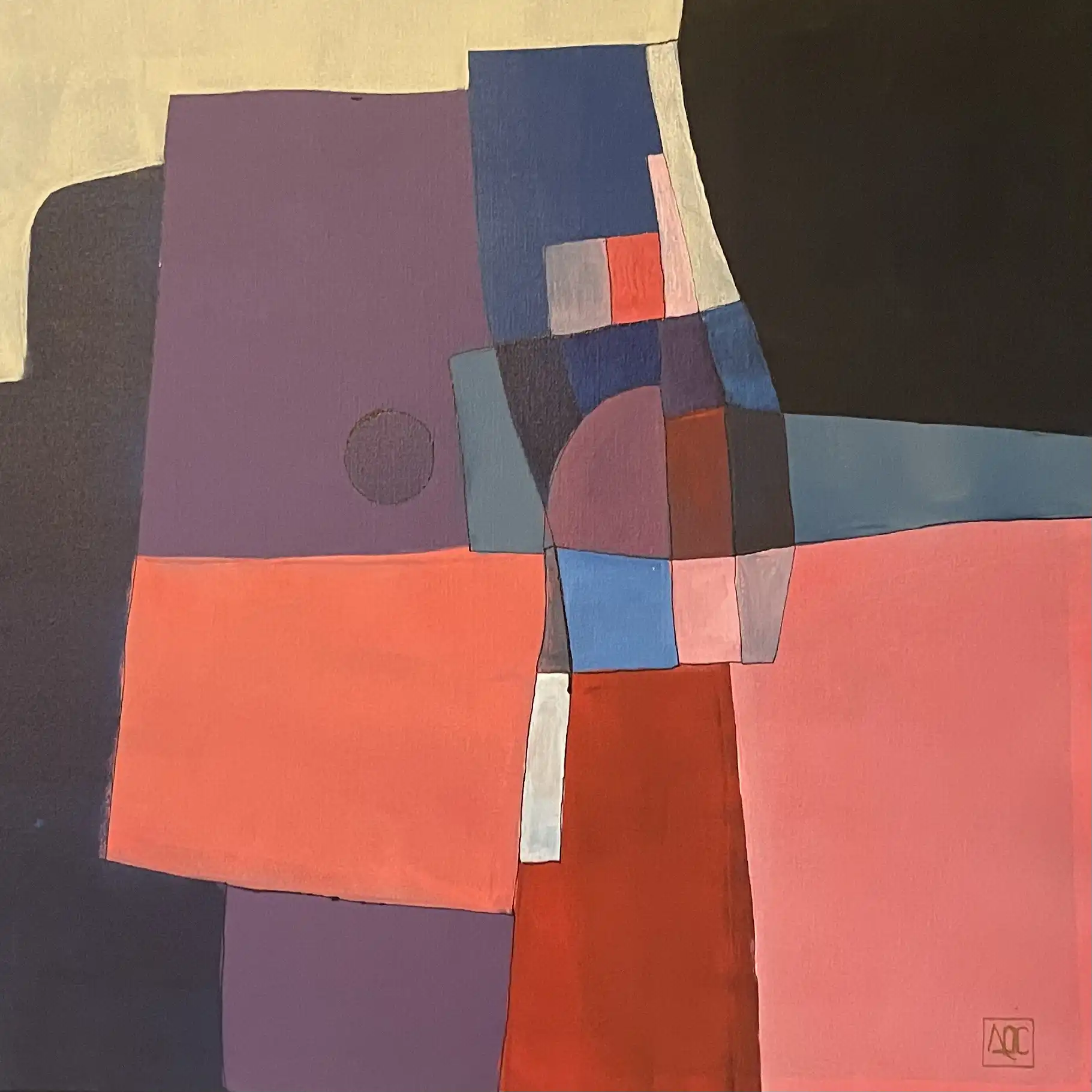
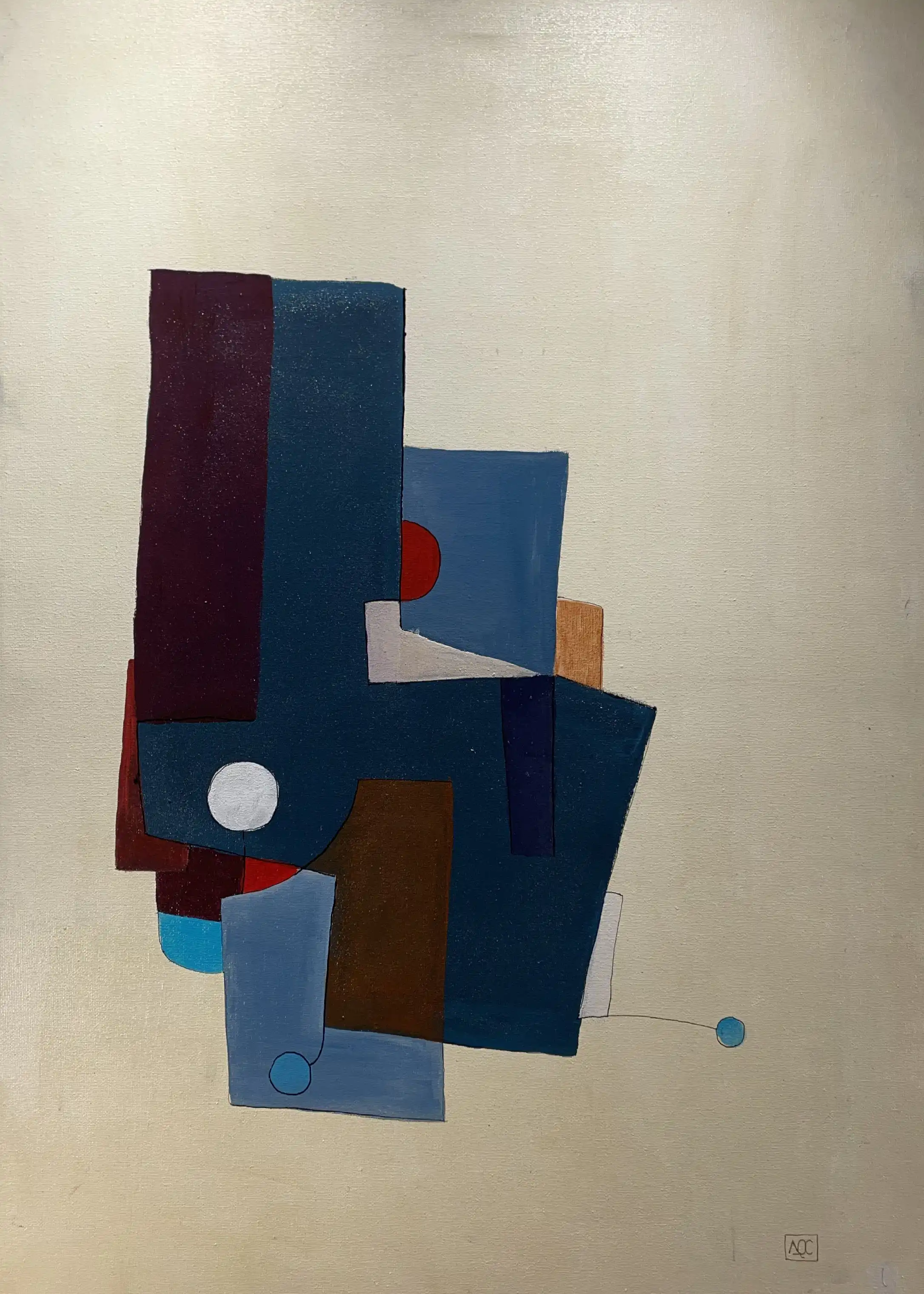
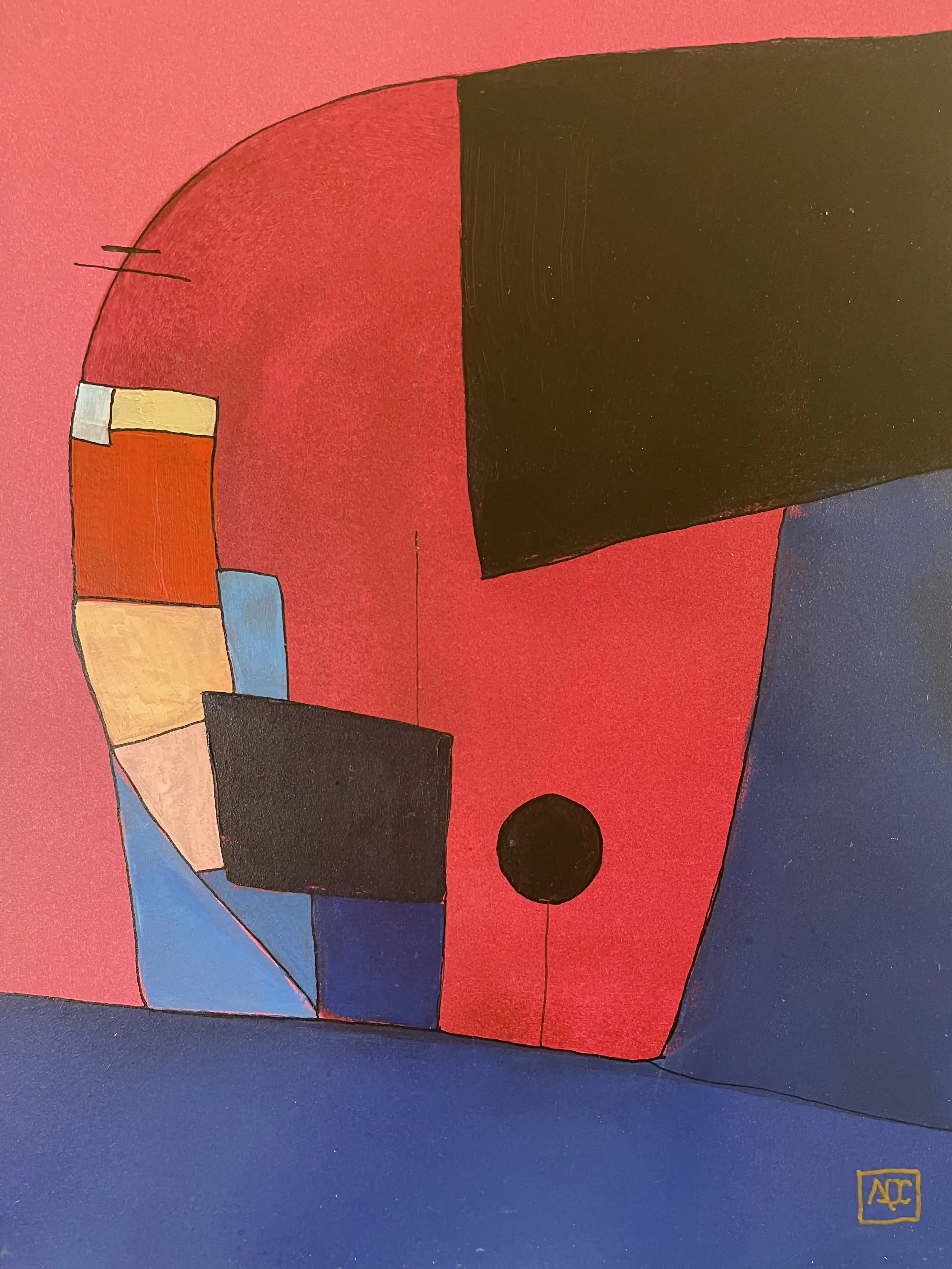
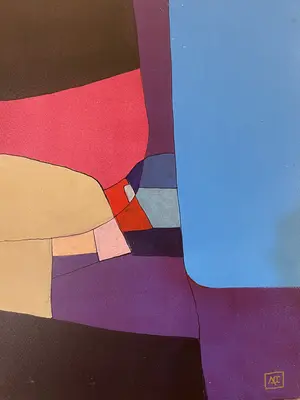
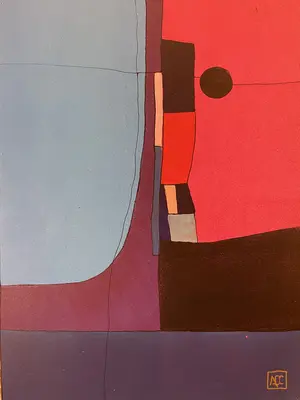
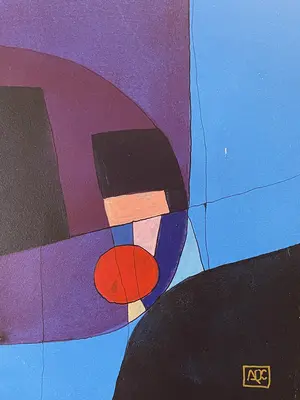
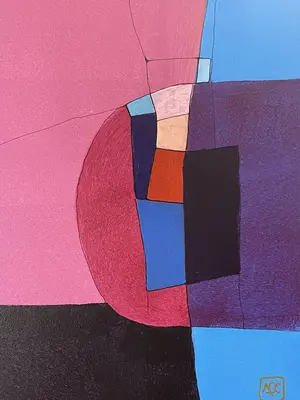
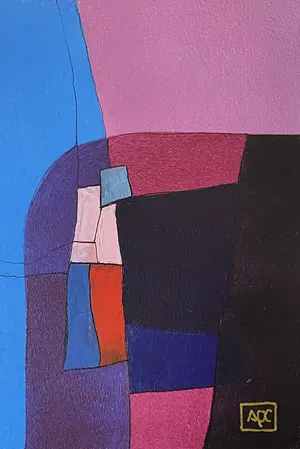
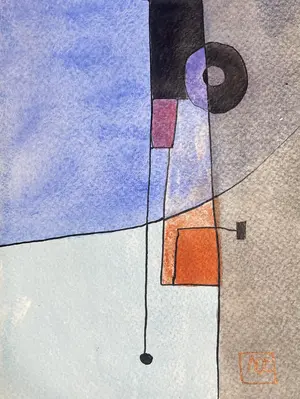
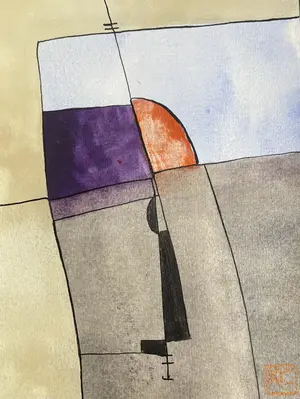
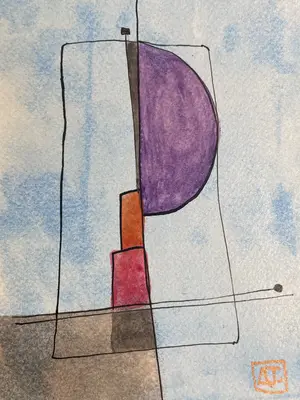
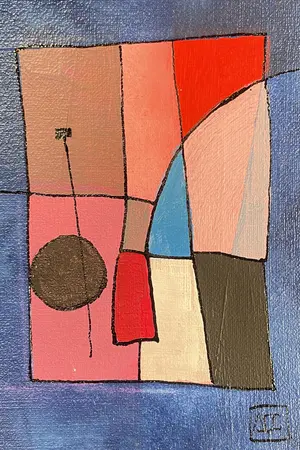
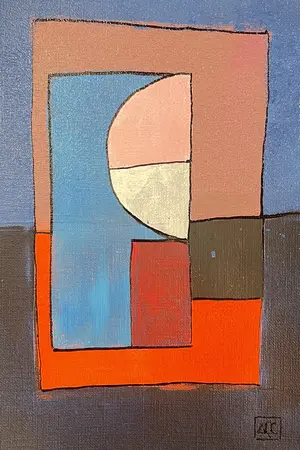
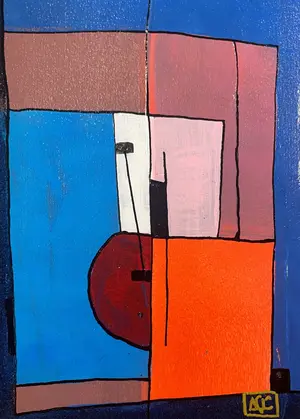
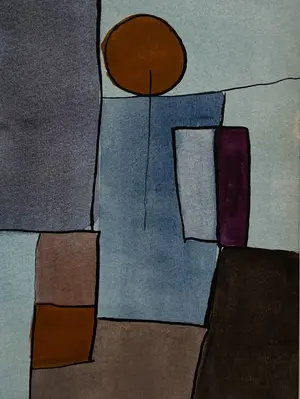
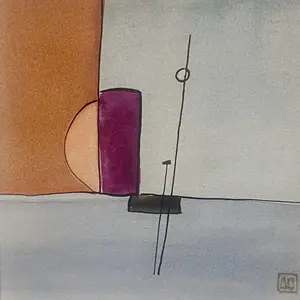
F minor is a series of 24 paintings by Arnaud Quercy, created between 2024 and 2026 in acrylic on canvas, acrylic on linen canvas, acrylic on paper, acrylic on wood panel, oil on linen canvas and watercolor on paper. Formats range from 10×15 cm to 60×73 cm. 19 works are held in private collections (Paris, France, Canada, San Francisco, USA, Le Havre, France, Corsica, France, Bogota, Colombia, Tokyo, Japan, Amsterdam, Netherlands, Santo Domingo, DOMINICAN REPUBLIC). 2 remain available for acquisition at Art Quam Anima, 28 rue du Dragon, Paris. Works presented at: Rencontres au Marché de la Création, Salon d'art contemporain – Metamorphose, Paris and Permanent Collection 2025 – Resonance in Form and 8 more.
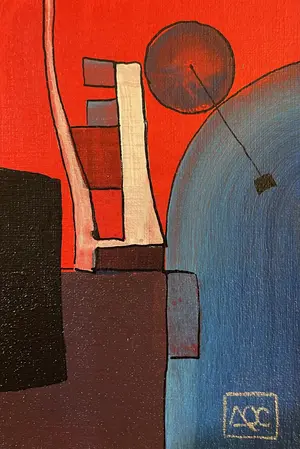
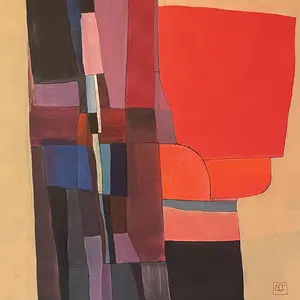
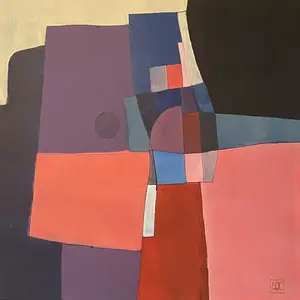
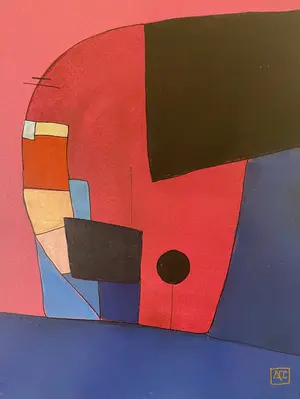
F minor is a key of sustained tension. Its three pitches — F, Ab, and C — map to red-violet, blue, and red: a palette of unusual coolness for a minor triad, the flat third carrying none of the warm orange or ochre found in other minor chords. Chopin returned to this key repeatedly for his most turbulent writing, and Brahms reached for it in moments of unresolved longing. What distinguishes it tonally is the Ab: a minor third that is genuinely, persistently cold.
In harmonic-chromatic translation, F minor reads as a chord in two temperatures. The root, F, translates to red-violet — warm enough, but with a violet cast that already tilts toward cool. The fifth, C, comes in as red: grounded, direct. But the minor third, Ab, is unmistakably blue. In the low register, near-black red-violet at the bass; in the high register, Ab bleaches toward silver-white, the blue almost entirely washed out. Between these extremes, the midrange holds a layered field: red-violet, blue, and red in close proximity, neither warm nor cold winning. When chromatic accents enter — and they do, frequently — they bring orange or yellow-orange warmth that interrupts the chord's characteristic cool from within.
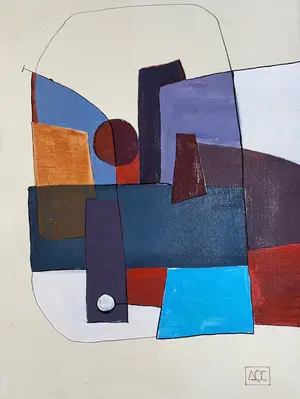
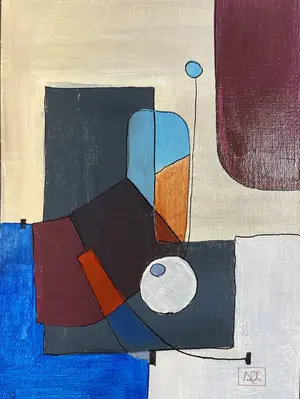
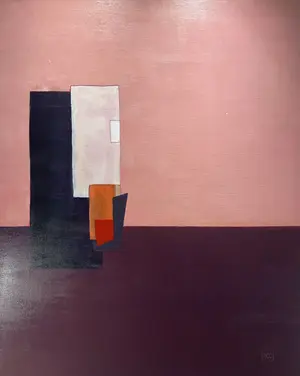
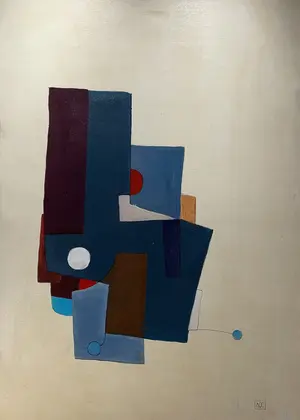
Arnaud Quercy explores F minor across twenty-two études, the largest series in the Harmonic Crossing collection, painted in acrylic on paper in the standard 21×30 cm format. The dominant form is the valley: the phrase dips low before returning upward, mostly Animé, forward-moving, with legato connecting the notes into a continuous shape. Two ascending waltzes provide the series' other rhythmic texture — one quiet, one the only mf in the collection. A handful of Lent bell arches slow the tempo and deepen the palette. Two Modéré études — neither fast nor slow — sit in the most shadowed register of all, as if the measured tempo allows the chord's coolness to settle undisturbed. The sub-bass F0 appears in several works, descending below the threshold of definite pitch; Ab7 appears at the extreme high, its blue bleached to near-white. The range across the series spans this full distance — seven-plus octaves of F minor terrain. The note count runs from four to nine, the densest work filling the phrase from floor to ceiling.
Three études mark the series' extremes. Variation 3 is F minor at its most expansive: eight notes, valley-shaped, Animé, reaching from F0 at the sub-bass to Ab7 near-white, with a yellow E5 accent punctuating the ascent — what the artist describes as "a brief warm note in a largely cool phrase." It is the only étude that states the full range simultaneously, the chord from its deepest darkness to its lightest near-silver in a single gesture. Variation 15 is the opposite pole: the series' darkest work, with the smallest range (F2 to F5) and only two percent highlights. Orange and yellow-orange accents appear but cannot lift the palette; the phrase stays compressed and shadowed, the chord at its most inward. Variation 18 presents the series' most elaborate descent: nine notes, Lent, from Ab6 down through Ab's, F's, and C's in sequence, with a single orange D4 as chromatic warmth at the midpoint — a long, cool, unhurried fall that examines the chord in exhaustive detail.
On the canvas, F minor reads as a cool field with warm intrusions. The blue of Ab occupies much of the upper register across the series — light but cold, bleaching toward silver at Ab7 without losing its essential temperature. The red-violet of F anchors the bass in near-darkness, the two roots often appearing together in consecutive octaves, their violet-inflected red deepening as the register falls. The red of C brings a note of warmth to the middle — the fifth is not cool — but it is flanked by the chord's two cooler colors on either side. What visually recurs is the tension between these zones: blue at the top, red-violet at the bottom, red in between. The chromatic accents — D in orange, A in yellow-orange, E in yellow — appear as warm interjections distributed through the middle and lower-high registers, brief moments of a different temperature in the chord's dominant cool. The series as a whole does not resolve this tension; it inhabits it, canvas after canvas.
F minor may be the chord in this practice that most resists resolution. The same blue Ab returns in étude after étude — sometimes dense and shadowed, sometimes bleached to silver, sometimes flanked by warm chromatic guests — but always cool, always the chord's most unmistakable element. The twenty-two variations do not domesticate the key; they document it from many angles, in many tempos and registers and densities, and the chord stays itself throughout. Several of these works have found their way into collections in France, Japan, and Colombia — the cool palette traveling far, carrying its particular temperature with it.

Arnaud Quercy is a Parisian artist working across painting, music, and sculpture. His practice is grounded in Ideamorphism — the principle that a work of art does not carry meaning, but triggers it. Each piece is engineered to diffract differently through each person who encounters it.
He creates and exhibits at Art Quam Anima, his gallery-atelier at 28 rue du Dragon, Saint-Germain-des-Prés, Paris.
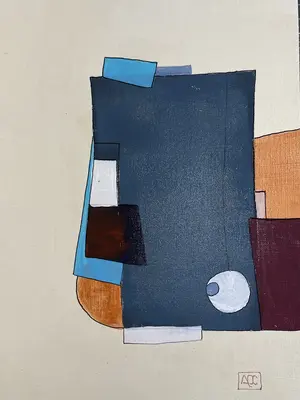
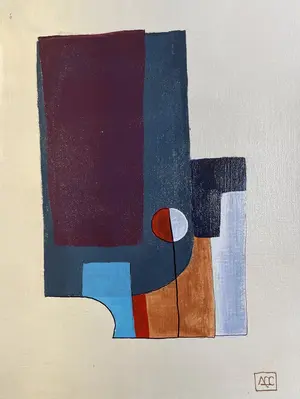
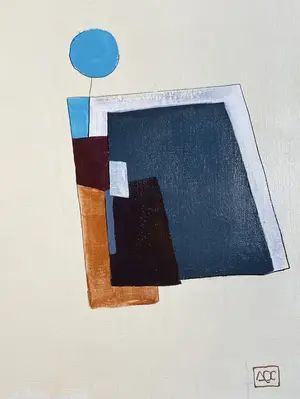
Works — F minor
Related hubs
- Collection: Harmonic Crossing
Exhibitions 10
- Permanent Collection 2025 – Resonance in Form (2025-01-01 → 2025-12-31, arnaudquercy.art, Paris)
- Paris Studio Visit (2025-02-18 → 2025-02-18, Artist's Studio, Paris)
- Marché d'Art Contemporain – Seine Port (2025-05-17 → 2025-05-17, MAC Seine-Port, Seine-Port)
- Nuit des Artistes, St Germain-en-Laye, France (2025-05-24 → 2025-05-24, La Nuit des Artistes, Saint-Germain-en-Laye)
- Marché de l'Art de Saint-Germain-en-Laye, 17ème édition – France (2025-06-14 → 2025-06-14, Marché de l'Art, Saint-Germain-en-Laye)
- Salon d'art contemporain – Metamorphose 2025–2026, Paris (2025-12-26 → 2026-01-04, Halle des Blancs Manteaux, Paris)
- Art Quam Anima – Pre-opening (2026-01-31 → 2026-02-28, Art Quam Anima, Paris)
- Through the Aperture — Research on Harmony (2026-03-09 → 2026-04-30, Art Quam Anima, Paris)
- Rencontres au Marché de la Création (2024-04-23 → 2024-12-31, Marché de la Création – Paris Montparnasse, Paris)
- Salon d'art contemporain – Metamorphose, Paris (2024-12-26 → 2025-01-05, Halle des Blancs Manteaux, Paris)
Other series in this collection 35
Documented at 1
Catalogue raisonné entries 24
- F minor - Research on Harmony
- F minor - Research on Harmony - Variation 1
- F minor - Research on Harmony - Variation 2
- F minor - Research on Harmony - Variation 3
- F minor - Research on Harmony - Variation 4
- F minor - Research on Harmony - Variation 5
- F minor - Research on Harmony - Variation 6
- F minor - Research on Harmony - Variation 7
- F Minor - Research on Harmony - Variation 8
- F Minor - Research on Harmony - Variation 9
- F Minor - Research on Harmony - Variation 10
- F Minor - Research on Harmony - Variation 11
- F Minor - Research on Harmony - Variation 12
- F Minor - Research on Harmony - Variation 13
- F Minor - Research on Harmony - Variation 14
- F Minor - Research on Harmony - Variation 15
- F Minor - Research on Harmony - Variation 16
- F Minor - Research on Harmony - Variation 17
- F Minor - Research on Harmony - Variation 18
- F Minor - Research on Harmony - Variations 19
- F Minor - Research on Harmony - Variations 20
- F Minor - Research on Harmony - Variations 22
- Watercolor Study in F minor- No. 1
- Watercolor Study in F Minor No. 3