Bb Major series — 11 Paintings by Arnaud Quercy
ART-SER0025
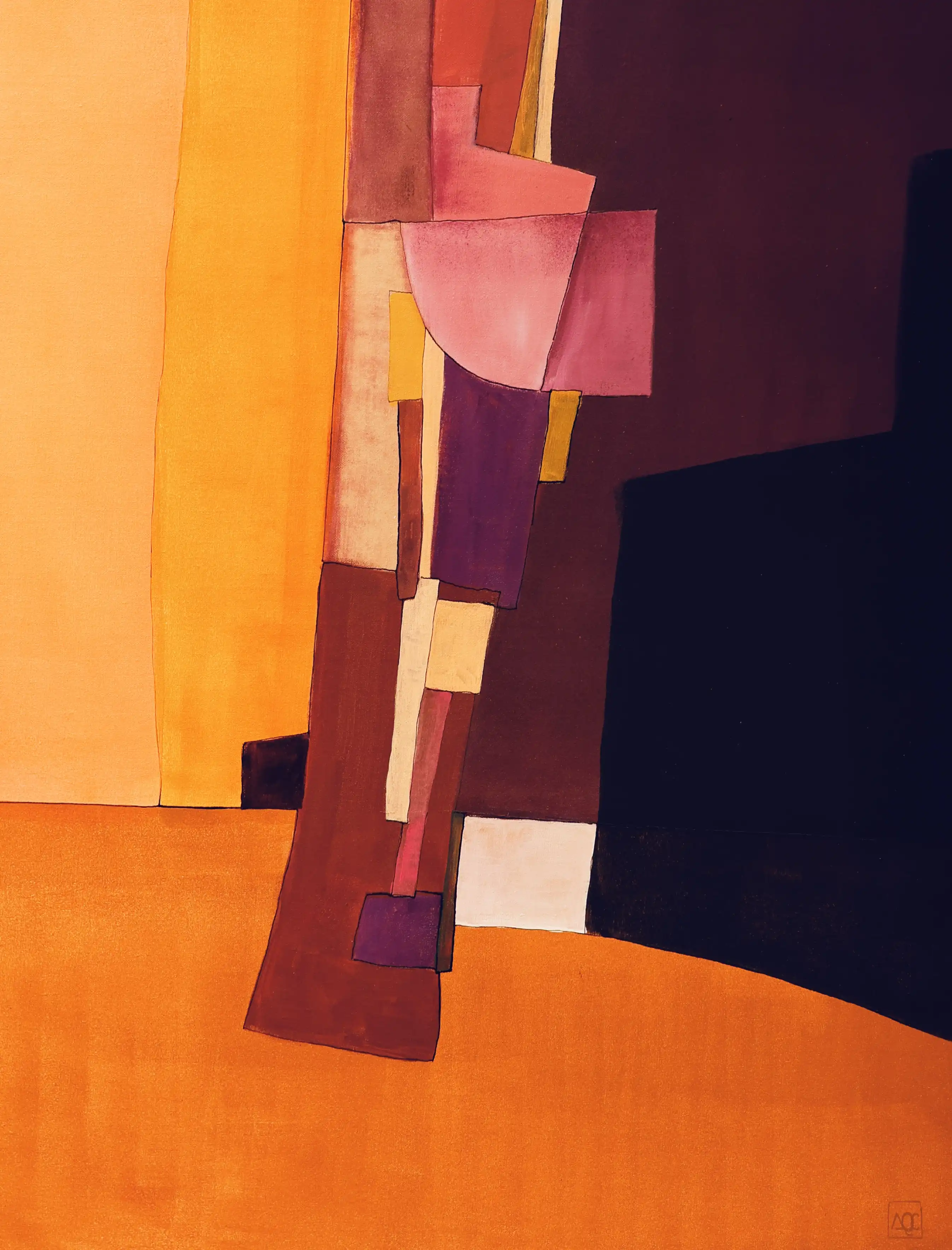
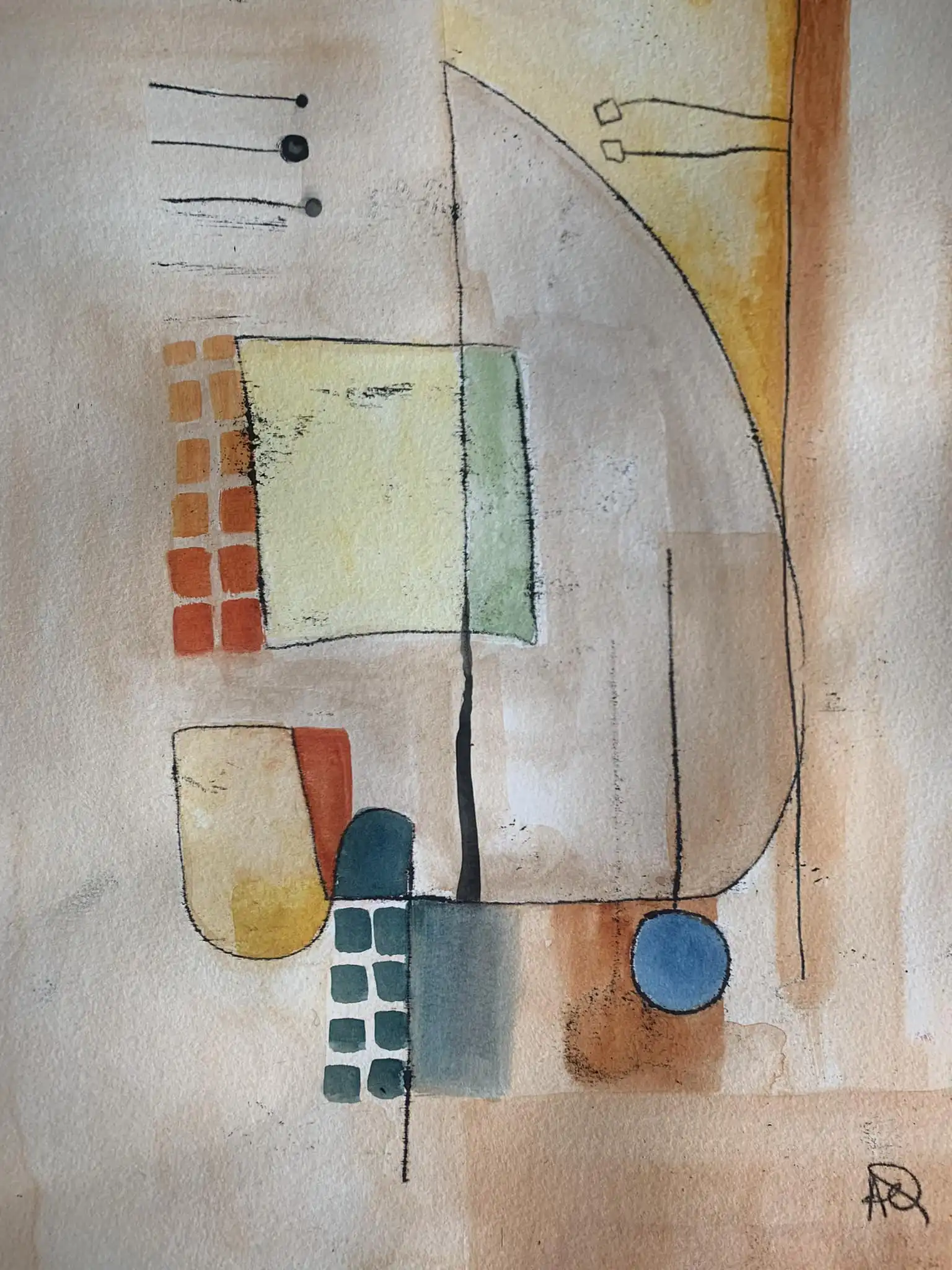
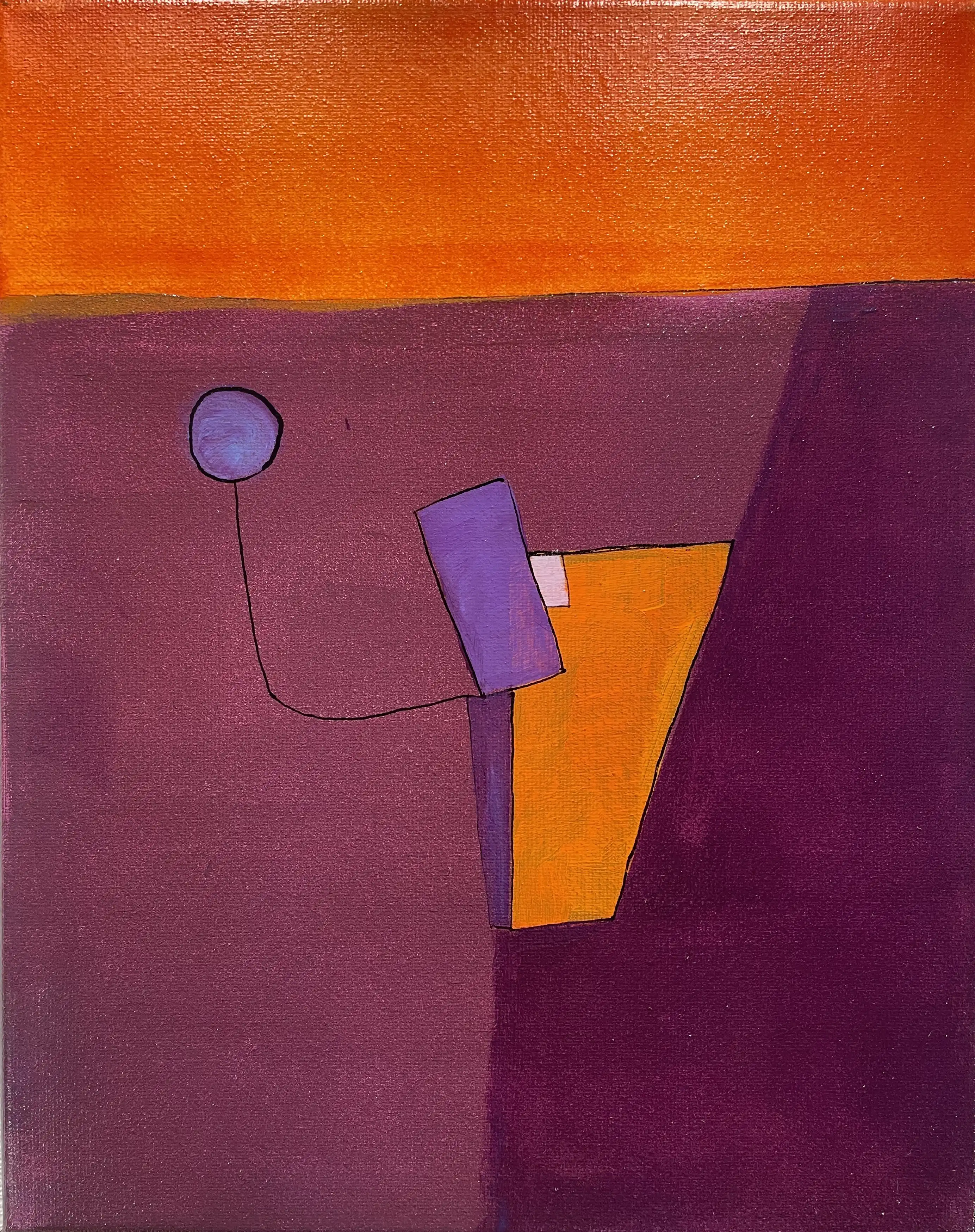
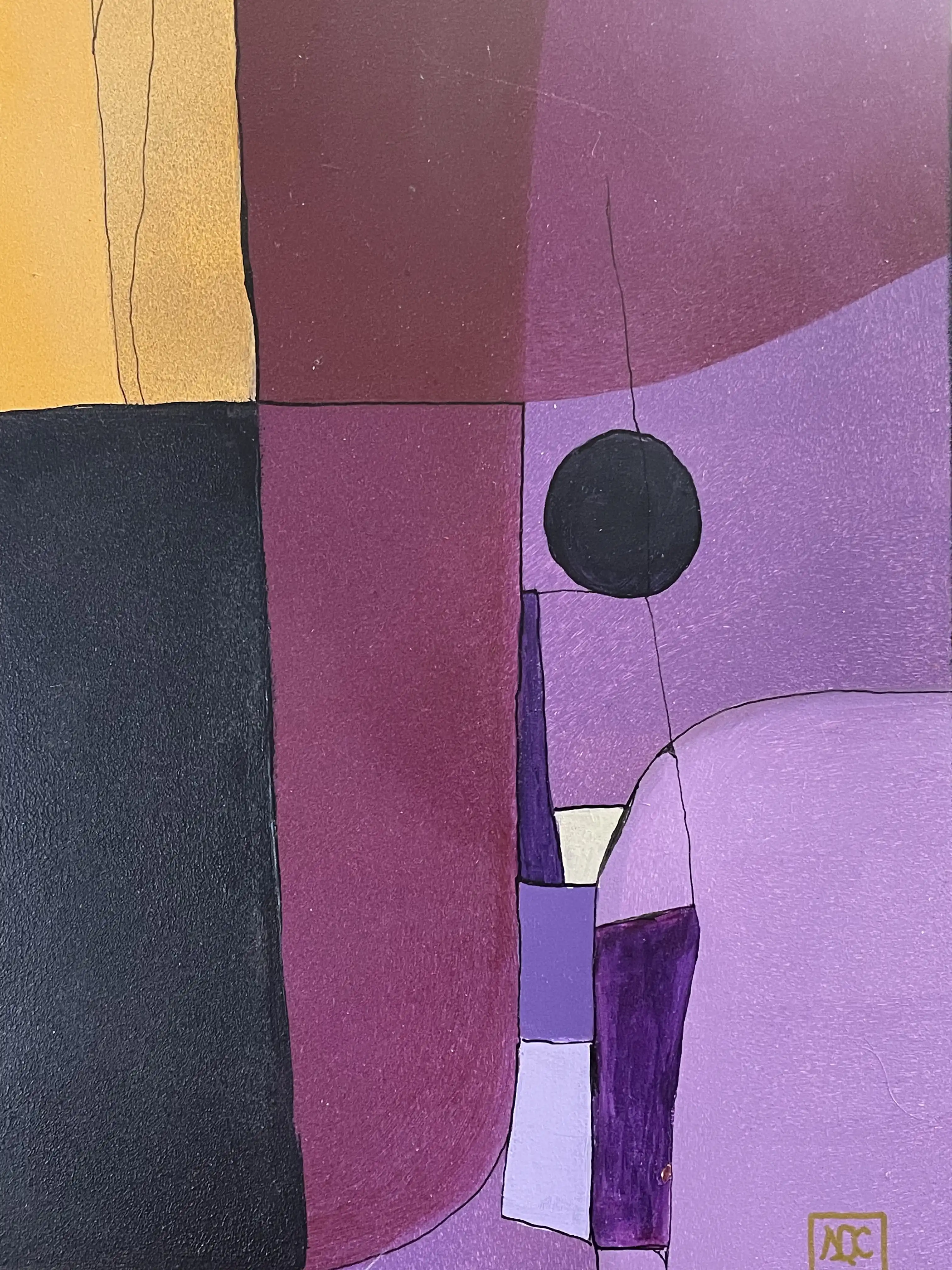
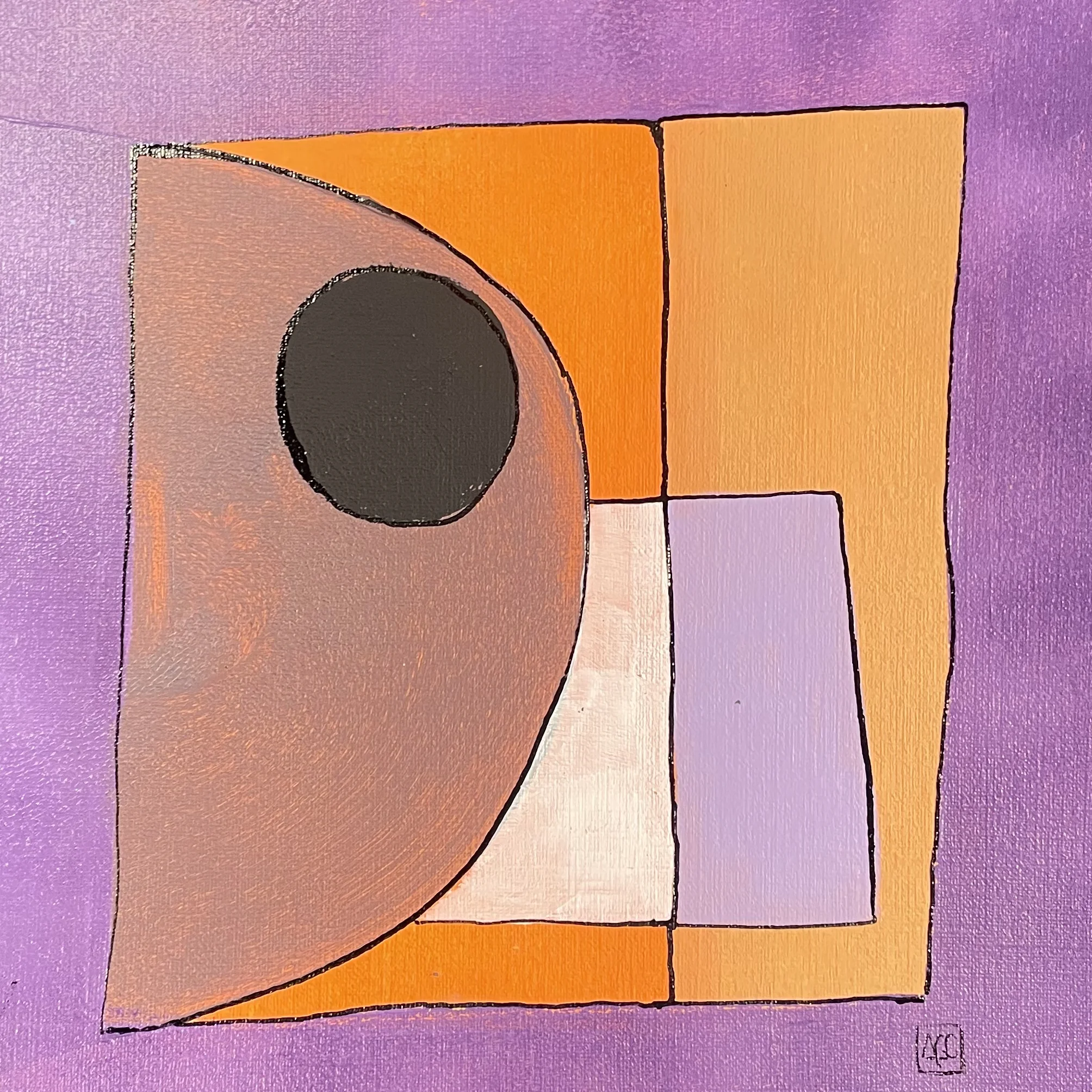
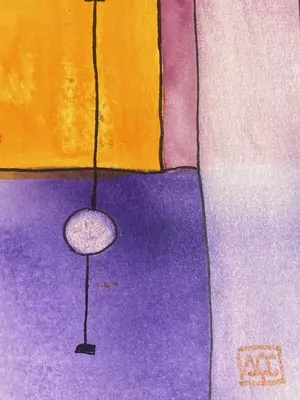
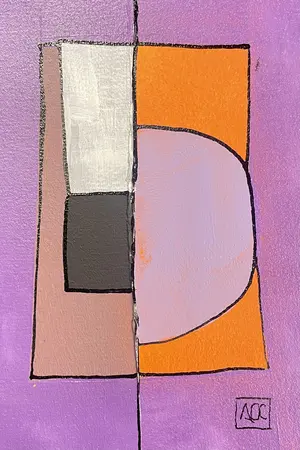
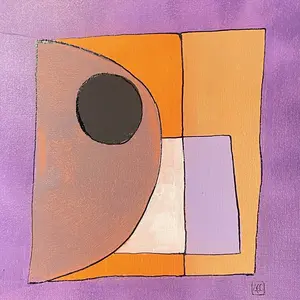
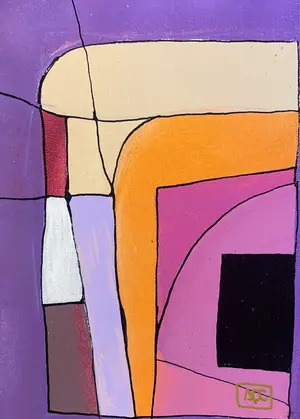
Bb Major is a series of 11 paintings by Arnaud Quercy, created between 2023 and 2025 in acrylic on canvas, acrylic on linen canvas, acrylic on paper, acrylic on wood panel and watercolor on paper. Formats range from 10×15 cm to 81×100 cm. All 11 works in this series are held in private collections (Paris, France, London, UK, Sao-Paulo, Brazil, New York, USA, Sao Paul, Brazil). Works presented at: Transcendence – World Premiere of Ephemera Arts, Rencontres au Marché de la Création and Salon d'art contemporain – Metamorphose, Paris and 8 more.
B-flat Major is built on the interval of a major third above a deep root — Bb, D, F — a triad whose warmth lives in the middle voices while its foundation reaches into darkness. It is the natural key of clarinets and trumpets, the key in which Brahms set his Second Piano Concerto and in which countless jazz standards breathe. Two flats give it a gravity that brighter major keys lack, a resonance that sits low in the body before it opens upward.
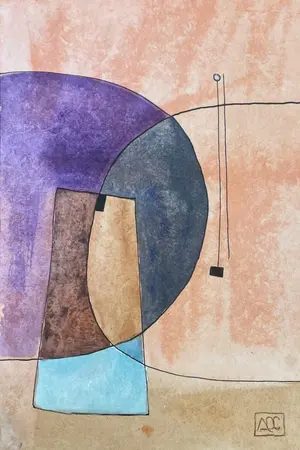
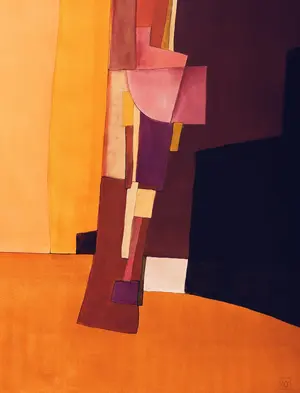
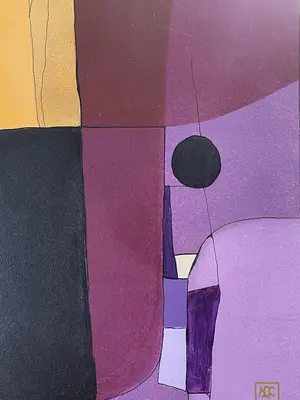
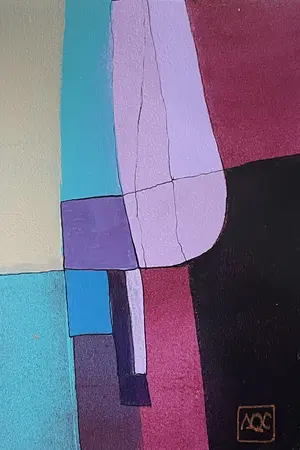
Through harmonic-chromatic, the Bb Major triad translates to a palette torn between cool and warm. The root appears as violet — compressed toward black in the lowest registers, rich and full in the middle octaves. The third, D, carries orange: saturated and glowing at the center of the keyboard, thinning to pale silver as it climbs past the sixth octave. The fifth, F, reads as red-violet, a mediating hue that bridges the root’s coolness and the third’s warmth. Together, the three tones produce a twilight palette — violet darkness below, orange warmth at the center, red-violet threading between them.
Eleven piano études explore this chord across nearly six octaves, from Bb1 to D7. The series favors legato phrasing throughout, dividing almost evenly between slow waltzes in triple time and animated phrases in four. Dynamics stay restrained — mp is the prevailing dynamic, with only the opening Research on Harmony study rising to mf and one variation dropping to piano. Descents and inverted bells dominate the contour, the phrases repeatedly dipping into the sub-bass before climbing upward through the registers. The fifth is treated sparingly: several études omit F entirely, building the chord on root and third alone, while others grant it a single appearance. Only in the final variations does the full triad emerge across multiple octaves. The series reads as a gradual unveiling — the chord revealing itself one tone at a time.
Variation 2 is the series’ largest format — acrylic on linen canvas at 81 by 100 centimeters — yet it contains only three notes, the most compact gesture in the collection. “A chord reduced to its barest gesture,” the artist writes: root once, third twice, the fifth entirely absent, played at the softest dynamic in the series. At the opposite extreme, Variation 5 admits three non-chord accents — blue, blue-green, and yellow intrusions that pull the harmony sideways, “the series’ one moment of genuine ambiguity.” Between these poles, Variation 9 closes the collection with a true arch, the only rising-and-returning contour among the later studies, all three chord tones finally balanced across six octaves.
Across the collection, violet anchors every canvas that reaches into the low registers — near-black at Bb1, dark and weighty at Bb2, warming as the root climbs. Orange dominates the middle and upper space wherever the third appears, fading from saturated warmth to near-white at the highest octaves. Red-violet enters selectively, marking the fifth’s presence in the lower-middle registers when it appears at all. The visual rhythm is one of alternation: dark violet floors giving way to warm orange centers, with occasional cool interruptions — a blue-green accent here, a yellow flash there — reminding the viewer that the chord exists in tension with the chromatic world around it.
Bb Major reveals its character through restraint. Eleven études, mostly quiet, mostly descending, strip the triad to its essential dialogue between violet and orange and let the fifth arrive only when the harmony needs completing. The series now lives in collections spanning Paris, London, New York, and Sao Paulo — a geography as wide as the six octaves the chord itself inhabits. What repetition teaches here is that a chord’s identity is not fixed: it shifts with register, with density, with the presence or absence of a single tone. Bb Major is not one color but a spectrum, its twilight palette different each time the triad sounds.

Arnaud Quercy is a Parisian artist working across painting, music, and sculpture. His practice is grounded in Ideamorphism — the principle that a work of art does not carry meaning, but triggers it. Each piece is engineered to diffract differently through each person who encounters it.
He creates and exhibits at Art Quam Anima, his gallery-atelier at 28 rue du Dragon, Saint-Germain-des-Prés, Paris.
Works — Bb Major
Related hubs
- Collection: Harmonic Crossing
Exhibitions 11
- Rencontres au Marché de la Création (2024-04-23 → 2024-12-31, Marché de la Création – Paris Montparnasse, Paris)
- Salon d'art contemporain – Metamorphose, Paris (2024-12-26 → 2025-01-05, Halle des Blancs Manteaux, Paris)
- Permanent Collection 2025 – Resonance in Form (2025-01-01 → 2025-12-31, arnaudquercy.art, Paris)
- Paris Studio Visit (2025-02-18 → 2025-02-18, Artist's Studio, Paris)
- Marché d'Art Contemporain – Seine Port (2025-05-17 → 2025-05-17, MAC Seine-Port, Seine-Port)
- Nuit des Artistes, St Germain-en-Laye, France (2025-05-24 → 2025-05-24, La Nuit des Artistes, Saint-Germain-en-Laye)
- Marché de l'Art de Saint-Germain-en-Laye, 17ème édition – France (2025-06-14 → 2025-06-14, Marché de l'Art, Saint-Germain-en-Laye)
- Salon d'art contemporain – Metamorphose 2025–2026, Paris (2025-12-26 → 2026-01-04, Halle des Blancs Manteaux, Paris)
- Art Quam Anima – Pre-opening (2026-01-31 → 2026-02-28, Art Quam Anima, Paris)
- Through the Aperture — Research on Harmony (2026-03-09 → 2026-04-30, Art Quam Anima, Paris)
- Transcendence – World Premiere of Ephemera Arts (2023-10-29 → 2023-11-15, Koblenzer Kunstverein e.V., Koblenz)
Other series in this collection 35
Documented at 1
Catalogue raisonné entries 11
- Bb Major - Reflexions 1
- Bb Major - Research on Harmony
- Bb Major - Research on Harmony - Variation 1
- Bb Major - Research on Harmony - Variation 3
- Bb Major - Research on Harmony - Variation 2
- Bb Major - Research on Harmony - Variation 4
- Bb Major - Research on Harmony - Variation 5
- Bb Major - Research on Harmony - Variation 6
- Bb Major - Research on Harmony - Variations 7
- Bb Major - Research on Harmony - Variations 8
- Bb Major - Research on Harmony - Variations 9