Augmented Chords series — 6 Paintings by Arnaud Quercy
ART-SER0049
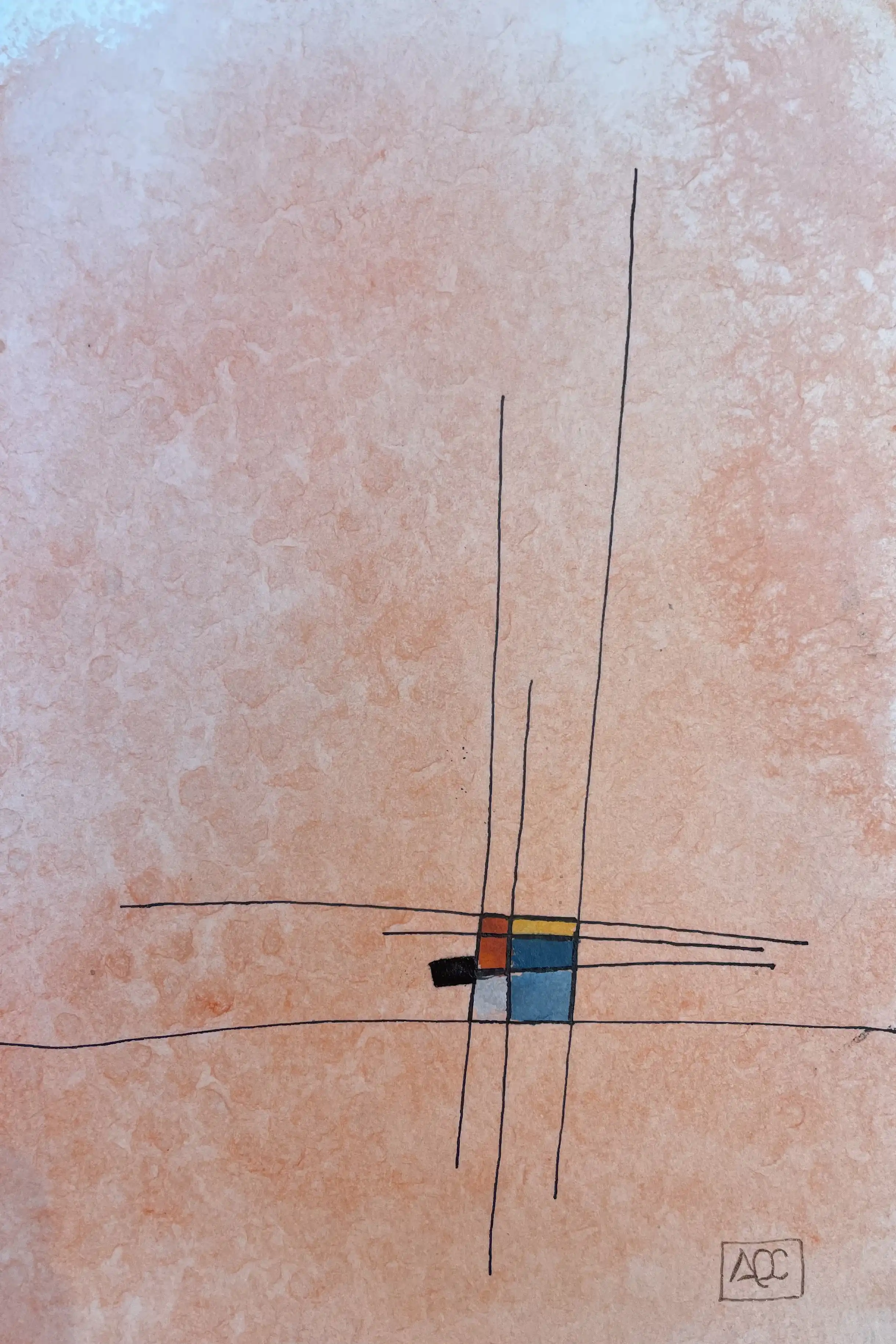
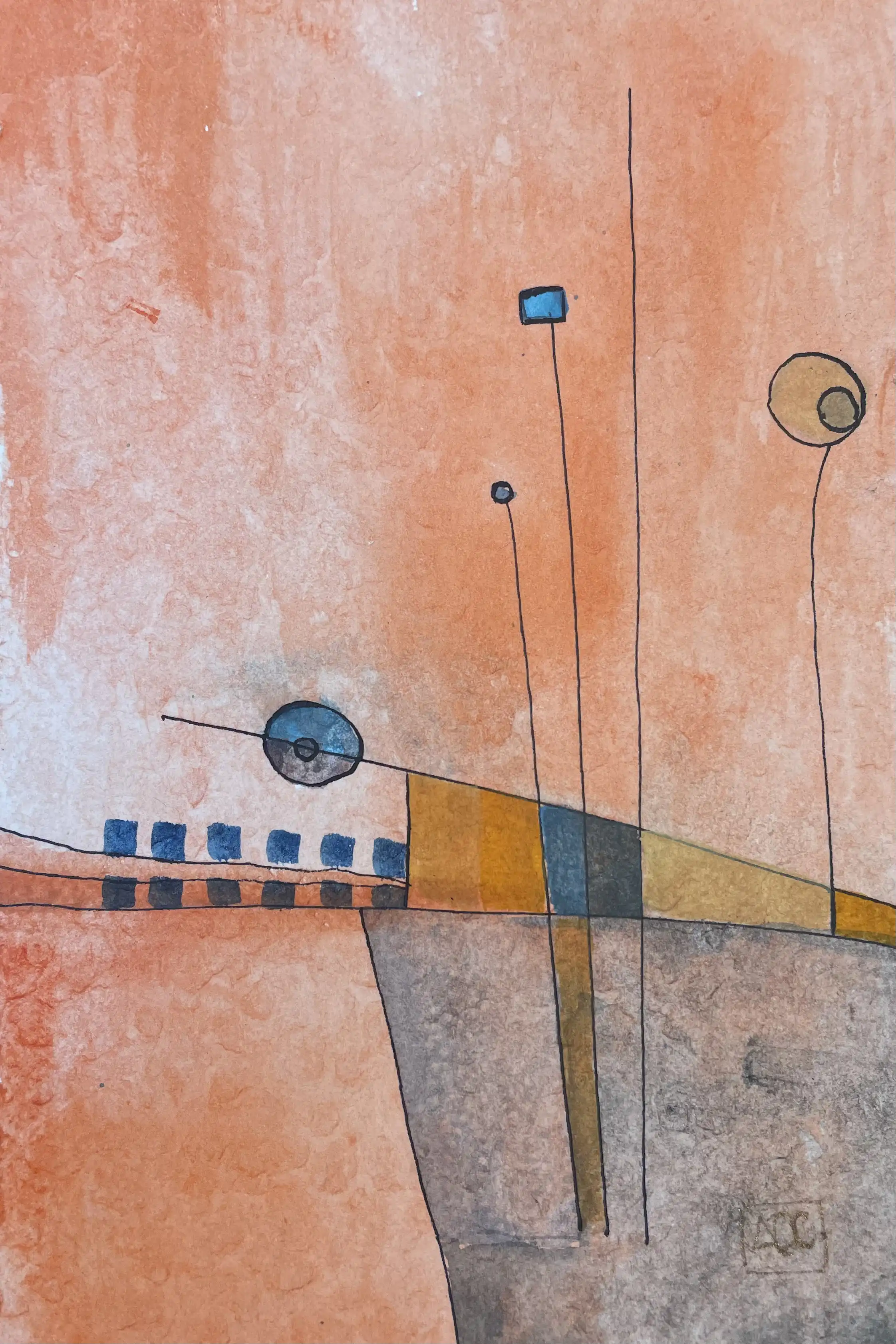
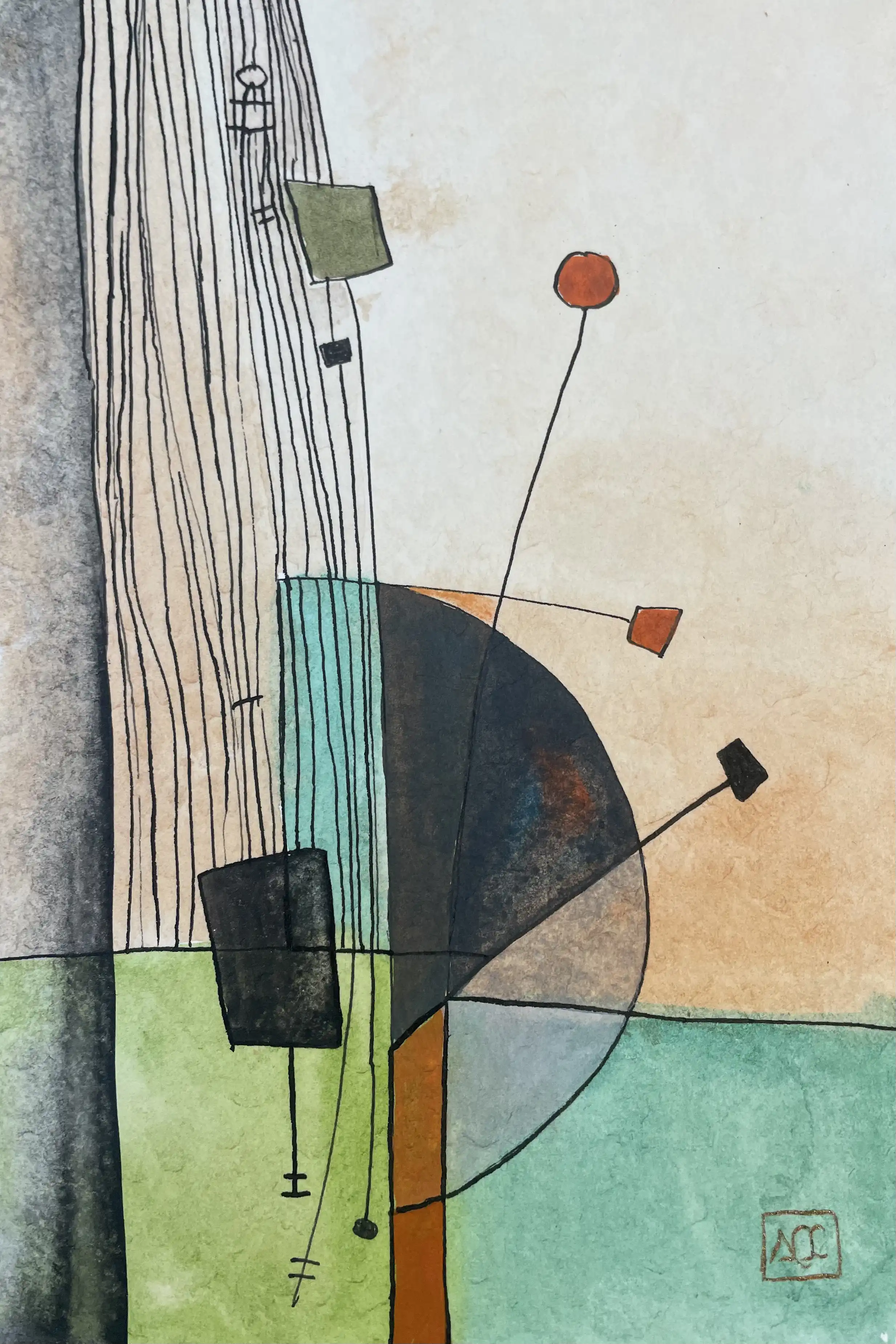
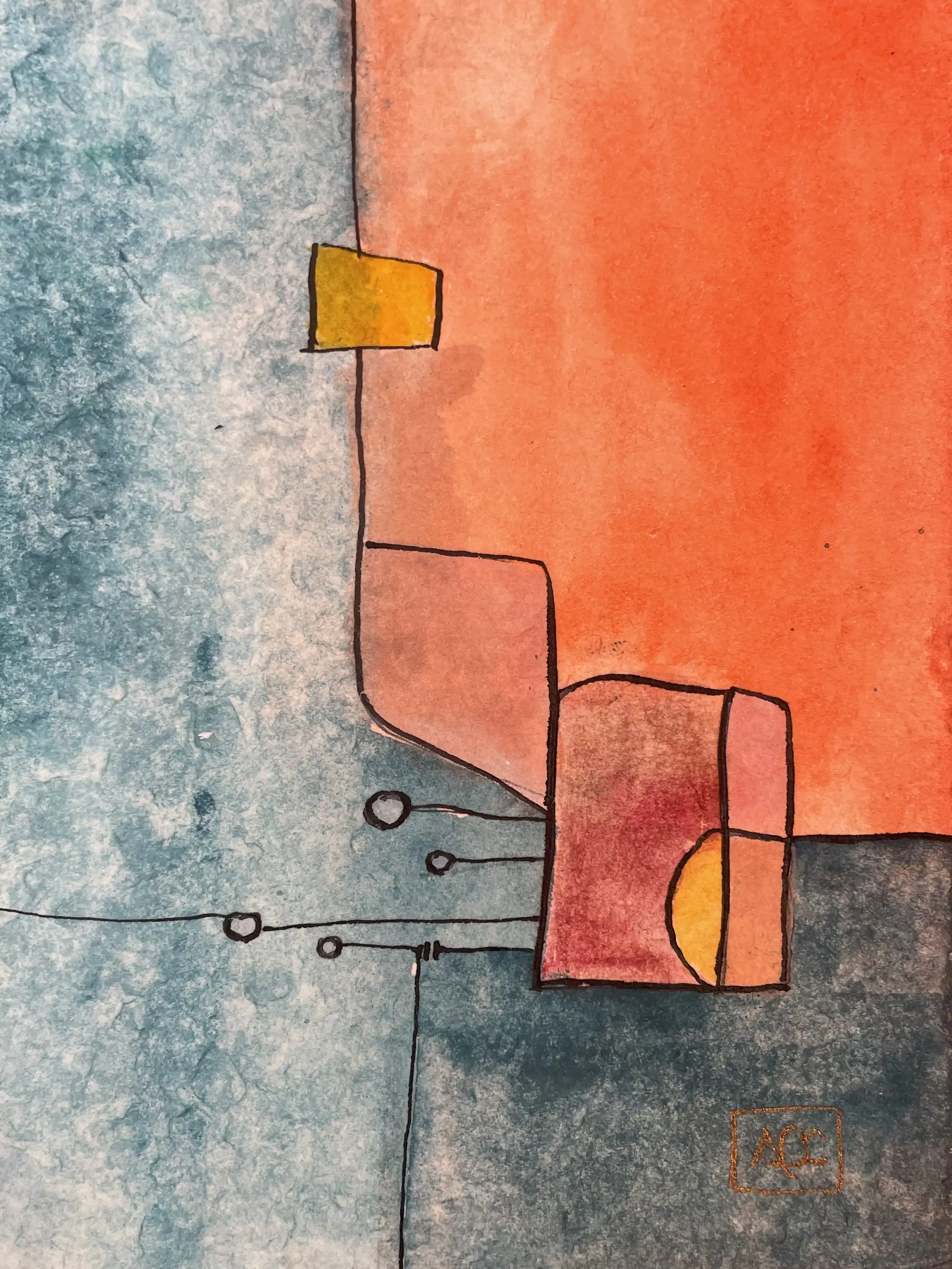
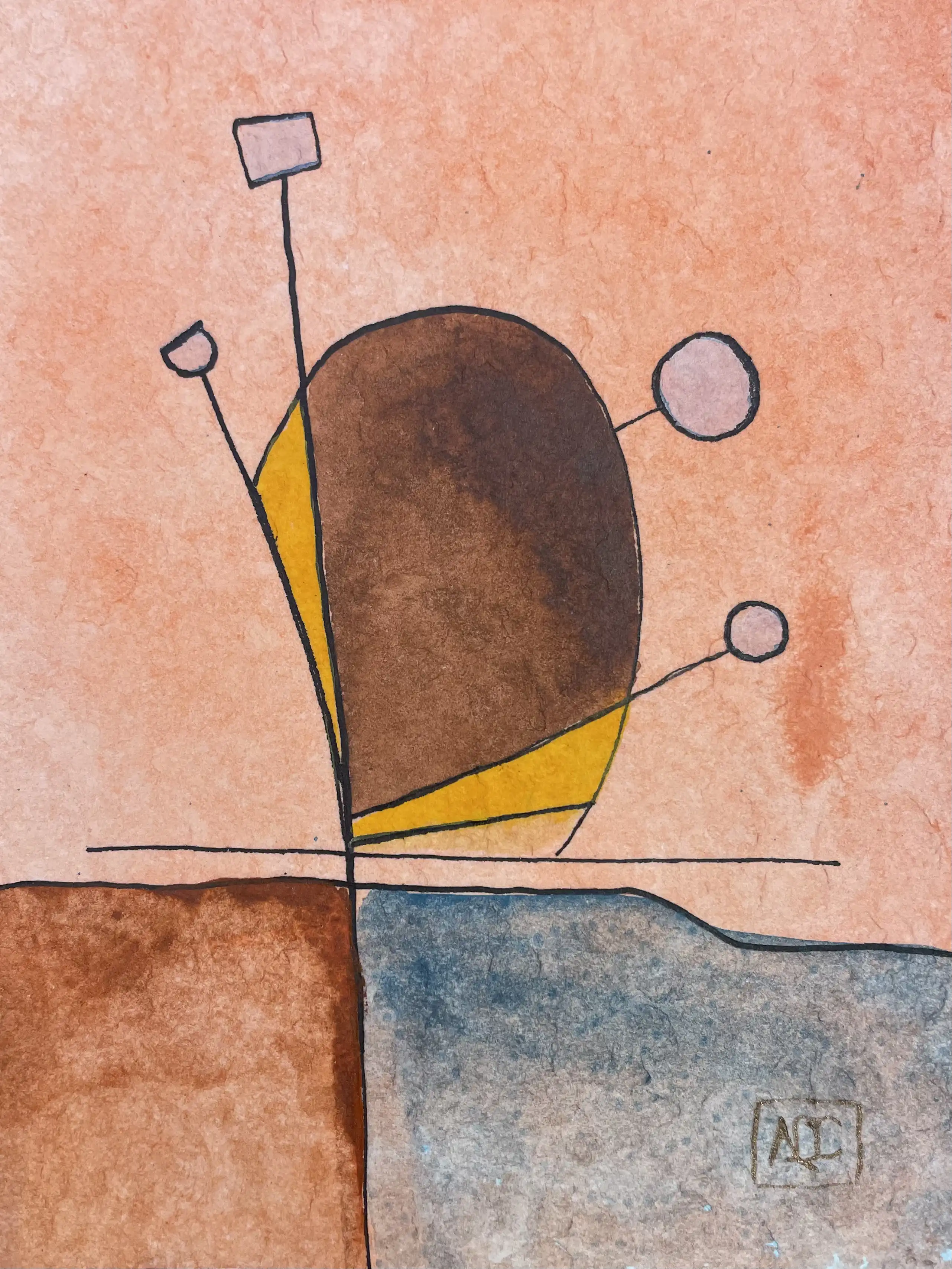
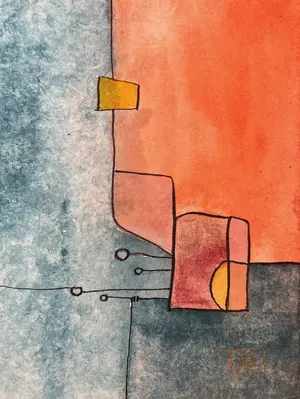
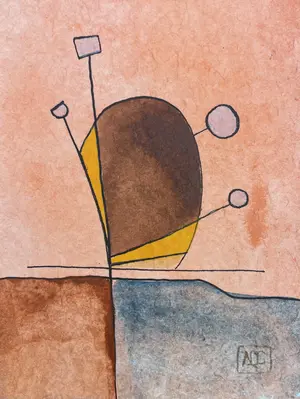
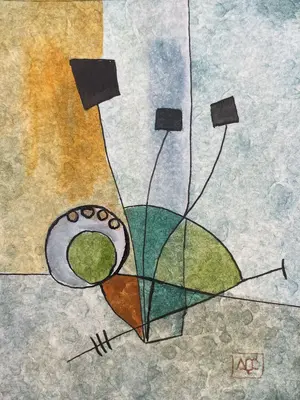
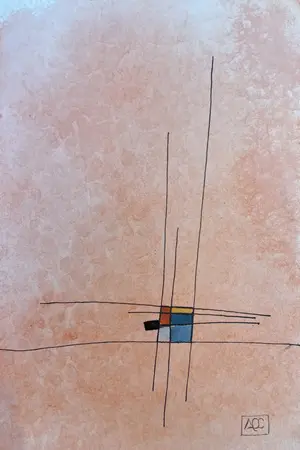
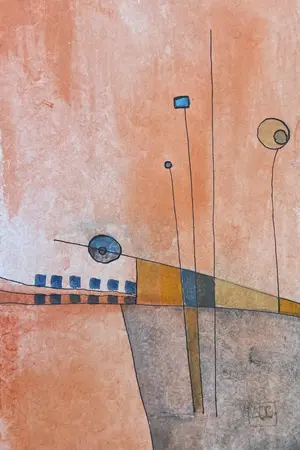
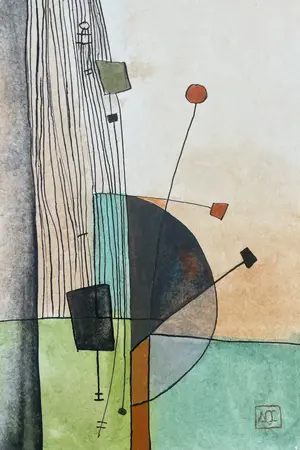
Augmented Chords is a series of 6 paintings by Arnaud Quercy, created in 2024 in watercolor on paper. Formats range from 12×16 cm to 16×24 cm. All 6 works in this series are held in private collections (Paris, France, Germany, Milan, Italy, USA). Works presented at: Rencontres au Marché de la Création, Salon d'art contemporain – Metamorphose, Paris and Permanent Collection 2025 – Resonance in Form and 4 more.
The augmented triad divides the octave into three equal major thirds — a chord of perfect symmetry and permanent restlessness. Unlike the major or minor triad, it has no stable fifth, no gravitational center; every inversion sounds the same, every tone equidistant from its neighbors. It is the chord of the uncanny — Stravinsky builds whole passages of Petrushka on its slippery surface, Bartók threads it through the night-music of his quartets, and generations of film composers have reached for it when reality tilts sideways. In Western harmony, the augmented triad is not a destination but a threshold, a chord that exists to move somewhere else.
In harmonic-chromatic translation, the C augmented triad — C, E, G-sharp — produces three distinct color families: the red of C, the yellow of E, and the blue of G-sharp. Unlike the warm-only palette of C Major, the augmented chord spans the full color temperature: warm at the root, bright at the third, cool at the raised fifth. Register reshapes each hue dramatically. C below the third octave darkens toward black; E above the sixth octave bleaches to near-white; G-sharp in the low register deepens into blue-violet. Between these extremes, mid-range tones hold their saturated character — red, yellow, blue — the three primaries arrayed across the keyboard. Orange accents from non-chord tones (D, primarily) glow between the chord tones like embers throughout most of the series.
Arnaud Quercy explores this unstable harmony across six études, all painted in watercolor on paper during 2024 — a compact, concentrated body of work in two small formats. The études divide between two transpositions of the same symmetrical structure: four on C augmented and two on A-flat augmented, which shares all three pitch classes (A-flat, C, and E are enharmonically identical to the same augmented triad). Most are played Lent, at a quiet mp, legato — slow and meditative. Three are written in common time, three in waltz time. The note count ranges from four to eight, the contours favoring arches and descents. One étude alone breaks the prevailing stillness: the final work, marked Animé, the only fast tempo in the collection. A single green accent at G-flat — cool where every other non-chord tone has been warm orange — closes the series with a color no other étude contains.
Three works define the poles of the collection. The opening étude spans nearly the full keyboard — eight notes from C2 to E7, the widest range in the series — drawing the augmented triad as a slow arch through five octaves, what Quercy describes as "a breath held and released." At the opposite extreme, Variation 3 distills the chord to four notes and a piano dynamic, the sparsest and quietest study in the group: root and third only, the raised fifth entirely absent, the canvas "almost empty — a dark anchor, a yellow center, a warm peak, and silence around them." Between these poles, Variation 2 offers the series' deepest descent — a waltz sinking from E6 to C1, the lowest bass note in the augmented collection, the phrase moving from pale light into a darkness so deep the color becomes black.
On the canvas, the augmented palette reads unlike any other chord in the Harmonic Crossing practice. Where major triads run warm and minor triads run cool, the augmented chord holds both temperatures simultaneously — red and yellow anchoring the warm end, blue and blue-violet cooling the raised fifth. The visual effect is a tension that never resolves: the eye moves between warm and cool poles without settling. Dark bass notes pull the reds and blues toward black at the bottom of each painting; high treble notes dissolve them toward silver and white at the top. The orange accents — present in five of the six works — provide the only median warmth, glowing between the primary colors like intervals of passage. The sixth étude replaces orange with green, a final cool gesture that shifts the entire temperature of the closing work.
Six études may be the smallest series in this collection, but the augmented triad does not need repetition to reveal its character — it needs only a few careful rotations to show that its symmetry is both its beauty and its unease. The same three equidistant tones, heard from C and from A-flat, in arches and descents, in common time and waltz time, slow and once fast, yield a body of work where no single painting settles and none needs to. The entire series has found its way into private collections from Paris to Milan to the United States — the restless chord, it seems, travelling as readily as it resolves.
Arnaud Quercy is a Parisian artist working across painting, music, and sculpture. His practice is grounded in Ideamorphism — the principle that a work of art does not carry meaning, but triggers it. Each piece is engineered to diffract differently through each person who encounters it.
He creates and exhibits at Art Quam Anima, his gallery-atelier at 28 rue du Dragon, Saint-Germain-des-Prés, Paris.
Works — Augmented Chords
Related hubs
- Collection: Harmonic Crossing
Exhibitions 7
- Rencontres au Marché de la Création (2024-04-23 → 2024-12-31, Marché de la Création – Paris Montparnasse, Paris)
- Salon d'art contemporain – Metamorphose, Paris (2024-12-26 → 2025-01-05, Halle des Blancs Manteaux, Paris)
- Permanent Collection 2025 – Resonance in Form (2025-01-01 → 2025-12-31, arnaudquercy.art, Paris)
- Paris Studio Visit (2025-02-18 → 2025-02-18, Artist's Studio, Paris)
- Marché d'Art Contemporain – Seine Port (2025-05-17 → 2025-05-17, MAC Seine-Port, Seine-Port)
- Nuit des Artistes, St Germain-en-Laye, France (2025-05-24 → 2025-05-24, La Nuit des Artistes, Saint-Germain-en-Laye)
- Marché de l'Art de Saint-Germain-en-Laye, 17ème édition – France (2025-06-14 → 2025-06-14, Marché de l'Art, Saint-Germain-en-Laye)