G Major series — 13 Paintings by Arnaud Quercy
ART-SER0015
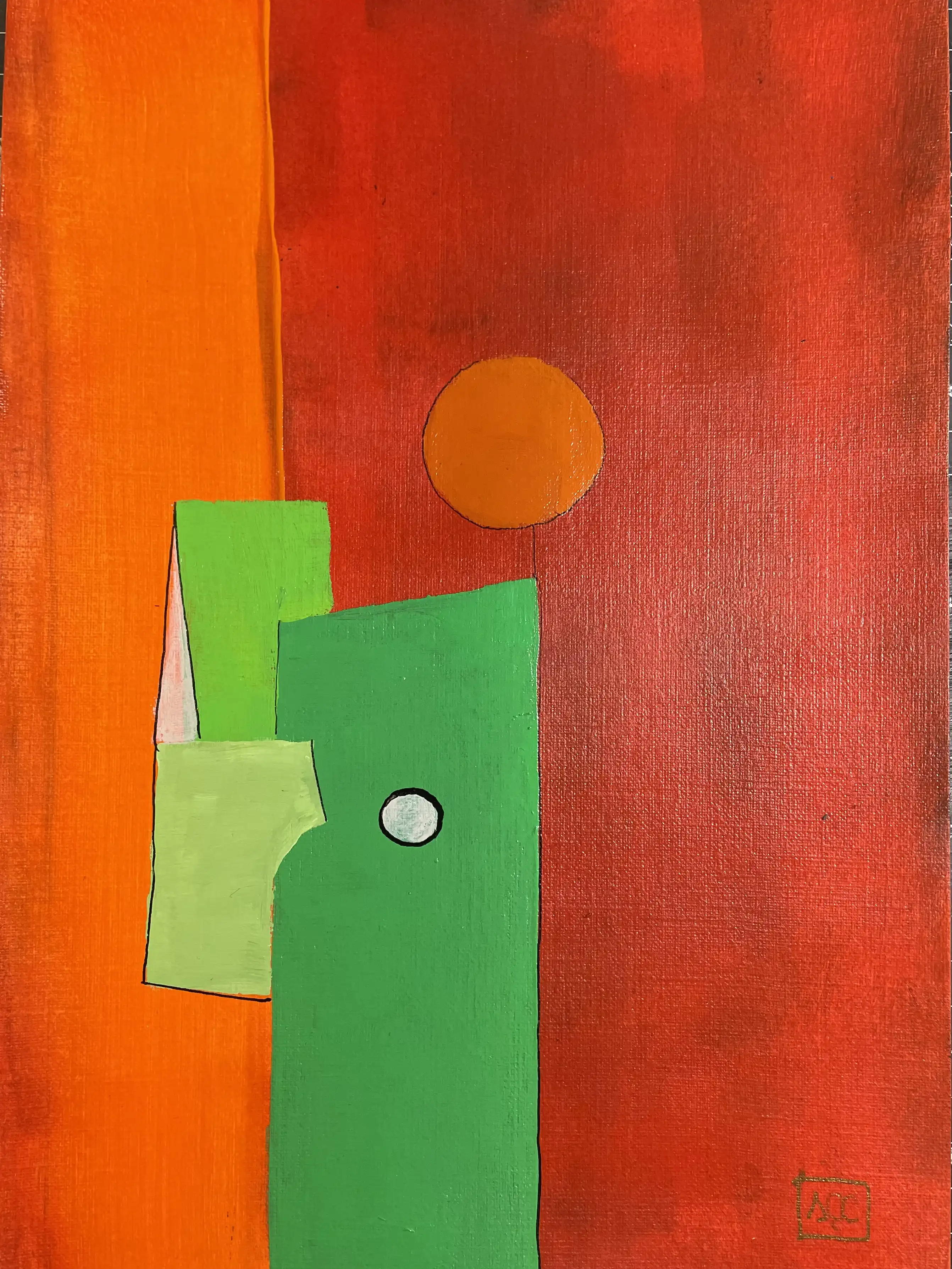
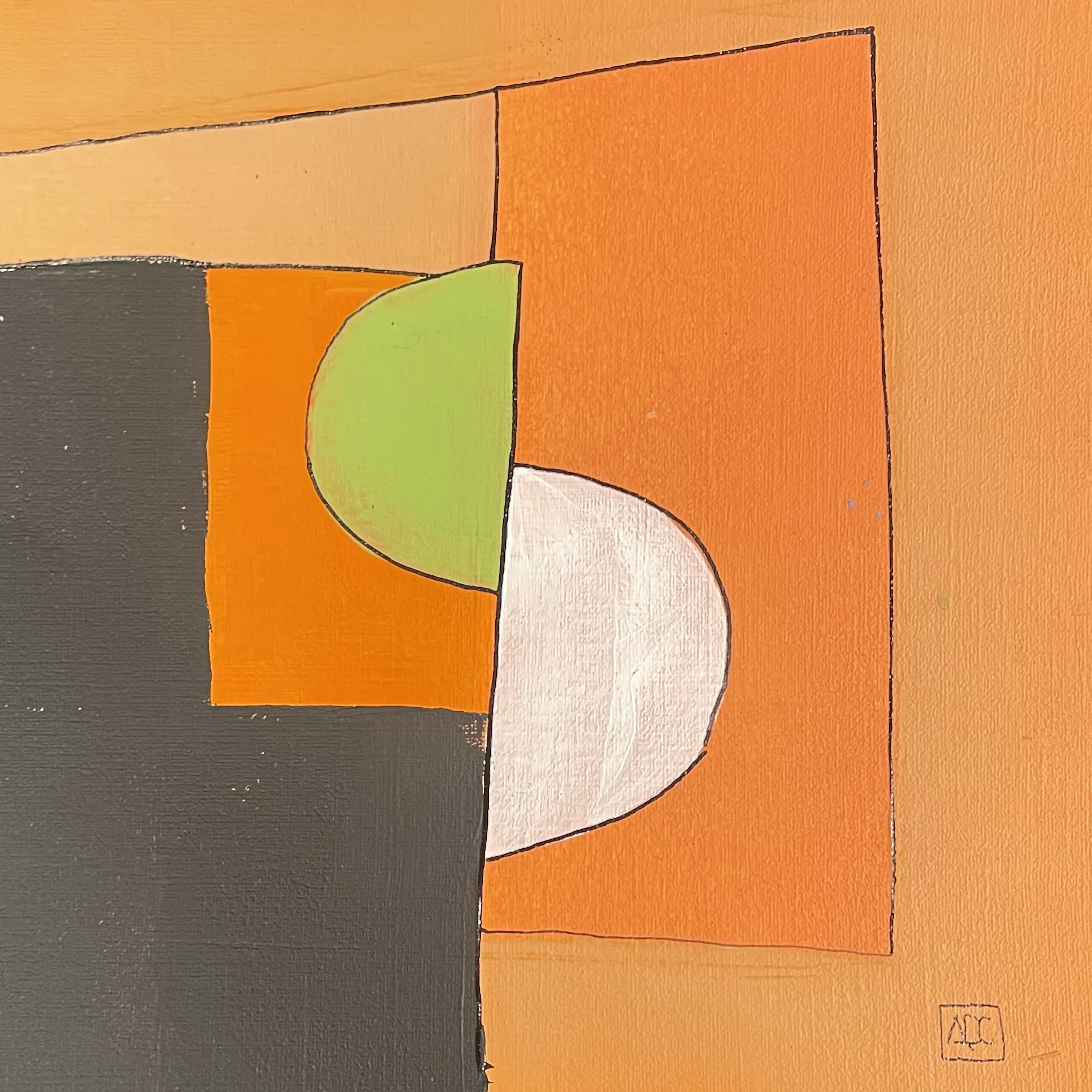
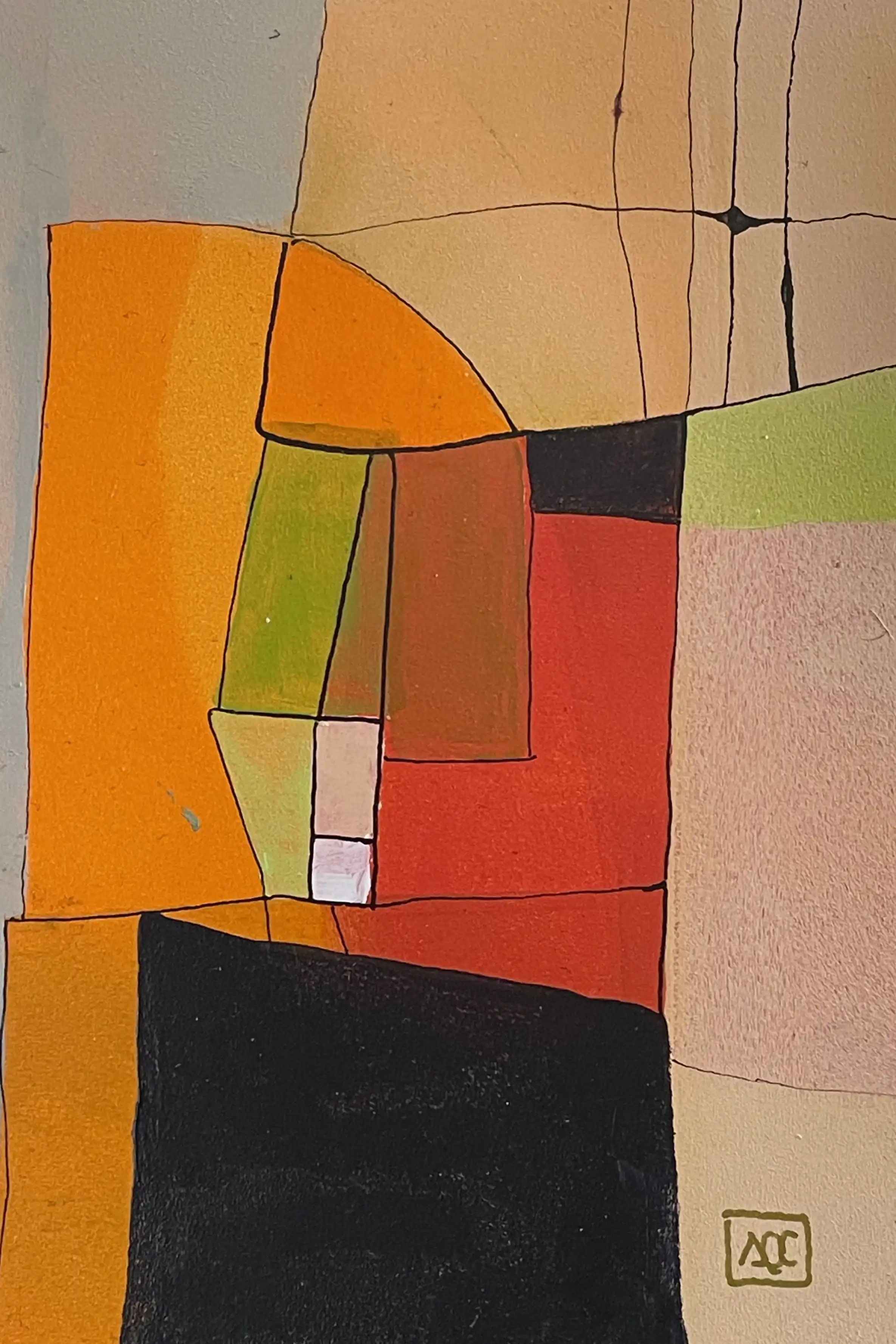
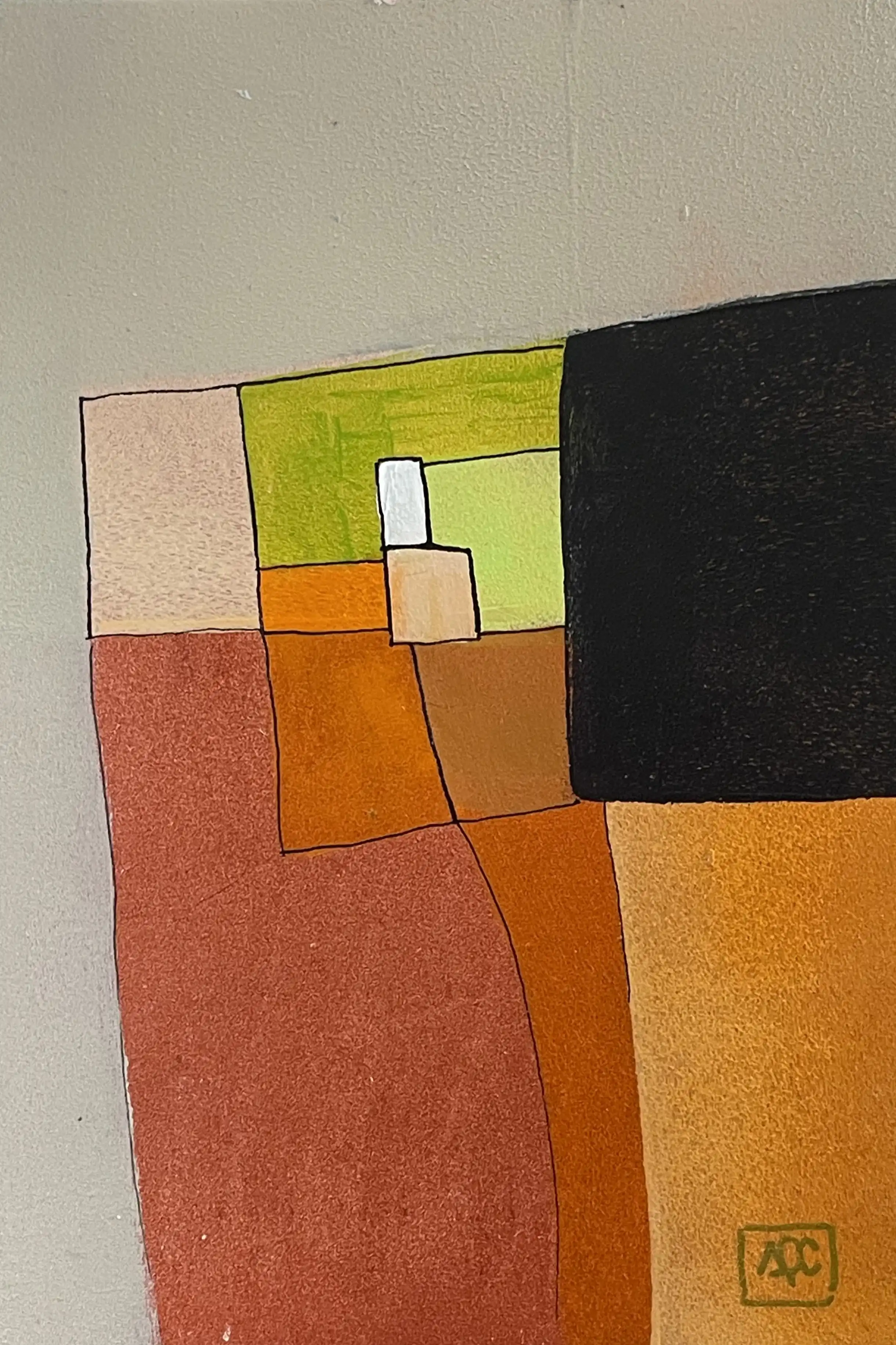
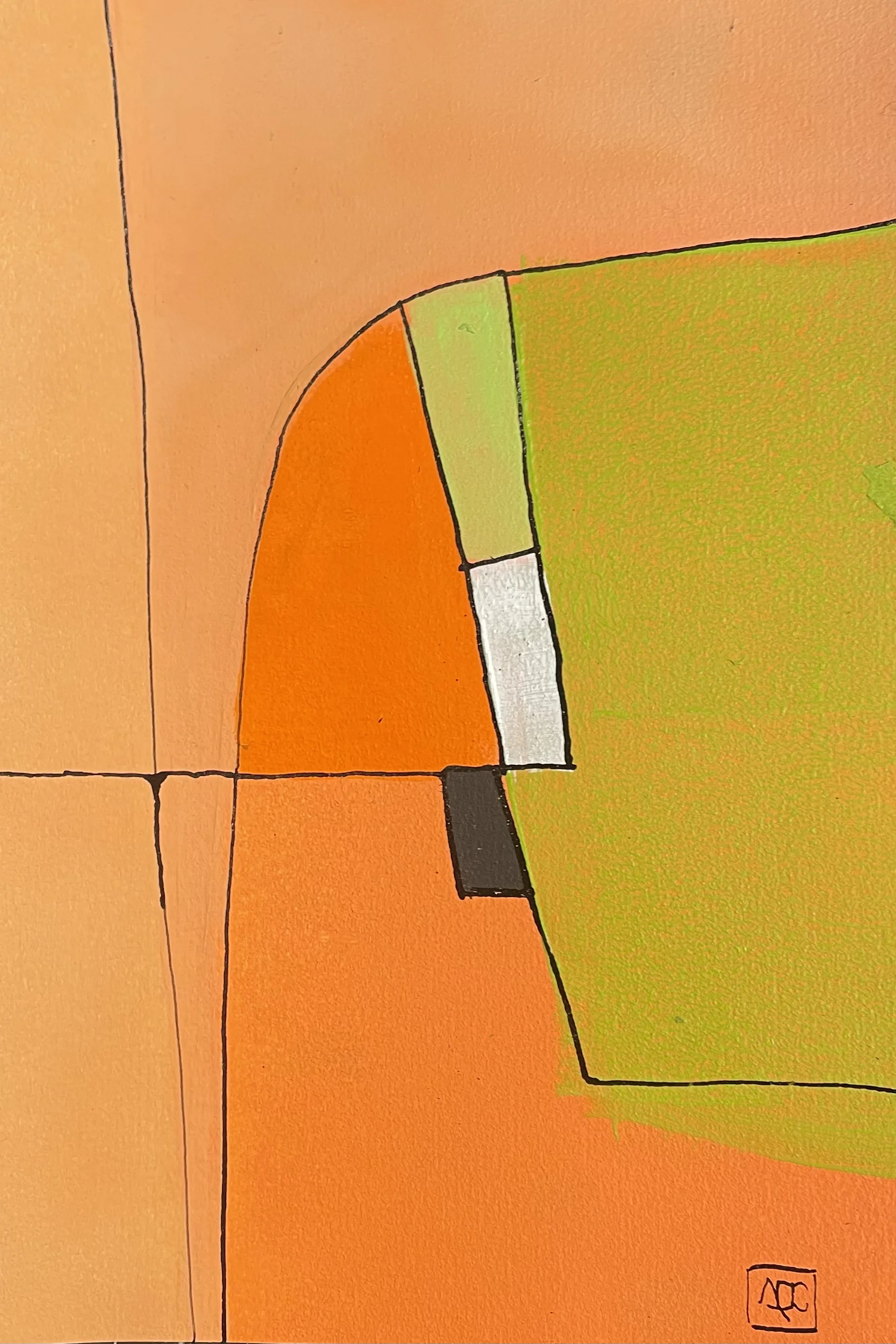
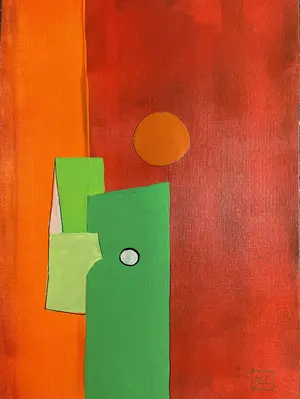
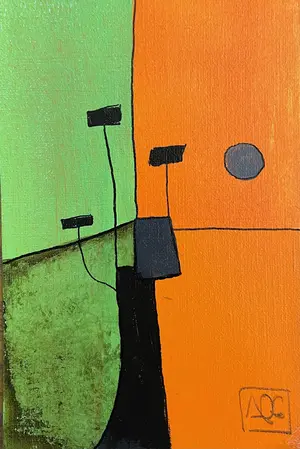
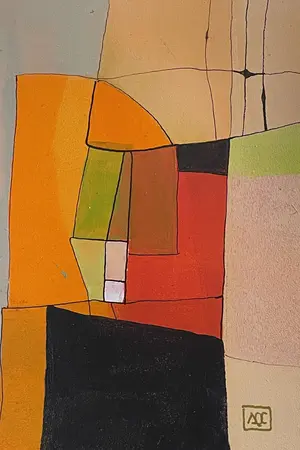
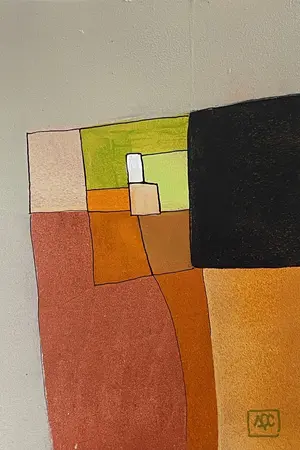
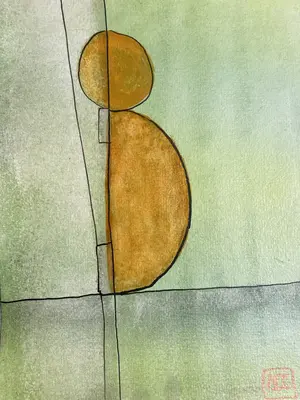
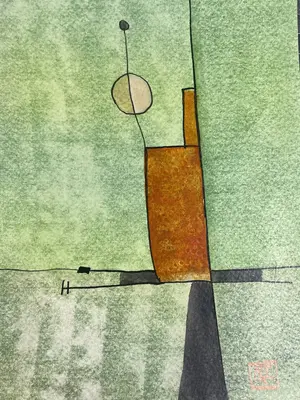
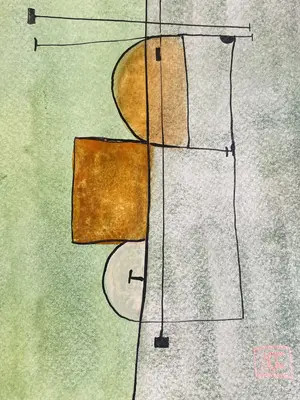
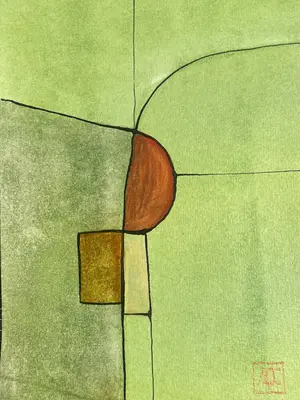
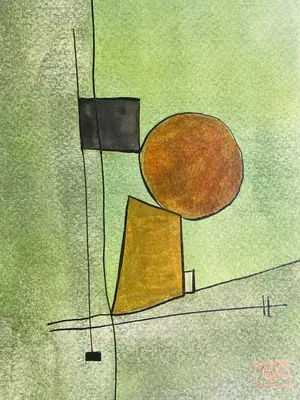
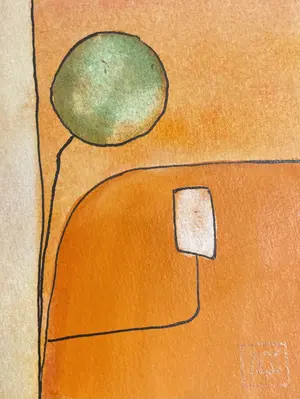
G Major is a series of 13 paintings by Arnaud Quercy, created between 2024 and 2025 in acrylic on paper, acrylic on wood panel and watercolor on paper. Formats range from 10×15 cm to 21×30 cm. 11 works are held in private collections (Paris, France, Greece, San-Francisco, USA, Brussels, Belgium, Russia, Santa Monica, USA, Italy, New York, USA). 1 remains available for acquisition at Art Quam Anima, 28 rue du Dragon, Paris. Works presented at: Rencontres au Marché de la Création, Salon d'art contemporain – Metamorphose, Paris and Permanent Collection 2025 – Resonance in Form and 7 more.
G Major carries one sharp and a particular brightness — the key of Bach’s third Brandenburg Concerto, of Schubert’s violin sonatinas, of the open strings that give string instruments their natural resonance. It is a key associated with the outdoors, with clarity, with a forward-moving energy that sits comfortably in the hand. Miles Davis chose it for "Freddie Freeloader," the plainspoken blues that opens Kind of Blue with a straightforward warmth. G Major hides nothing. It arrives direct.
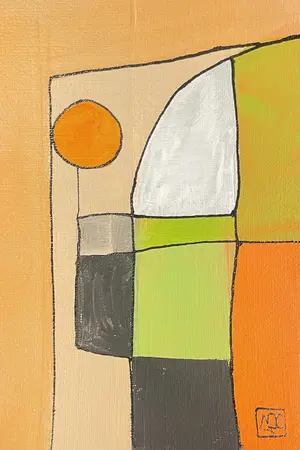
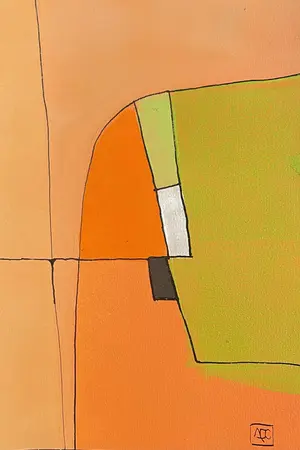
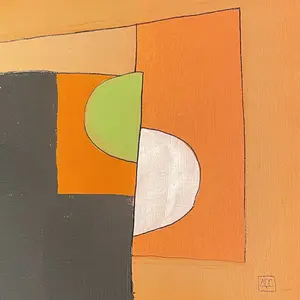
In harmonic-chromatic translation, the triad maps onto three closely related warm tones: the red-orange of G, the orange of D, and the yellow-green of B. No cool intrusion, no ambiguity — the three colors are adjacent on the wheel, almost a single flame seen at different temperatures. Register inflects everything: G below the second octave darkens toward near-black; B at the seventh octave bleaches to silver-white. In the middle range, where most of this series lives, the palette stays warm and saturated — red-orange at the root, orange through the fifth, a clean yellow-green brightness at the third. The fifth, D, is the warmest intermediary, the orange that mediates between root and third without pulling the eye either toward darkness or light.
Arnaud Quercy explores this amber palette across thirteen études painted between 2024 and 2025 in acrylic and watercolor, on paper and wood panel. Formats range from small intimate studies at 10×15 cm to a closing 21×21 cm square. The series has a clear dramatic arc: it opens with two unhurried descending waltzes at Lent, then pivots through a group of bell arches before breaking into a cluster of animated ascending études at 88 beats per minute — Animé, forward-moving, highlights dominant. The series closes as quietly as it opened, with slow bell arches returning in the final variations. Within this arc, meter shifts between triple time (the waltz) and quadruple, and dynamics stay restrained throughout: p or mp, never forte. Note counts run from three to seven. The sparsest études are also the most structurally surprising.
Three works mark the series’ range. Variation 8 (AQC0841) is among the most unusual in the collection: five notes comprising G2 and then four consecutive ascents through B — B4, B5, B6, B7 — the third of the chord repeated in successive octaves until it dissolves into near-white at the extreme. As the artist writes, this is "the journey of a single pitch-class — B — as it transforms through register from warm mid-range yellow-green to near-white at the top." The painting has almost no darkness; it is a study in how one color can travel through its own spectrum. Variation 9 (AQC0865), by contrast, is the series’ lone intrusion of another mode: three notes, one octave wide, explicitly G minor — D4, Bb4, D5. The violet of Bb appears between two orange D’s, a brief, whispered departure from the series’ prevailing warmth that sold to a collector in West Hollywood. At the other structural extreme, Variation 6 (AQC0839) leaps five octaves of silence — two dark G’s in the bass, nothing, then two pale B’s at the top — the waltz ascending without a middle register to bridge the gap.
On the canvas, G Major reads as a key in motion. The opening descending études anchor darkness in the bass, the red-orange of G at the bottom, yellow-green brightness arriving and departing at the top. The animated middle section of the series turns the palette upside down: highlights flood the upper registers, shadow nearly disappears, and the warm yellow-green of B dominates painting after painting. The closing bells find equilibrium — dark root in the bass, orange warmth in the middle, silver at the apex. Across the full series, orange is the reliable center of gravity: D at the fifth appears more consistently than either root or third, the midrange tone that holds the chord’s warmth together. The visual rhythm is one of rising and returning, the same three warm colors rebalanced thirteen times.
G Major is the key where warmth becomes almost monochrome — three neighbors so close on the color wheel that the challenge is not contrast but differentiation. What Quercy discovers across these thirteen études is how much variation lives inside what appears to be a single temperature. Register, contour, note count, and the momentary intrusion of the minor third in Variation 9 all shift what is, at root, a flame-colored palette toward subtlety. Several of these works now live in collections from Paris to Italy to the United States — the open, forward-moving key finding its way into varied hands, each canvas a different angle on the same amber light.
Arnaud Quercy is a Parisian artist working across painting, music, and sculpture. His practice is grounded in Ideamorphism — the principle that a work of art does not carry meaning, but triggers it. Each piece is engineered to diffract differently through each person who encounters it.
He creates and exhibits at Art Quam Anima, his gallery-atelier at 28 rue du Dragon, Saint-Germain-des-Prés, Paris.
Works — G Major
Related hubs
- Collection: Harmonic Crossing
Exhibitions 10
- Permanent Collection 2025 – Resonance in Form (2025-01-01 → 2025-12-31, arnaudquercy.art, Paris)
- Paris Studio Visit (2025-02-18 → 2025-02-18, Artist's Studio, Paris)
- Marché d'Art Contemporain – Seine Port (2025-05-17 → 2025-05-17, MAC Seine-Port, Seine-Port)
- Nuit des Artistes, St Germain-en-Laye, France (2025-05-24 → 2025-05-24, La Nuit des Artistes, Saint-Germain-en-Laye)
- Marché de l'Art de Saint-Germain-en-Laye, 17ème édition – France (2025-06-14 → 2025-06-14, Marché de l'Art, Saint-Germain-en-Laye)
- Salon d'art contemporain – Metamorphose 2025–2026, Paris (2025-12-26 → 2026-01-04, Halle des Blancs Manteaux, Paris)
- Art Quam Anima – Pre-opening (2026-01-31 → 2026-02-28, Art Quam Anima, Paris)
- Through the Aperture — Research on Harmony (2026-03-09 → 2026-04-30, Art Quam Anima, Paris)
- Rencontres au Marché de la Création (2024-04-23 → 2024-12-31, Marché de la Création – Paris Montparnasse, Paris)
- Salon d'art contemporain – Metamorphose, Paris (2024-12-26 → 2025-01-05, Halle des Blancs Manteaux, Paris)
Other series in this collection 35
Documented at 1
Catalogue raisonné entries 13
- G Major - Research on Harmony
- G Major - Research on Harmony - Variation 1
- G Major - Research on Harmony - Variation 2
- G Major - Research on Harmony - Variation 3
- G Major - Research on Harmony - Variation 4
- G Major - Research on Harmony - Variation 5
- G Major - Research on Harmony - Variation 6
- G Major - Research on Harmony - Variation 7
- G Major - Research on Harmony - Variation 8
- G Major - Research on Harmony - Variation 9
- G Major - Research on Harmony - Variations 10
- G Major - Research on Harmony - Variations 11
- G Major - Research on Harmony - Variations 12