G minor 7 series — 2 Paintings by Arnaud Quercy
ART-SER0017
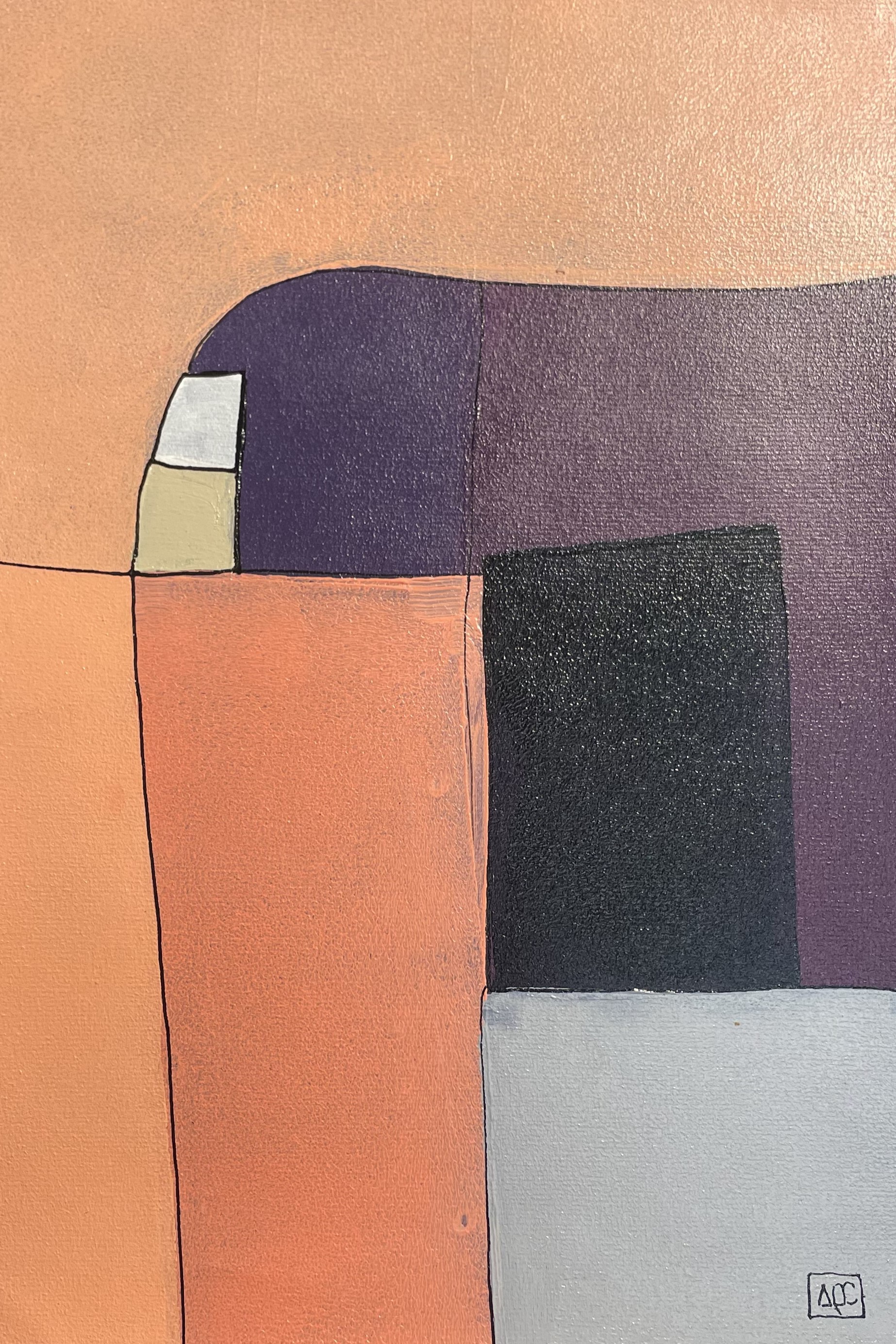
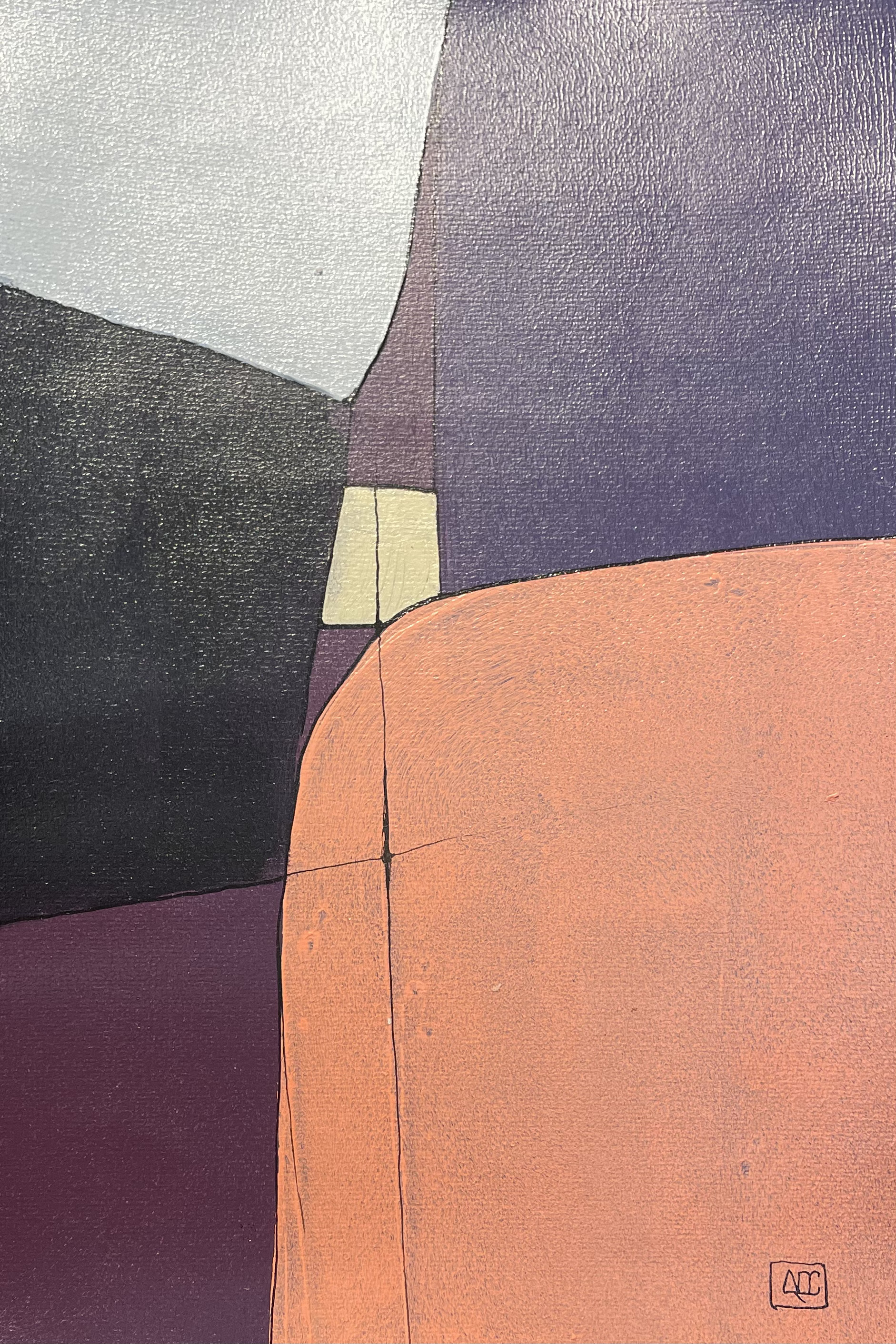
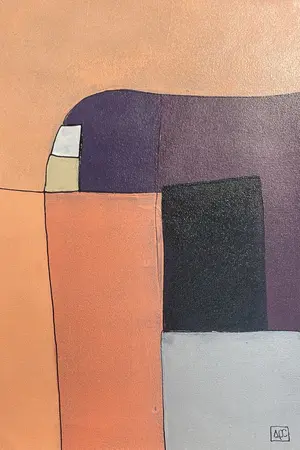
G minor 7 is a series of 2 paintings by Arnaud Quercy, created in 2026 in acrylic on paper. Format: 21×30 cm. All 2 works in this series are held in private collections (New-York, USA, London, United Kingdom). Works presented at: Through the Aperture — Research on Harmony.
G minor 7 is one of the most ubiquitous chords in the jazz tradition — the ii chord in F major, the opening sonority of Miles Davis’s "So What," a chord built for longing and forward motion. Its four tones stack in minor thirds and a perfect fifth: G, B-flat, D, F. In harmonic-chromatic translation, this is a chord of warm darkness threaded with cool: red-orange at the root, orange at the fifth, violet at the minor third, red-violet at the seventh. The minor seventh adds a fourth voice, and with it a gravitational pull — this harmony does not rest easily in itself.
The harmonic-chromatic palette spans from near-black in the deep bass to pale cream at the keyboard’s upper edge. G in the lowest register compresses toward black, its red-orange identity swallowed by the darkness of extreme low pitch. B-flat carries the chord’s most distinctive voice: violet in the middle register, cooling toward silver and near-white as it climbs into the sixth and seventh octaves. D holds the warmth — orange in the mid-range, the one fully saturated tone in the upper half of the canvas. F adds red-violet below, close to the minor third in register, the two cool-warm tones clustering in the lower-middle before the palette opens. The overall temperature is a warm-to-cool gradient: red-orange grounding the bass, violet and red-violet rising through the middle, orange floating above them, the minor third dissolving to light at the crest.
This series is the most concentrated in the Harmonic Crossing collection: two études only, painted in acrylic on paper at 21×30 cm, both created at the Rue du Dragon studio in Paris in March 2026. Both are played Lent, legato, in four — the same slow, meditative pulse, the same held breath. The contrast lies in density and dynamic. The opening étude is the fullest statement: nine notes, all four chord tones present, the arch spanning G1 to B-flat 7 across nearly seven octaves, played softly at mp. Variation 1 answers with subtraction: six notes, a louder mf, more space between each color on the canvas. The series does not expand outward — it contracts inward, from declaration to distillation.
The two études function as poles of a single argument. The opening work is the complete statement — nine notes from G1 to B-flat 7, all four chord tones present, the arch spanning the near-full keyboard. What the artist describes as "the full chord declared across seven octaves, every tone accounted for" establishes the harmonic field from which everything else proceeds. Variation 1 answers with economy: six notes, the root appearing only once, the fifth only once, while B-flat returns three times — at B-flat 3, B-flat 6, and B-flat 7 — the minor third claiming the phrase and carrying it upward into near-white silence. Louder by one dynamic step, sparser by three notes: more space, more presence.
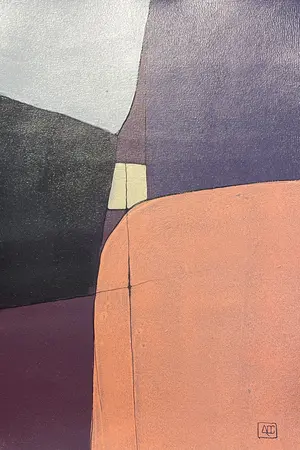
On the canvas, these two small paintings hold the full personality of the chord. The opening étude is dense and meditative: red-orange at the base, violet and red-violet gathering in the lower-middle, orange warming the mid-range, the palette dissolving to silver and cream at the top. Variation 1 opens that density into zones of color separated by silence — the wide gap between D5 and B-flat 6 visible as an empty field on the canvas, the orange of the fifth isolated at mid-height, the upper register given over entirely to the violet family fading toward white. The visual rhythm of the series is not repetition with variation but contrast: one canvas full, one canvas spare.
G minor 7 asks, in two paintings, what a four-note minor seventh chord becomes when spread across the full register of the piano and then deliberately thinned. The answer is not resolution — this chord, as Bill Evans understood, carries its own restlessness — but a kind of honest portraiture. Both études were created in the same week in Paris, one shown at the inaugural "Through the Aperture" exhibition at Art Quam Anima. The minor seventh never settles; it leans. These two works lean together, each illuminating the other.
Arnaud Quercy is a Parisian artist working across painting, music, and sculpture. His practice is grounded in Ideamorphism — the principle that a work of art does not carry meaning, but triggers it. Each piece is engineered to diffract differently through each person who encounters it.
He creates and exhibits at Art Quam Anima, his gallery-atelier at 28 rue du Dragon, Saint-Germain-des-Prés, Paris.
Works — G minor 7
Related hubs
- Collection: Harmonic Crossing
Exhibitions 1
- Through the Aperture — Research on Harmony (2026-03-09 → 2026-04-30, Art Quam Anima, Paris)