Power Chords series — 3 Paintings by Arnaud Quercy
ART-SER0050
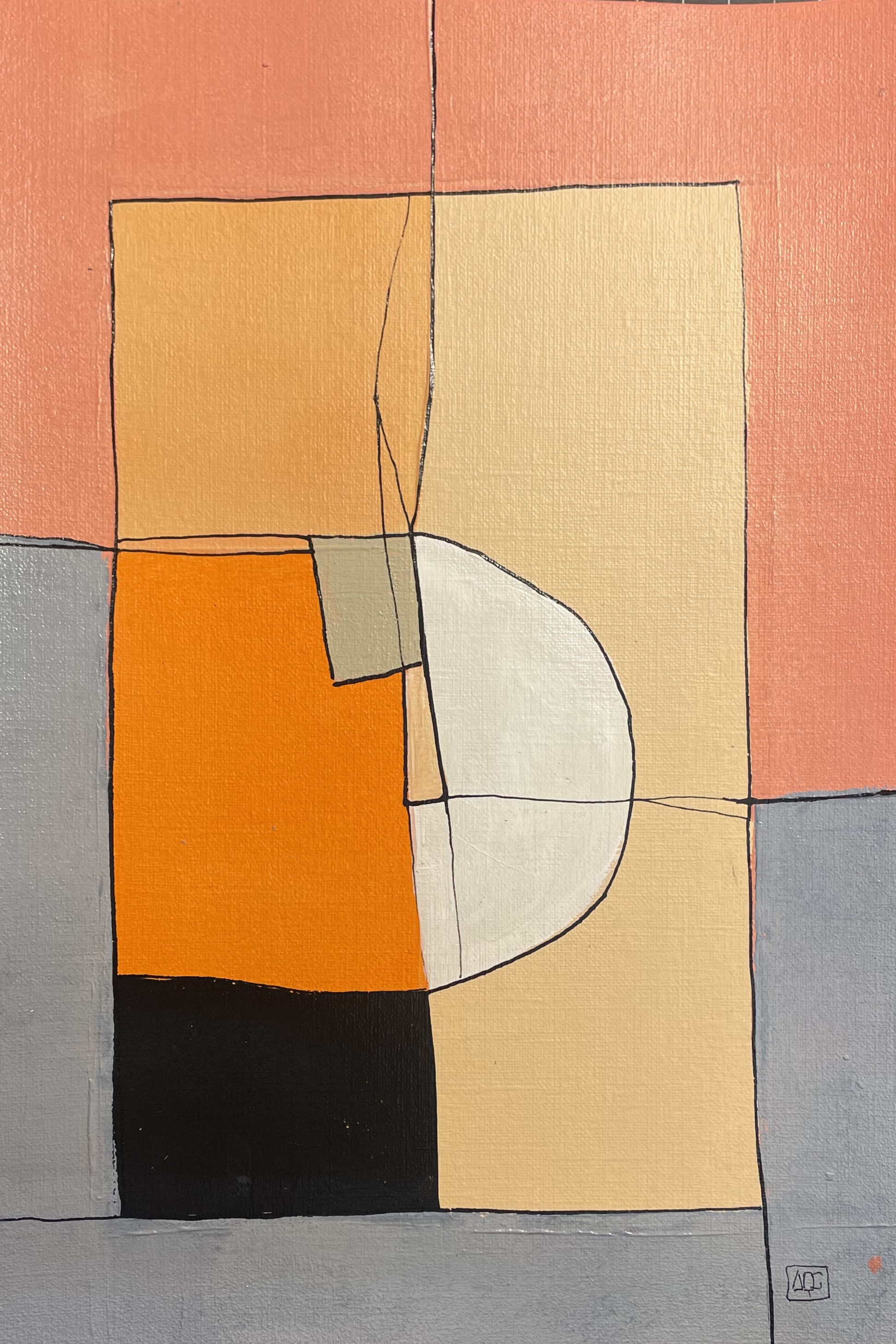
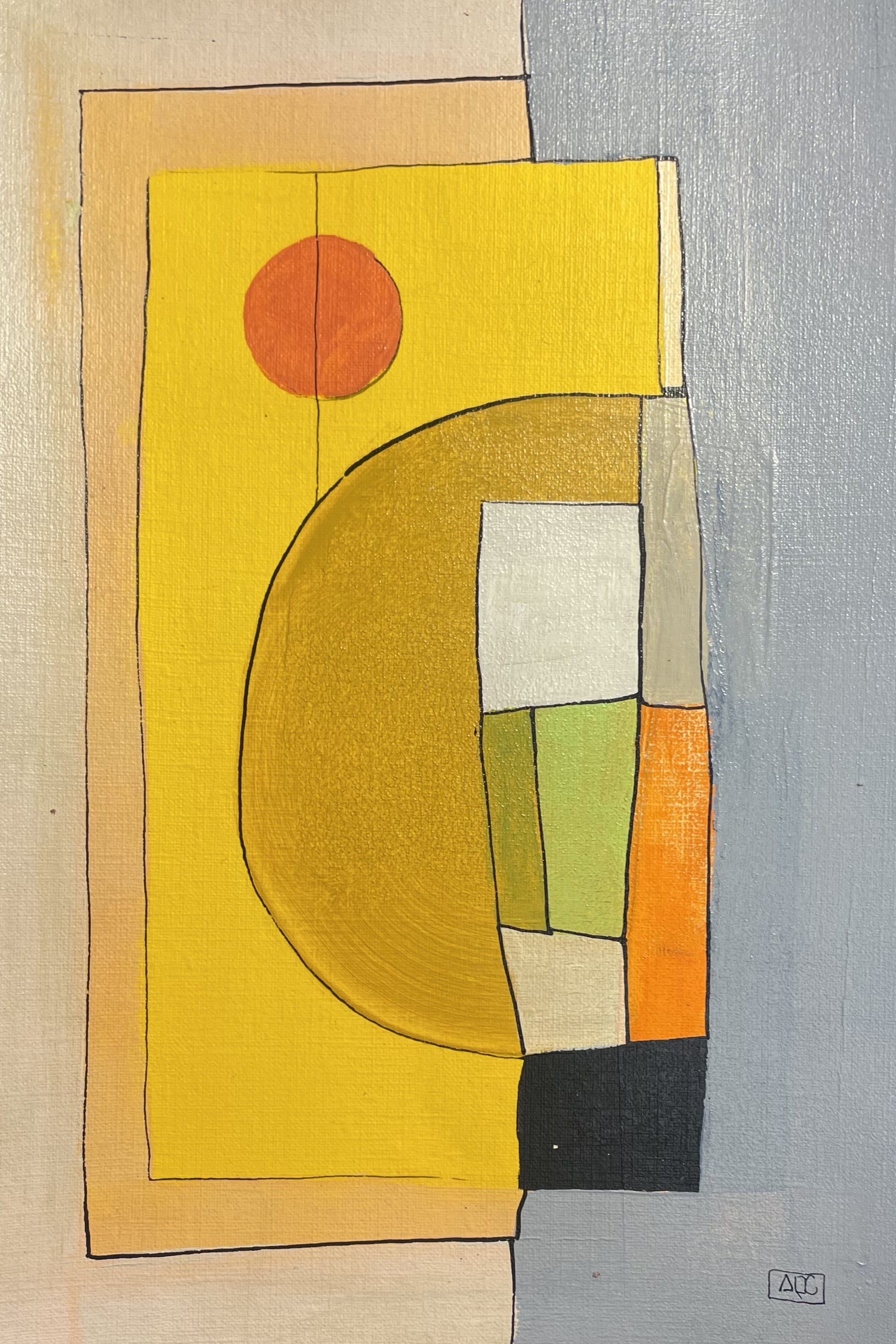
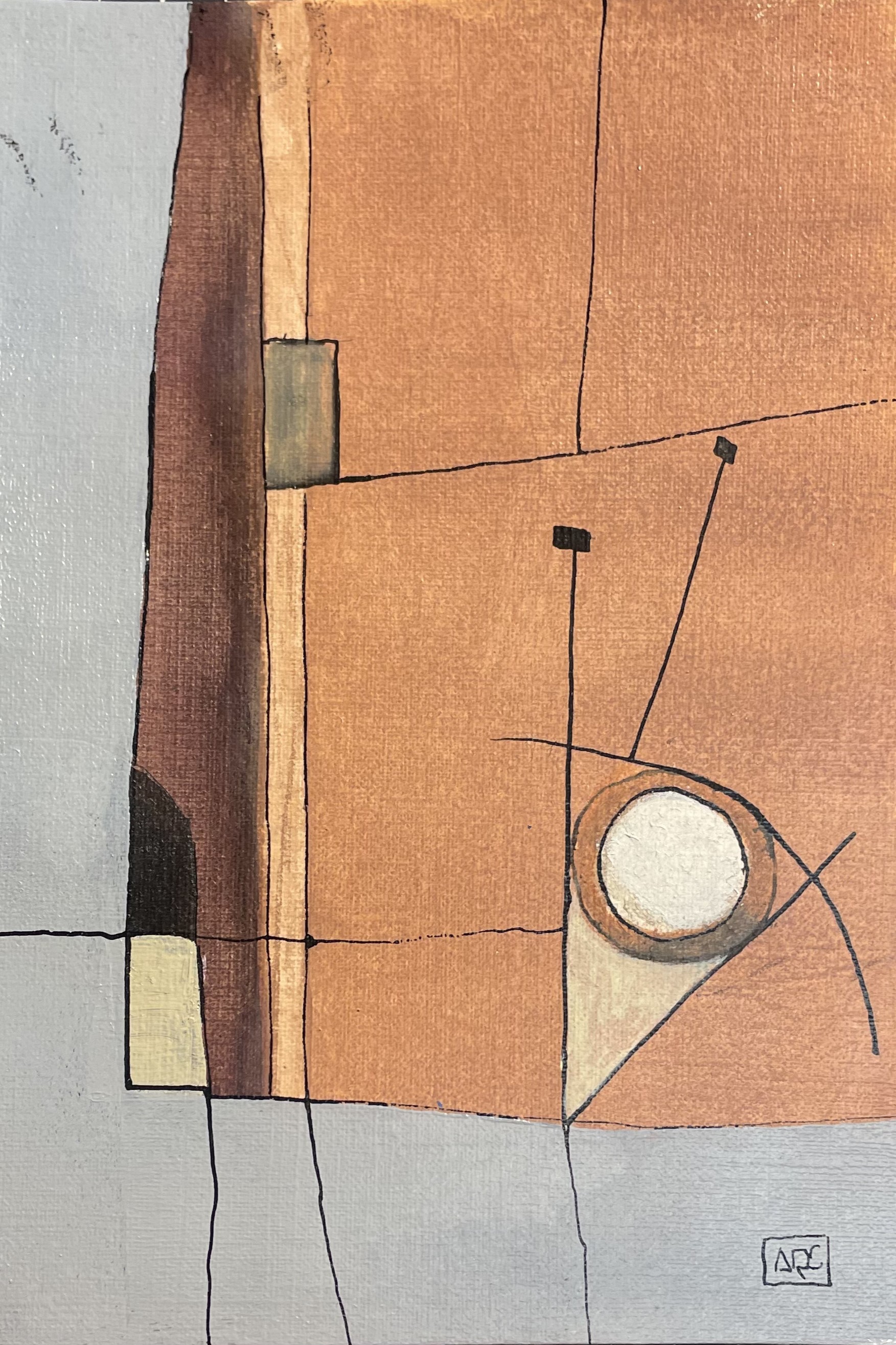
Power Chords is a series of 3 paintings by Arnaud Quercy, created in 2026 in acrylic on paper. Formats range from 15×21 cm to 21×30 cm. All 3 works in this series are held in private collections (Switzerland, New York, USA, New-Jersey, USA). Works presented at: Through the Aperture — Research on Harmony.
The power chord is the oldest interval in Western music and, in some ways, the most radical. Root and fifth only — no third, no defining quality of major or minor. The harmony that medieval organum built its parallel voices on, that Satie stripped his piano writing down to, that rock guitar has used for a century precisely because it refuses to resolve into sweetness or melancholy. The power chord is neither bright nor dark, neither hopeful nor resigned. It simply is — a perfect fifth, open, stable, and entirely without agenda.
In harmonic-chromatic translation, the power chord lives in a narrow but deep band of warm color. D’s root tones read as orange through near-black depending on register; the fifth A arrives as yellow-orange lightening toward sandy cream at the highest octaves. No cool color intrudes — there is no third to complicate the palette. The two pitches share a single warm family: amber in the bass, orange through the mid-register, pale gold at the heights. The interval’s openness translates directly: these are paintings without chromatic tension, without the contrasting color that a third would introduce. The temperature is even, the hue consistent, the warmth uninterrupted from darkness to light.
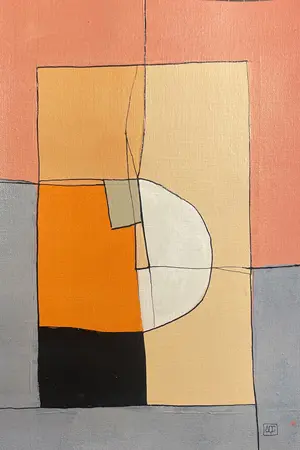
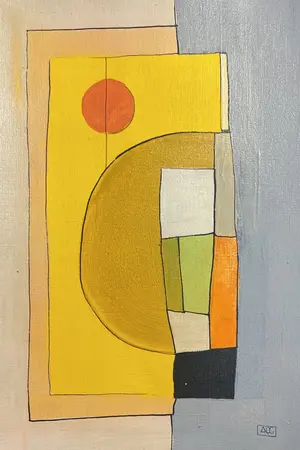
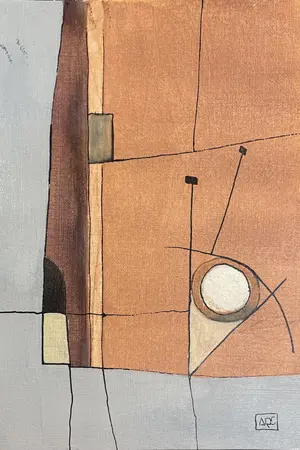
Arnaud Quercy explores the power chord across three études, all painted in 2026 in acrylic on paper. The formats are intimate — two at 21×30 cm, one at 15×21 cm — befitting a harmony that needs no grand gesture to make its point. All three are played Lent, at mp, legato, the pacing meditative and unhurried. The contours divide between arch and descent: the opening étude draws a full six-octave arch in four, the A power chord descends as a slow waltz in three, and the D variation descends methodically through a column of graduated register. Note counts range from five to six. This is the smallest series in the Harmonic Crossing collection — three études, each treating the same open interval from a different angle: as landscape, as light, as gradient.
Each of the three works offers a distinct perspective. The opening étude, D5 Power Chord — Research on Harmony (21×30 cm, acrylic on paper), is the defining statement: five notes spanning six octaves, the arch rising from D1 at the threshold of audibility to A6 before folding back. "The simplest harmony in the collection — two pitches, root and fifth, the interval that precedes all chords" — the étude establishes what this series is about. Its sold status, now in a Swiss collection, marks it as the flagship. The A5 Power Chord inverts the premise entirely: no bass anchor, the chord floating in the upper half of the keyboard, a waltz in three descending from silver through gold. It is the most luminous work in the series, the power chord without gravity. The D5 Variation 1 (15×21 cm) is the most methodical — four consecutive octaves of the root before the fifth enters, the descent rendering the chord as a column of the same color at six different depths, orange compressing steadily toward silence.
On the canvas, the power chord reads as a warm monochrome. There is no opposing color, no cool accent to create visual tension — only a single hue moving through its full range of register-driven value, from near-black in the deepest bass to pale cream at the treble’s edge. The warmth is even and unhurried, consistent across all three works. What varies between études is not color but register: where in the spectrum of light-to-dark the painting chooses to live, how much of that gradient it traverses, whether it anchors in the bass or floats free of it. The A5 étude is almost entirely bright, a rare painting in this collection that carries no darkness. The D5 opening étude balances the full range. The Variation holds mostly to earth tones.
The power chord series asks a question the other series in Harmonic Crossing cannot: what does harmony look like before it has chosen a quality? No major warmth, no minor shadow — only the open fifth, which carries neither promise nor regret. Quercy renders this neutrality as pure chromatic warmth, an interval that in medieval polyphony served as the stable consonance all other intervals resolved toward. Three études are enough. The power chord does not require elaboration — only patience, register, and the orange that runs through it from floor to ceiling.
Arnaud Quercy is a Parisian artist working across painting, music, and sculpture. His practice is grounded in Ideamorphism — the principle that a work of art does not carry meaning, but triggers it. Each piece is engineered to diffract differently through each person who encounters it.
He creates and exhibits at Art Quam Anima, his gallery-atelier at 28 rue du Dragon, Saint-Germain-des-Prés, Paris.
Works — Power Chords
Related hubs
- Collection: Harmonic Crossing
Exhibitions 1
- Through the Aperture — Research on Harmony (2026-03-09 → 2026-04-30, Art Quam Anima, Paris)