C# Major series — 4 Paintings by Arnaud Quercy
ART-SER0029
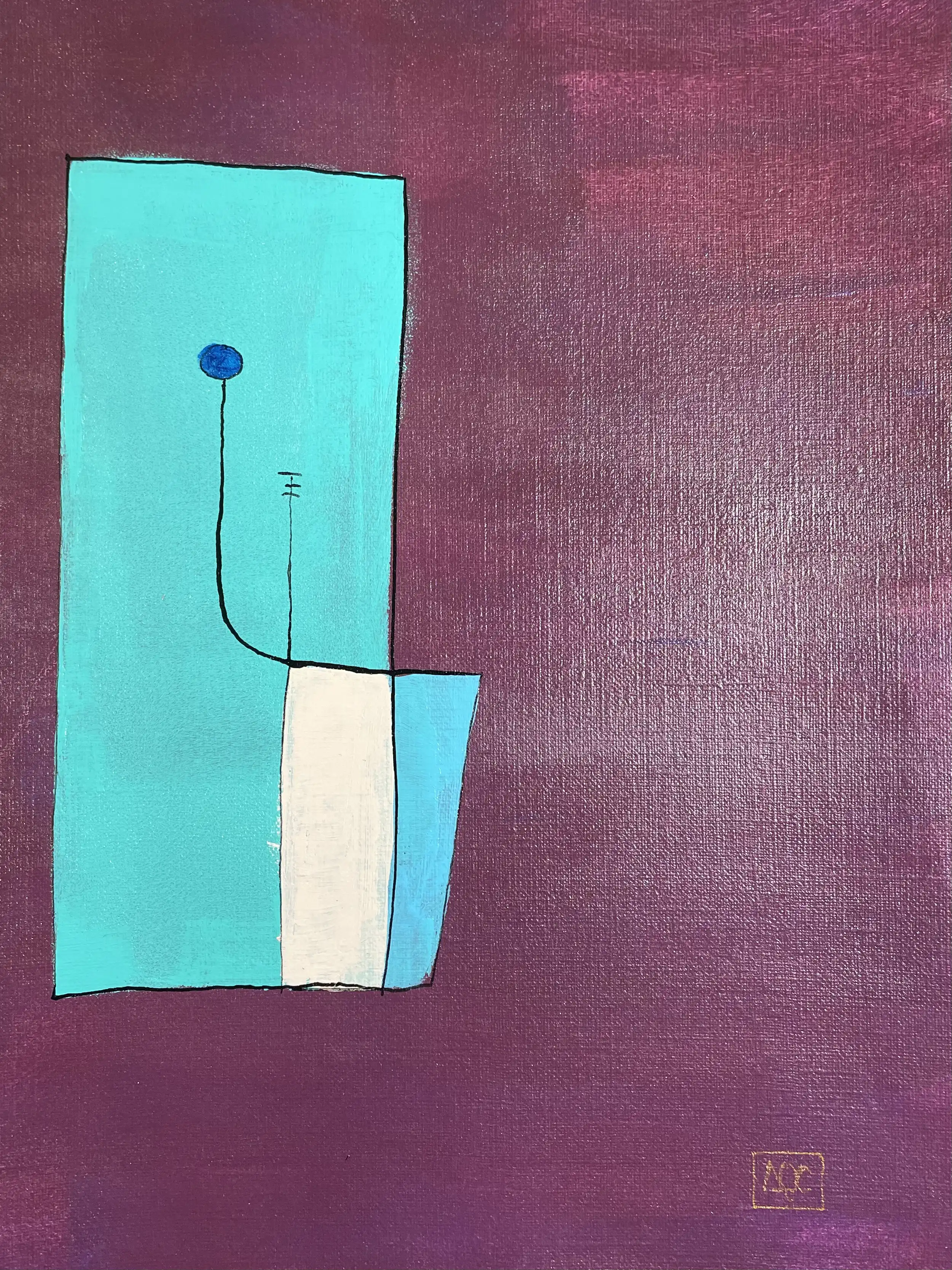
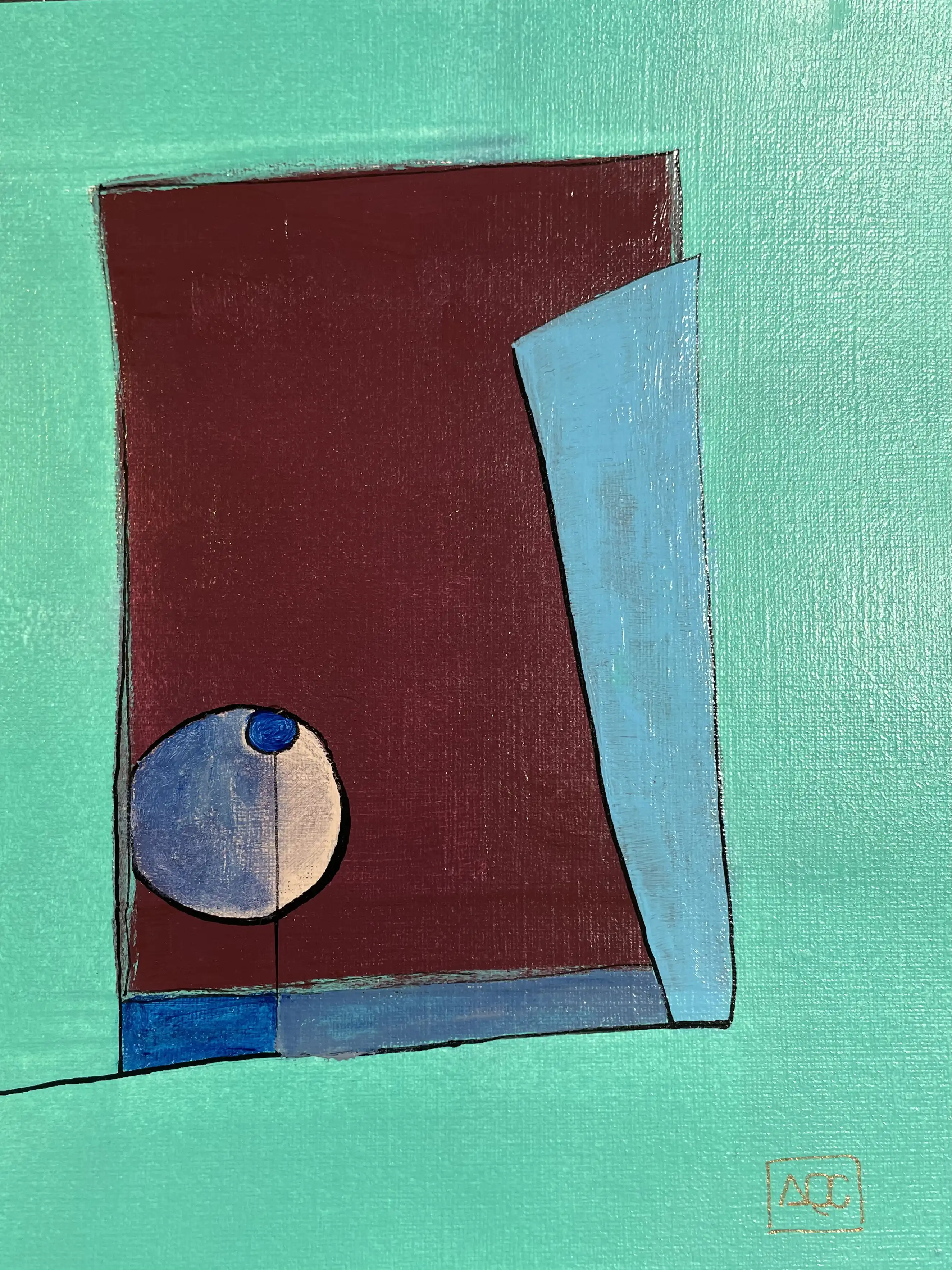
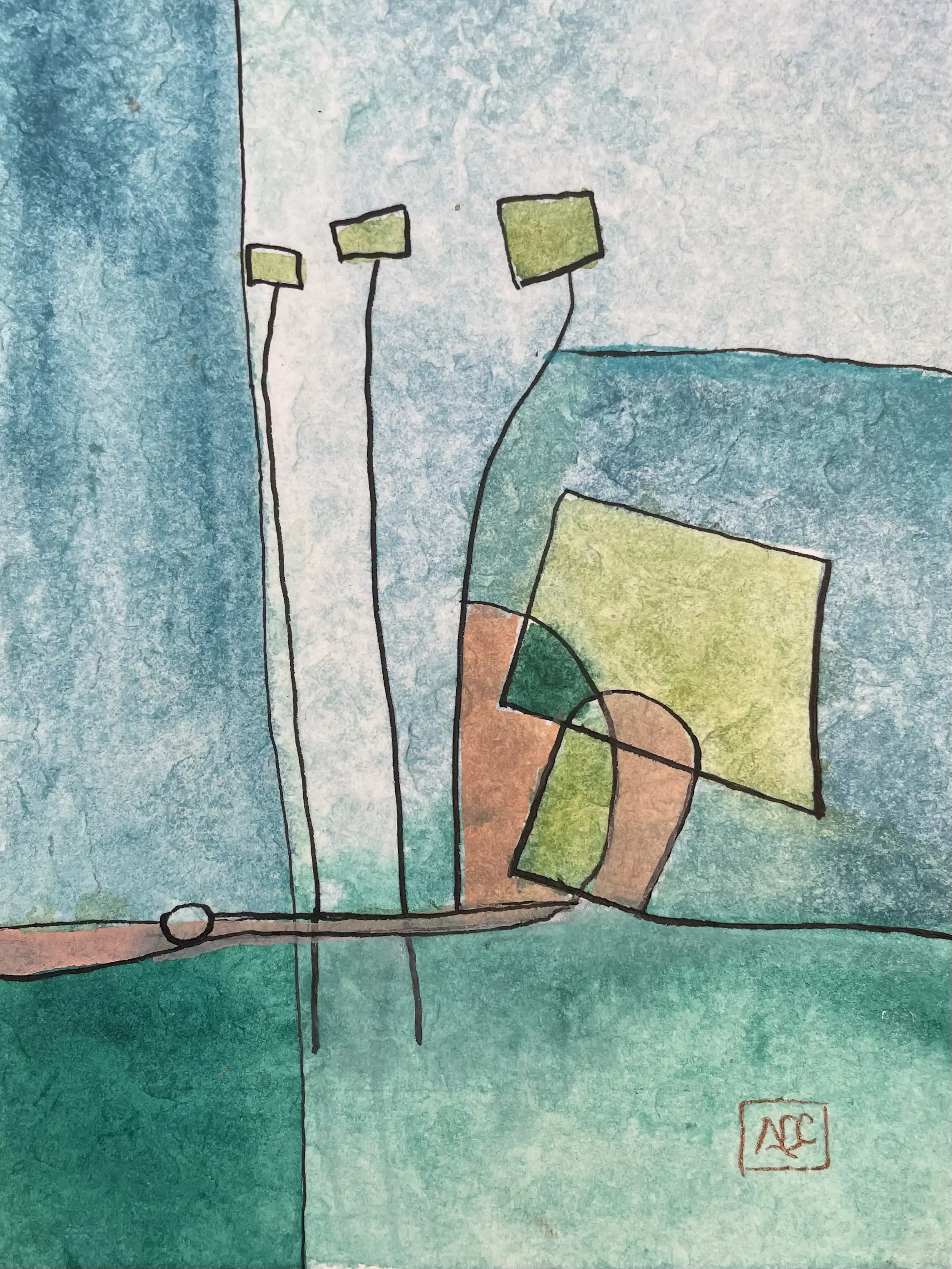
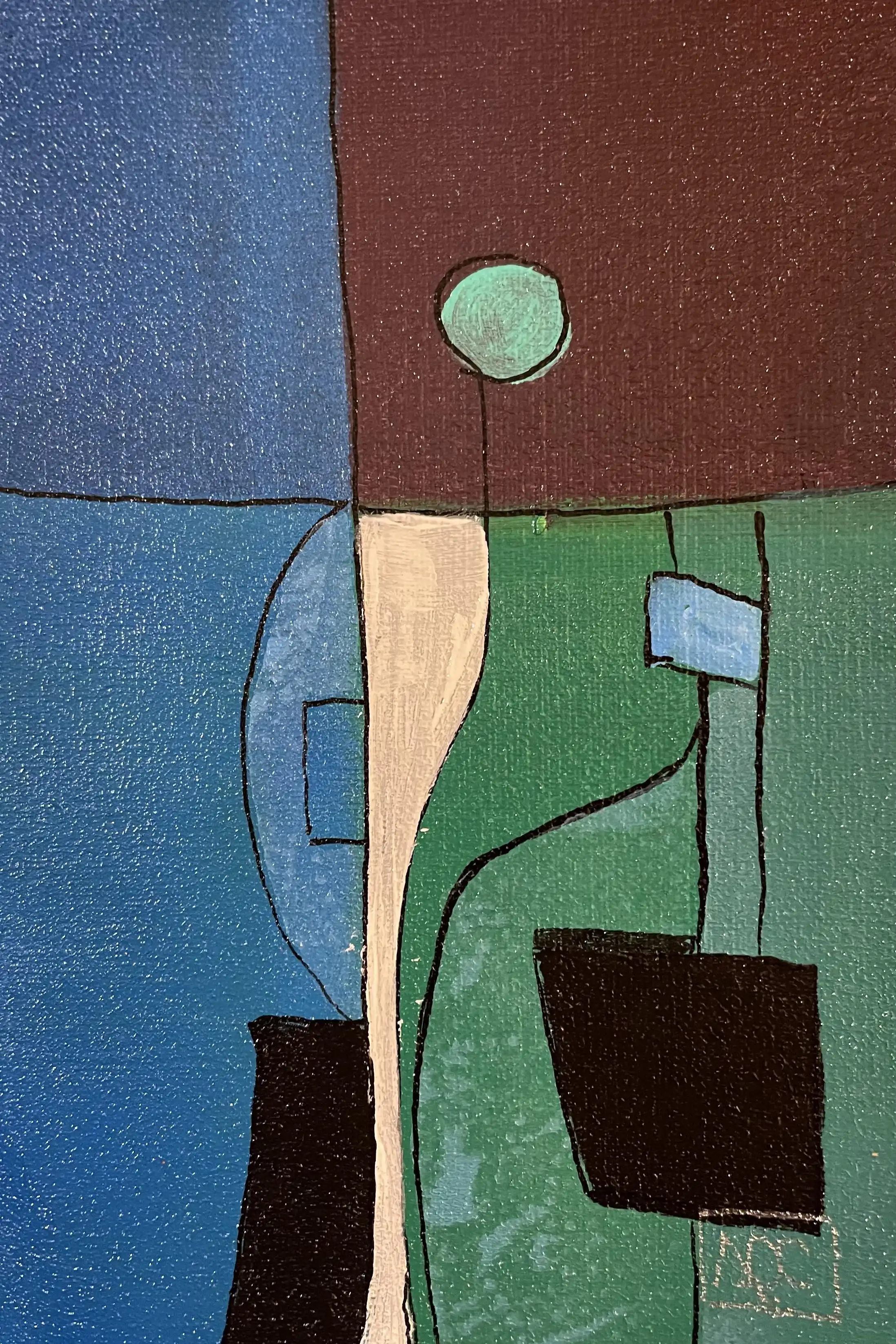
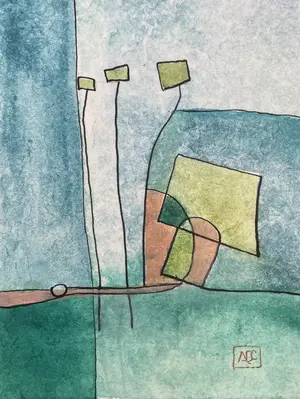
C# Major is a series of 4 paintings by Arnaud Quercy, created in 2024 in acrylic on paper and watercolor on paper. Formats range from 10×15 cm to 21×30 cm. All 4 works in this series are held in private collections (Taiwan, France, Williamsville, USA, Melbourne, Australia). Works presented at: Rencontres au Marché de la Création, Salon d'art contemporain – Metamorphose, Paris and Permanent Collection 2025 – Resonance in Form and 4 more.
C-sharp Major is a key that exists in notation as a theoretical extreme — seven sharps, the farthest reach of the sharp side before enharmonic spelling takes over. In practice, musicians think of it as D-flat Major, five flats, a key Chopin favored for its dark lyricism in the Prelude Op. 28 No. 15, the so-called "Raindrop." The triad — C-sharp, E-sharp, G-sharp — carries a cool, contained gravity, major in name but remote in character, as if brightness had been submerged.
Through harmonic-chromatic translation, C-sharp produces a blue-green that darkens toward black in the bass and reaches full saturation in the middle register. The major third, F (enharmonically E-sharp), yields red-violet — the only warm presence native to the chord. The fifth, G-sharp, translates as deep blue, shading toward blue-violet where it sits most vividly. Together, these three tones produce an aquatic palette: cool, luminous, without a trace of yellow or orange. Register deepens the effect — low entries compress toward near-black, high entries bleach toward white, and the narrow band of saturation sits in the middle octaves.
Quercy’s C-sharp Major series comprises four concentrated études, all created in 2024. Three move in waltz time at an Animé tempo with a mezzo-piano dynamic; Variation 1 alone slows to Modéré and pushes to mezzo-forte, the most deliberate and weighty of the group. Three phrases ascend; one descends. Contours range from a steady climb to an inverted bell that dips before rising. The opening study carries nine notes — the densest in the series — while Variation 2 and Variation 3 each hold seven or eight. Legato articulation governs every entry. Non-chord tones appear in half the series: B (the major seventh) intrudes in Variation 2, and G, D, and B bring warm accents to Variation 3, the most chromatically adventurous of the four.
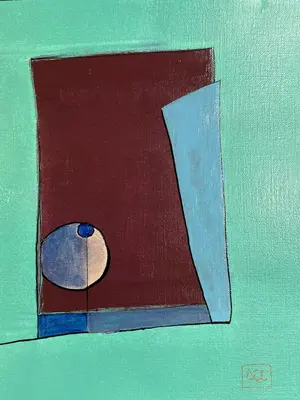
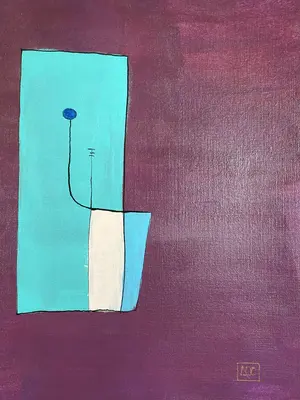
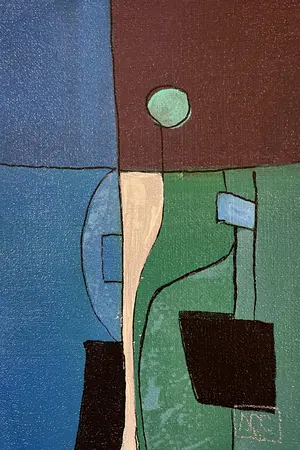
Variation 1 is the largest work, acrylic on paper at 21 by 30 centimeters, and the warmest in palette — "red-violet commands the middle of the canvas," the major third given room to dominate the cool field through a descending phrase that settles into richness before its final pitch escapes upward. Variation 2 is the outlier, the only study in quadruple time, its inverted bell contour and prominent major seventh pulling the chord off-center — "the chord pulled off-center by a tone that doesn’t belong." The smallest work, at 10 by 15 centimeters, it is also the strangest. Variation 3 closes the series in watercolor rather than acrylic, trading the fifth entirely for three warm non-chord intrusions, ending the key not with purity but with curiosity.
Across the four canvases, blue-green anchors every composition — dark and nearly invisible in the lowest registers, vivid and saturated through the middle, paling as phrases climb. Red-violet appears wherever the third enters, a warm thread through the cool expanse, most prominent in Variation 1 and most distant in Variation 2. Deep blue from the fifth surfaces sparingly; in two of the four études it is absent or reduced to a single entry. The warm intrusions — red-orange, orange, yellow-green from non-chord tones — appear only in the later variations, as if the series gradually admits colors from outside its own harmony. The visual rhythm is one of cool restraint punctuated by rare warmth.
Four études are enough to reveal what C-sharp Major is: a major key that refuses to behave like one. Where C Major radiates and G Major strides, C-sharp Major recedes — cool, self-contained, almost nocturnal. Quercy’s series proves that repetition under constraint does not narrow the palette but deepens it, each variation uncovering a different facet of the same remote harmony. All four works have found homes in collections spanning Taiwan, France, New York, and Melbourne — a quiet global dispersal fitting for a key that keeps its warmth hidden.
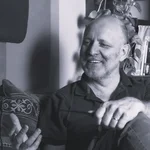
Arnaud Quercy is a Parisian artist working across painting, music, and sculpture. His practice is grounded in Ideamorphism — the principle that a work of art does not carry meaning, but triggers it. Each piece is engineered to diffract differently through each person who encounters it.
He creates and exhibits at Art Quam Anima, his gallery-atelier at 28 rue du Dragon, Saint-Germain-des-Prés, Paris.
Works — C# Major
Related hubs
- Collection: Harmonic Crossing
Exhibitions 7
- Rencontres au Marché de la Création (2024-04-23 → 2024-12-31, Marché de la Création – Paris Montparnasse, Paris)
- Salon d'art contemporain – Metamorphose, Paris (2024-12-26 → 2025-01-05, Halle des Blancs Manteaux, Paris)
- Permanent Collection 2025 – Resonance in Form (2025-01-01 → 2025-12-31, arnaudquercy.art, Paris)
- Paris Studio Visit (2025-02-18 → 2025-02-18, Artist's Studio, Paris)
- Marché d'Art Contemporain – Seine Port (2025-05-17 → 2025-05-17, MAC Seine-Port, Seine-Port)
- Nuit des Artistes, St Germain-en-Laye, France (2025-05-24 → 2025-05-24, La Nuit des Artistes, Saint-Germain-en-Laye)
- Marché de l'Art de Saint-Germain-en-Laye, 17ème édition – France (2025-06-14 → 2025-06-14, Marché de l'Art, Saint-Germain-en-Laye)