Sculptures by Arnaud Quercy
Twenty-nine unique works in ceramic, steel, and mixed media. Each sculpture is a one-of-a-kind original — handmade, signed, and certified by the artist.
A Sculptor's Practice
Sculpture came to me through music, through the hands. After years of piano — where every gesture has weight, duration, and consequence — I found in clay and metal another way of composing: building form the way one builds a phrase, where each decision about mass, void, and surface carries the whole.
My sculptural work spans ceramic and steel, figurative and abstract, intimate and imposing. It draws from the Cubist tradition of Lipchitz, Laurens, and Gaudier-Brzeska — the conviction that a form can be simultaneously fragmented and whole, abstract and deeply felt. But it also draws from jazz, from philosophy, from mythology, from the quiet observation of animals and people who don't know they're being watched.
Every piece in this catalog is a unique original. Not an edition, not a reproduction, not a cast from a mould. Every surface bears the singular trace of its making — the compressions, cuts, and decisions that can never be repeated. This is what separates an original sculpture from everything else: it exists once, and only once.
Jazz in Three Dimensions
Music was my first language, and it has never stopped shaping the way I sculpt. Charles Mingus, Charlie Parker, Thelonious Monk — these are not portraits in the conventional sense. They are attempts to give three-dimensional form to the sound these musicians made: Mingus's volcanic bass lines, Parker's mercurial bebop phrasing, Monk's angular, unpredictable architecture. In Bird (Charlie Parker), the figure dissolves entirely into the music — angular and curved shapes interact like notes in an improvised solo, unrestrained and alive. The question these works ask is whether a static form can capture the movement of sound, or whether it becomes its own kind of improvisation — a bridge between sight and sound.
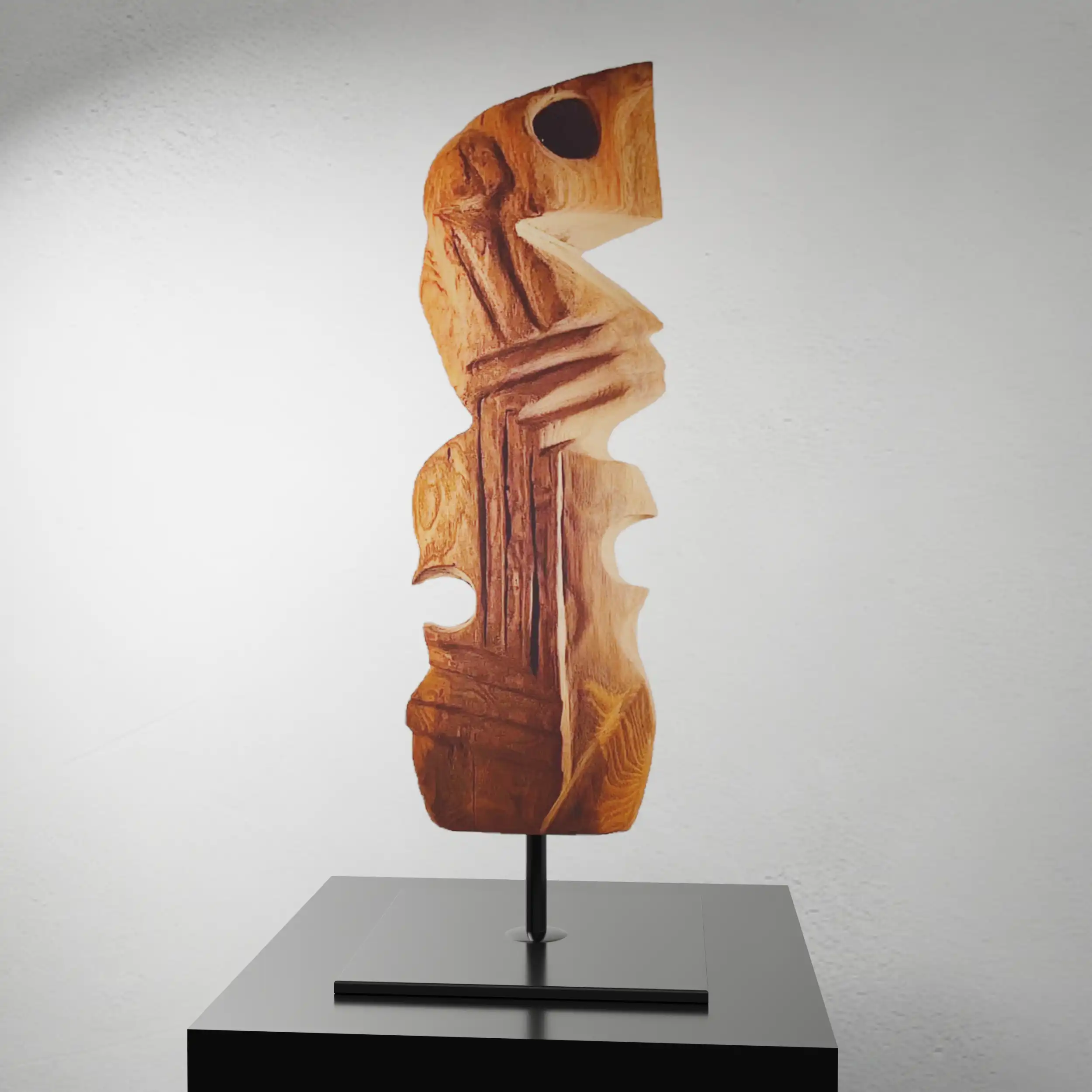
Charles Mingus — Artwork Description
Carved from a single oak log, this vertical sculpture embodies the physical and musical presence of Charles Mingus (1922-1979), the legendary jazz bassist and composer known as "The Angry Man of Jazz." The raw density of the oak mirrors Mingus's uncompromising artistic vision and notorious temperament—a man who was fired by Duke Ellington, who stopped performances to berate musicians and audiences, yet who created some of the most profound and tender music in jazz history.
The vertical grooves carved into the surface symbolize the strings of the double bass—the instrument Mingus revolutionized, lifting it from timekeeper to front-line voice. The angular cuts and negative spaces capture his contradictions: the structural composer who taught by ear rather than notation, the violent tyrant who wrote music of extraordinary vulnerability, the genius whose bullying pushed musicians toward greatness. The form stands tall and solid yet is destabilized by voids—strength and fragility held in tension, like Mingus himself.
Part of the Untamed Creations collection, this piece represents free artistic expression outside my systematic chromesthetic framework. Here, transliteration operates through symbolic choice rather than reproducible system: verticality as defiance, oak's resistance as temperament, carved lines as musical strings, fractured spaces as the contradictions of a towering, impossible, unforgettable figure.
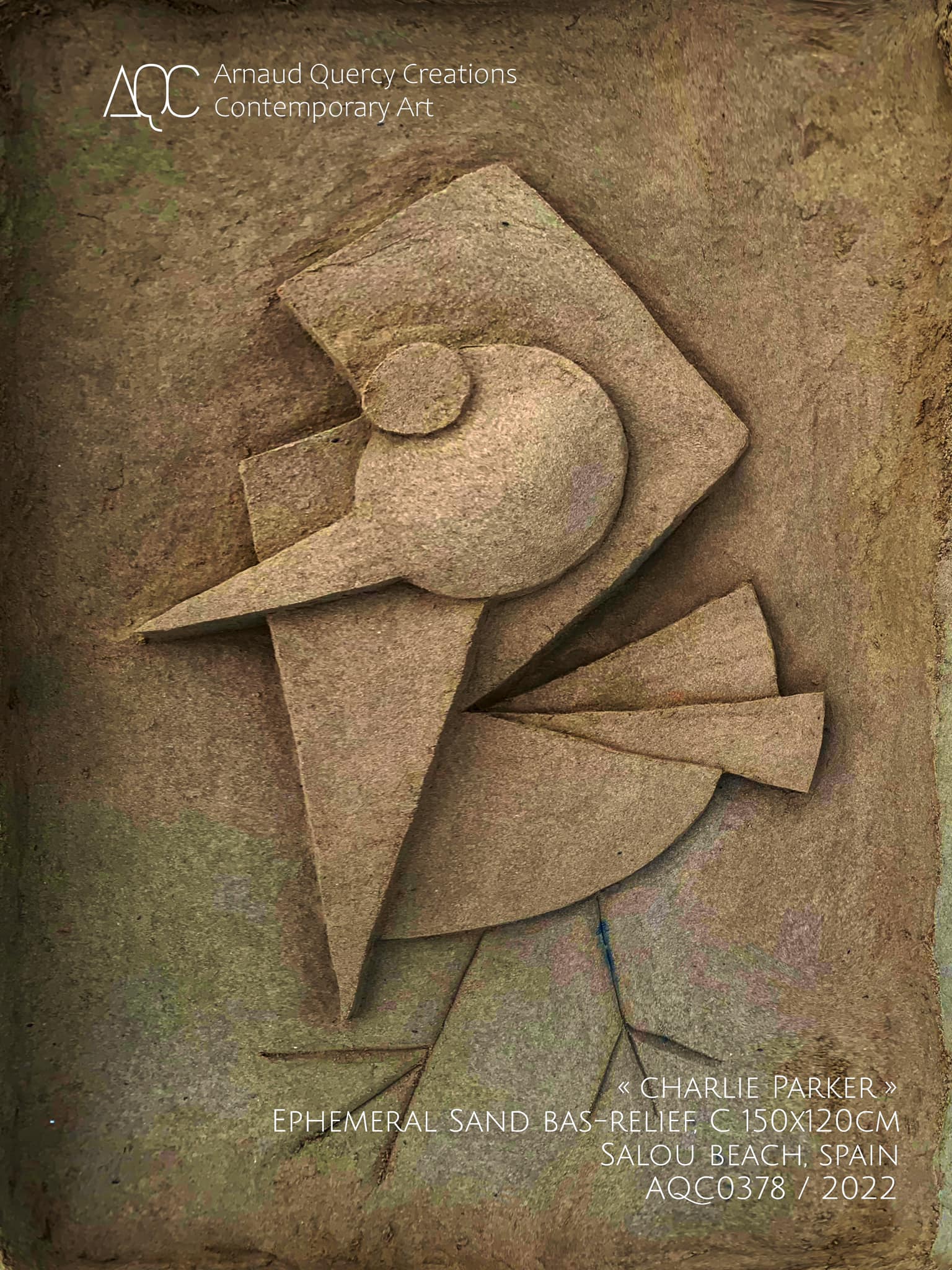
This sand bas-relief honors jazz legend Charlie Parker through an abstract bird form sculpted directly into Salou Beach, Spain. Working within the tradition of ephemeral art, I shaped beach sand into a tribute that references Parker's famous nickname "Bird," translating the musician's improvisational energy into angular geometric planes. The work belongs to the Untamed Creations collection, which explores materials that resist traditional sculptural permanence.
The composition presents a stylized bird through geometric abstraction, with sharp angular forms creating wings and body that suggest dynamic motion. Warm earth tones dominate the surface, ranging from deep brown in shadowed recesses to lighter tan in raised relief areas. The natural color variations of beach sand produce a cohesive palette that shifts subtly across the sculptural surface.
At monumental scale measuring 150×120 centimeters, the work existed only briefly during August 2022 before tide, wind, and footsteps erased it. The impermanence formed part of the work's meaning: beauty most alive when it cannot last. Photographic documentation preserves what the tide dissolved, demonstrating how ephemeral sculpture can achieve lasting presence through record rather than physical survival.
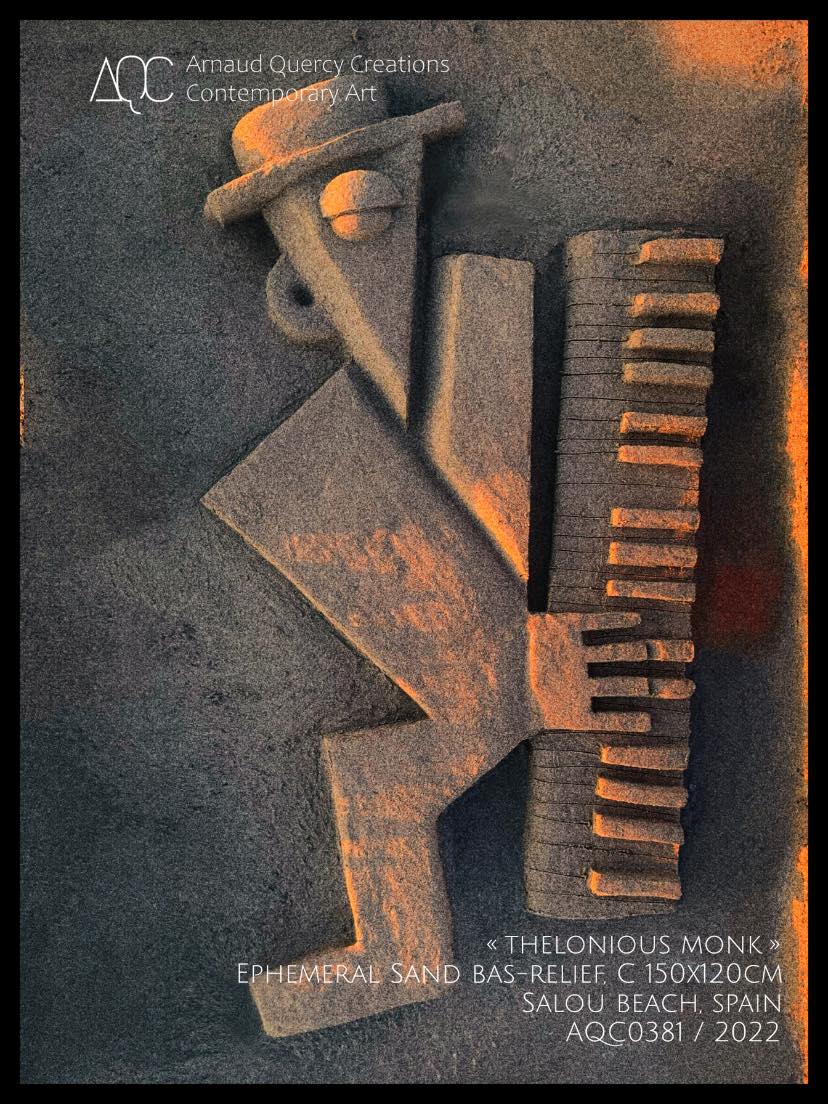
This ephemeral sand bas-relief pays tribute to jazz legend Thelonious Monk through monumental sculptural form carved directly on Salou Beach, Spain, during a five-day open-air exhibition in August 2022. At 150×120cm, the work translates Monk's angular musical language into geometric relief: the sharp brim of his trademark hat, faceted planes defining his face, and abstracted piano keys anchoring the lower composition. Warm earth tones dominate—deep grays and blacks create shadowed contours while burnt sienna and orange highlights catch Mediterranean light along raised edges.
Monk's music is all angles—dissonant intervals, unexpected harmonic choices, percussive attack at the piano. I rendered that angularity in bold, simplified forms that sand's granular medium demands: no fine detail, only strong shapes visible from distance. The monumental scale amplifies rather than resists the work's impermanence—hours of carving for a sculpture that survived until the tide reclaimed it. Documentation became the primary artifact, preserving what the waves erased.
Part of the Untamed Creations collection, this piece represents free artistic expression outside my systematic chromesthetic framework. Created alongside a companion bas-relief honoring Charlie Parker, the work demonstrates how ephemeral beach sculpture adapts tribute and homage to environmental constraints where time itself becomes the ultimate material condition.
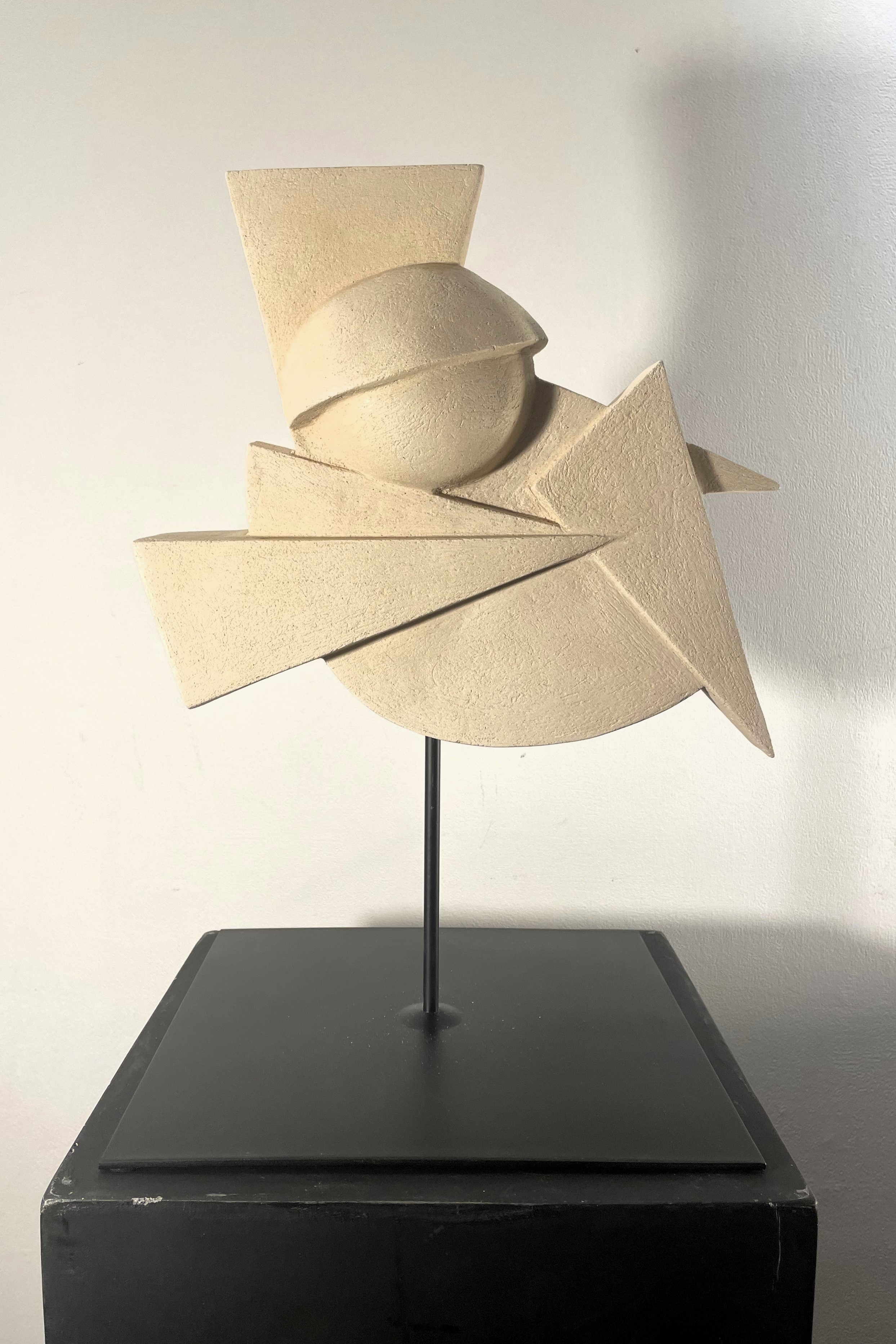
Charlie Parker (1920–1955)—nicknamed "Bird"—revolutionized jazz through bebop's harmonic complexity: tritone substitutions, deceptive resolutions, intertwined cadences that demanded virtuosic navigation. In this ceramic sculpture, I translate that architecture directly into spatial form. Interlocking geometric planes encode bebop's sophisticated structure—angular elements suggesting both bird wings and saxophone brass, curved bands wrapping around a central sphere like Parker's melodic lines coiling through harmonic changes. The piece merges symbol and instrument into unified cubist abstraction, operating at medium scale (26×45×10 cm) to invite close examination from multiple angles.
Constructing this geometric complexity required internal chimney channels within the forms—hidden vents allowing steam escape during high-temperature firing. Without this invisible engineering, thermal stress would shatter the piece. The sculpture is built from white clay body with fine grog (petit chamotte) for structural integrity, then treated post-firing with beeswax to protect the matte cream surface and deepen tactile engagement. Technical mastery remains concealed beneath expressive surface—paralleling bebop itself, where years of harmonic study and physical practice vanish into fluid improvisation.
This work diverges from my systematic chromesthetic practice. It is not codex-driven transliteration but devotional tribute—bebop as first love, Parker as god, this sculpture as homage to the music that shaped my entire artistic formation. Created in 2024 as part of the Untamed Creations collection, the piece encodes what bebop does: elaboration that rewards attention, complexity that resolves into coherence, virtuosic energy contained within rigorous structure.
Figures, Readers, Dreamers
Some sculptures begin with a person — real or imagined — and the quiet drama of their inner life. A Happy Man distills the anticipation of a father waiting for his child to be born: geometric lines reflecting grounded professionalism, a central void hinting at the fears that accompany hope. The Woman Reading and Reader explore the particular stillness of someone absorbed in a book — a body present but a mind elsewhere. Dreamer and Quietness inhabit the territory of contemplation, where smooth curves and minimalist restraint create spaces for silence.
Ramon, the Garden Keeper captures the dignity of daily labour. The Traveler and The Sailer embody movement and horizon — figures defined not by where they are but by where they are going. The Alchemist stands at the threshold between the known and the transformative, a figure that resonates with the alchimorphic philosophy at the heart of my practice.
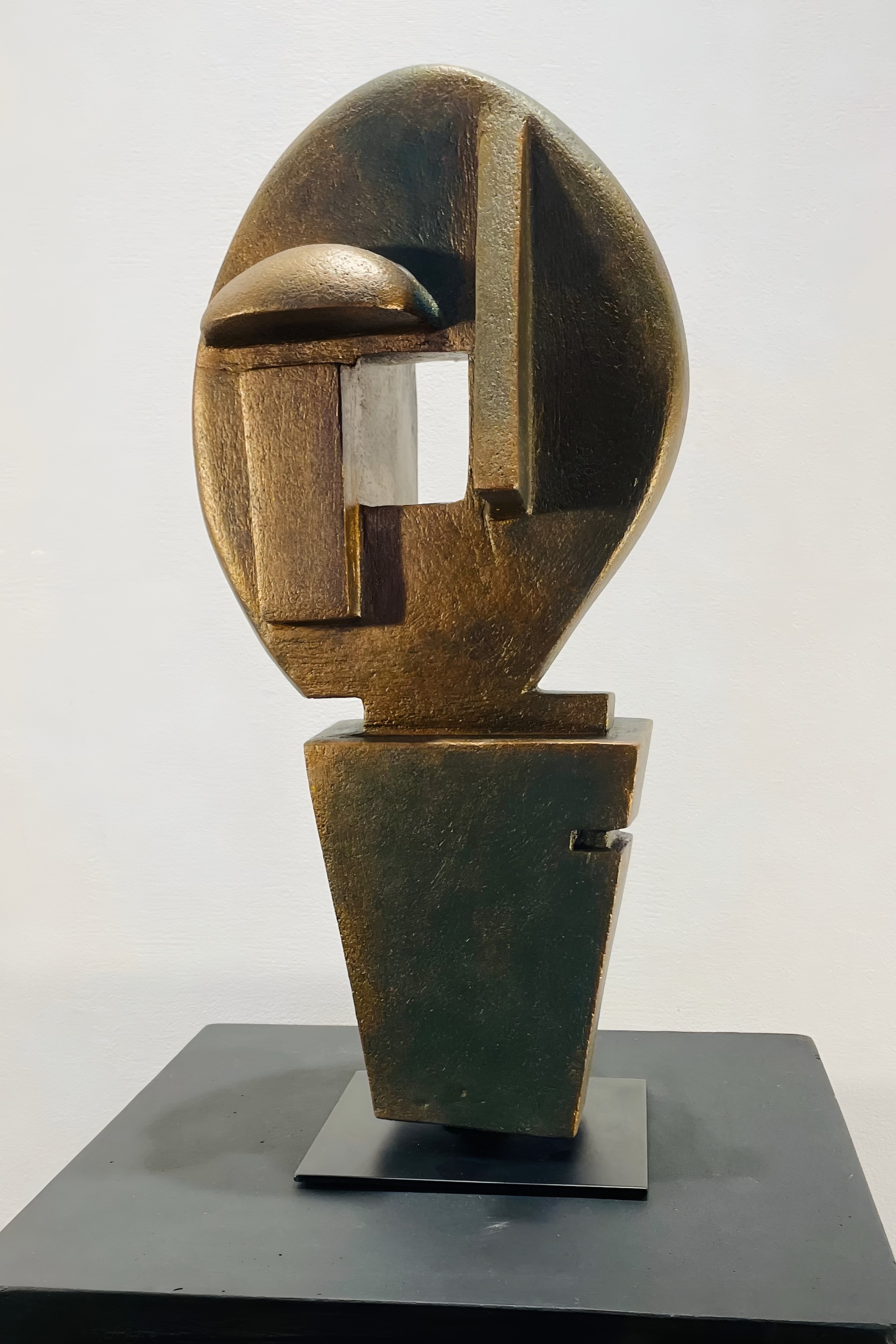
This ceramic sculpture forms half of a diptych with its accompanying short story. The egg-shaped head, divided into geometric planes of bronze and moss green, presents a face marked by professional restraint and suspended anticipation. A rectangular void interrupts the composition—an opening that suggests waiting, watching, something not yet revealed.
In the narrative, Léonard stands vigil through the night, checking instruments with meticulous care, awaiting an imminent birth under the watchful moon. The sculpture embodies this tension: geometric severity encoding professionalism, the central void reflecting doubt and hope intertwined, earth-toned surfaces carrying the quiet patience of waiting. As the narrative transitions from the anticipation of night to the revelation of dawn, the sculpture stands as tribute to the silent drama of waiting and the profound joy of life's unfurling.
Created in terre cuite with fine chamotte and finished with beeswax and pigment mixtures, the work belongs to the "Spells and Magic" collection. The sculpture doesn't merely illustrate the story—it participates in its enchantment, holding mystery until the narrative reveals what Léonard has been waiting for all along.
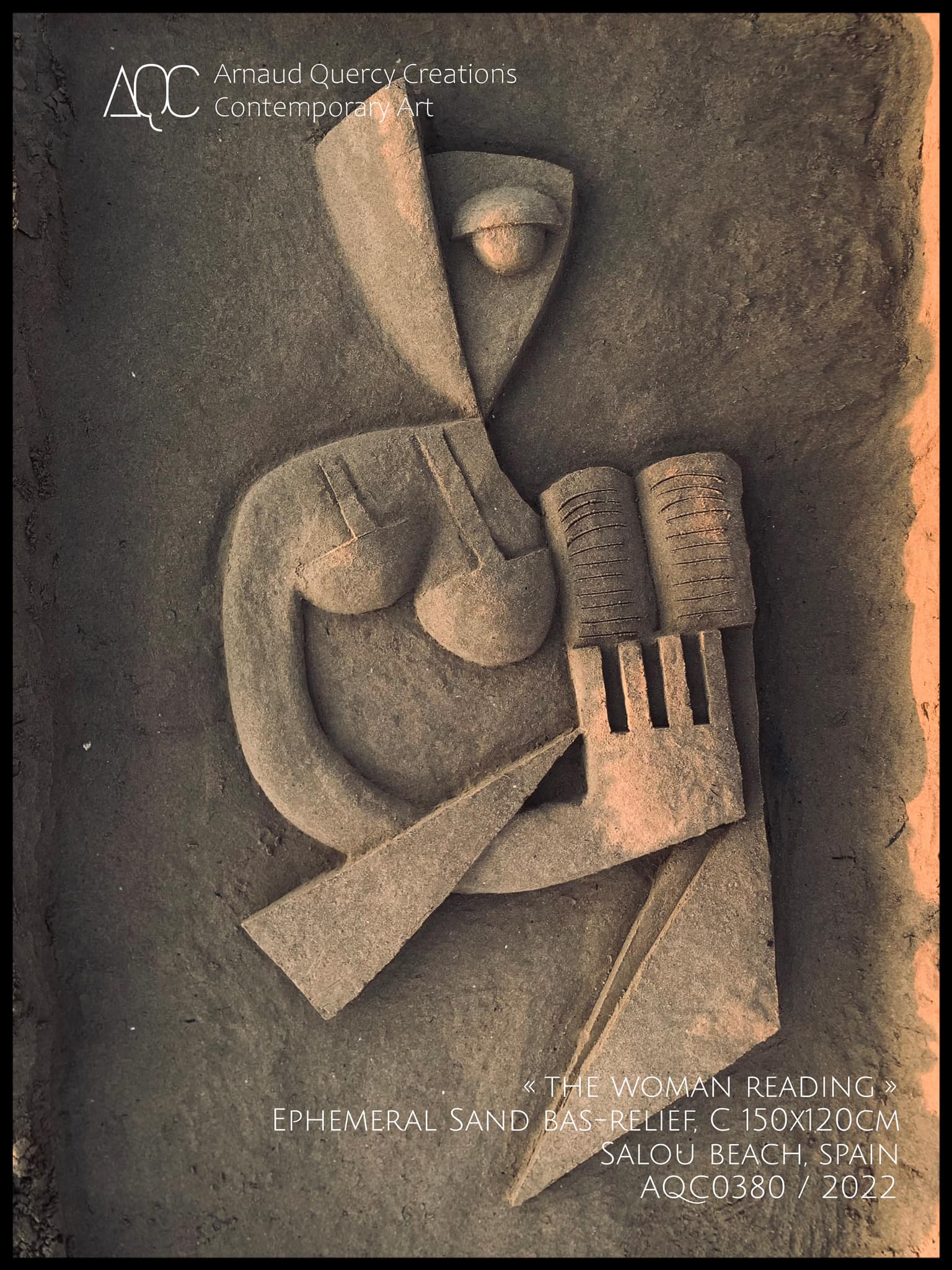
The Woman Reading translates the figure of a woman absorbed in reading into minimalist geometric forms—angular planes and curved volumes that encode head, body, book, and the posture of attention. The work applies ideamorphic principles to figurative representation, reducing the human form to essential structural relationships while maintaining legibility. What survives this radical simplification are the invariants: spatial relationships between body parts, the gesture of holding text, the inward focus characteristic of reading.
Created in sand on Salou beach in August 2022, the work's ephemerality mirrors the fleeting nature of reading itself. Reading exists as momentary mental event, traces left in consciousness that fade like marks in sand. The sculpture was erased by tide and wind within days—not as failure but as completion. The material temporality enacts the impermanence of the cognitive act it depicts. Large scale, careful composition, hours of labor committed to a medium guaranteed to erase them, mirroring the sustained attention and emotional investment of reading that leaves only traces.
The photograph remains as evidence of a temporary configuration that no longer exists, part of the Mediterranean Echoes series exploring geometric abstraction through site-specific ephemeral creation.
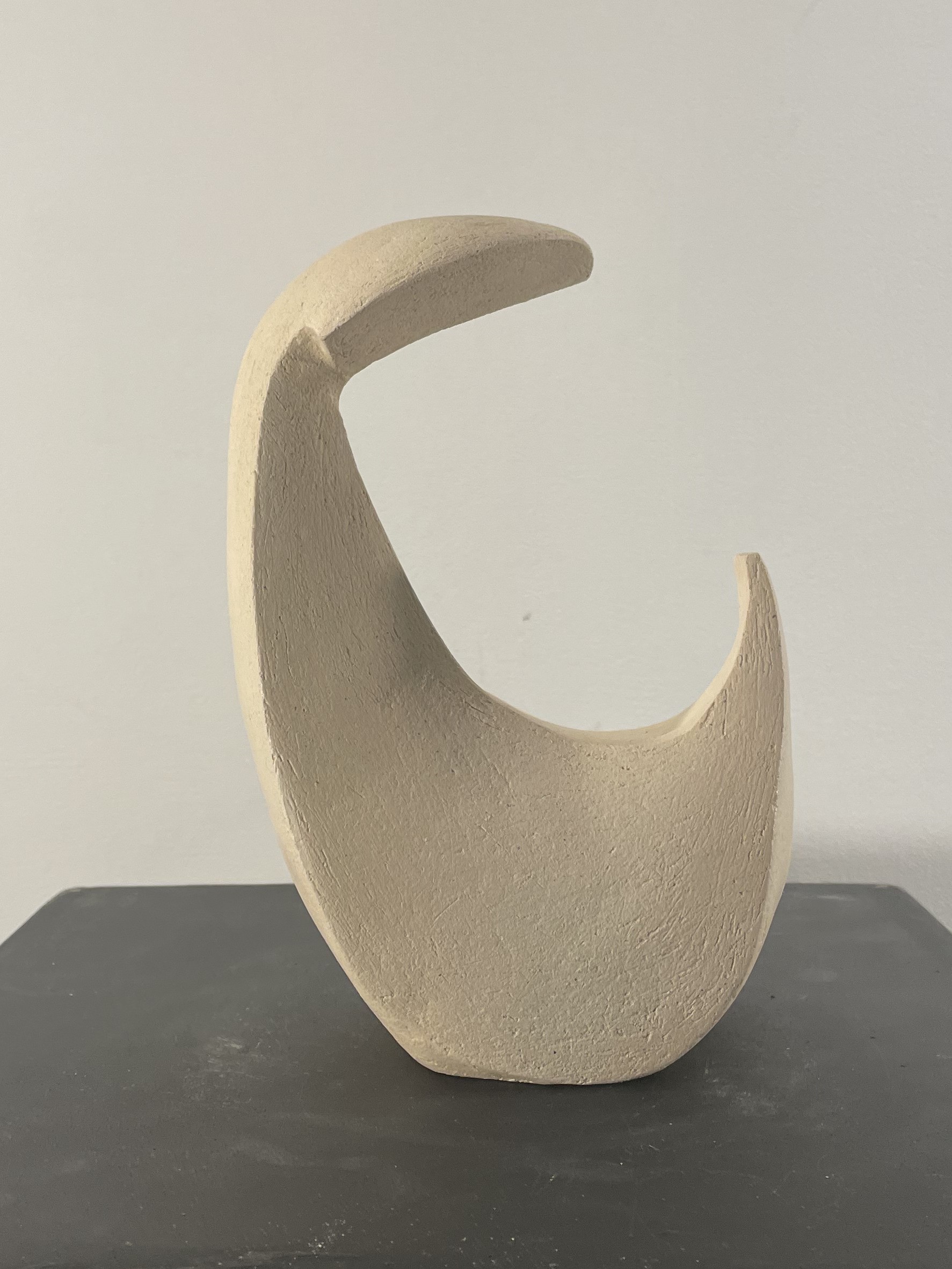
READER is a ceramic sculpture that captures the moment where the reader's mind and the book become indistinguishable — that instant of total absorption where consciousness has left the room, left the body, and inhabits the text entirely. The crescent form is simultaneously a figure curved in concentration and pages spread open, and it is impossible to see one without seeing the other. This is not ambiguity — it is the content of the work: at the moment depicted, reader and book are one thing.
The sculpture enacts a principle central to my practice: creation happens not in the author's writing but in the reader's imagination. An author emits words — abstract symbols carrying no sensory content of their own. The reader's mind transforms them into landscapes, faces, weather, emotion. That transformation is the creative act, and it belongs entirely to the receiver. READER depicts the exact site where this occurs: the aperture fully open, the diffraction total, a world being built from words inside someone's consciousness.
The matte, unglazed ceramic reinforces this subject. No glaze, no color, no visual spectacle — just the quiet warmth of a surface close to the tone of paper and parchment. The material withdraws from attention the way a reader withdraws from the room, pointing everything inward. The smooth, unbroken curve carries no joints or seams, because in the moment of deep reading there is no boundary between the person and the page.
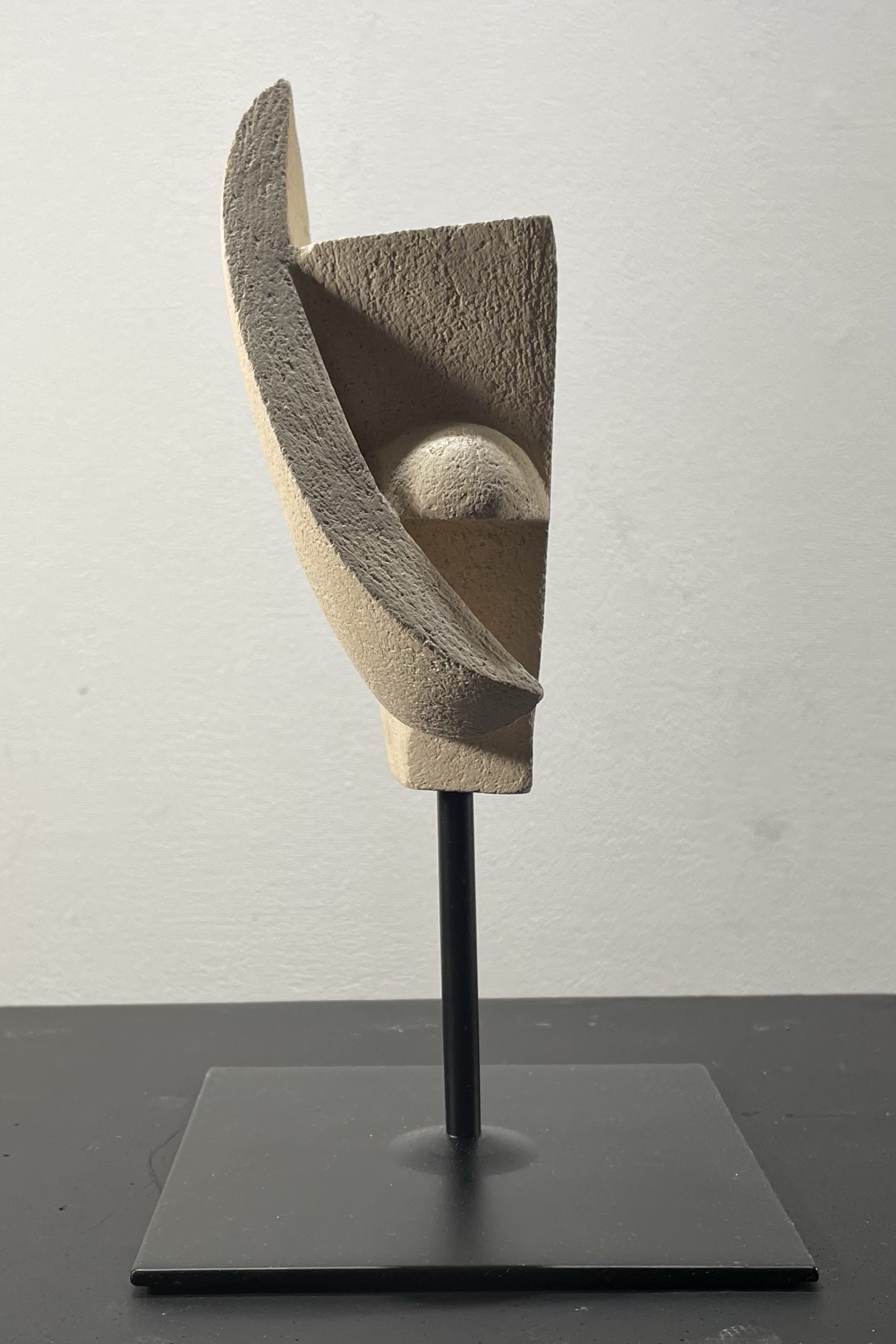
DREAMER
Ceramic, patina, 23x8x17cm, 750g
Arnaud Quercy Creations / AQC0660 / 2024
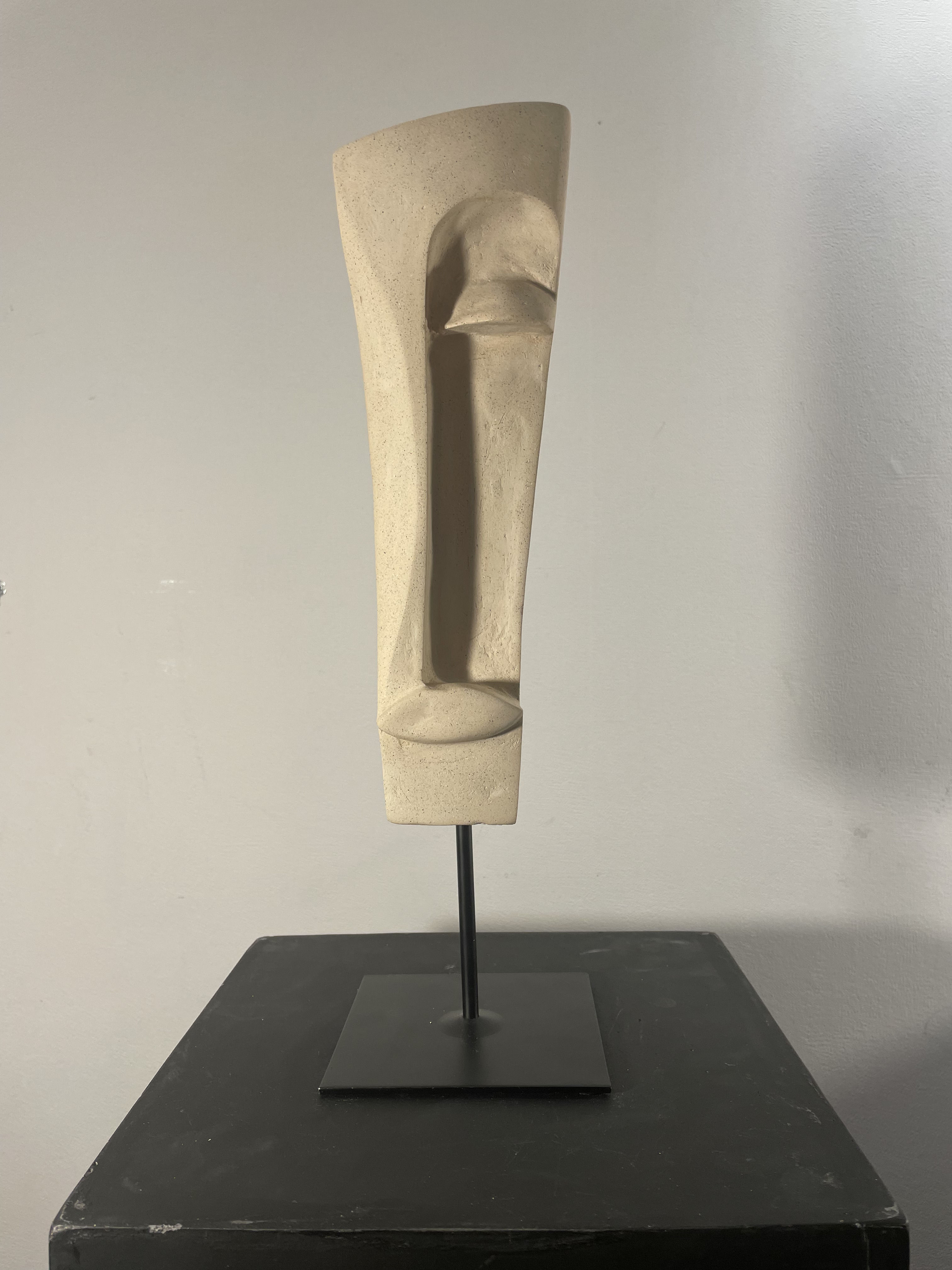
QUIETNESS reduces the human face to its essential geometry — a vertical blade, horizontal slits for closed eyes, a curved shell for the skull — to reach an archaic, almost liturgical register. The work joins a lineage of sculptors who found spiritual presence through geometric simplification: Brancusi's polished ovoids, Modigliani's elongated heads, the anonymous makers of Cycladic idols and medieval reliquary busts. Within this tradition, the piece seeks its own voice — flatter, more architectural, blade-like — a face that holds silence the way sacred objects do.
After high-temperature firing of the terre petite chamotte, the surface was entirely hand-sanded — a punishing process, as fired chamotte reaches near-granite hardness. The resulting luminous smoothness is impossible to achieve through clay work or glazing alone. Beeswax seals and warms the surface, producing a tactile quality closer to polished stone than fired ceramic. The material transformation mirrors the conceptual one: raw clay becoming something that feels ancient, worn by centuries rather than made yesterday.
A thin dark metal rod elevates the pale head above a square base, isolating it between earth and sky. Within the ideamorphic framework, the sculpture operates as an emission engineered for diffraction — the geometric reduction, the votive stillness, the deliberate incompleteness of a face without open eyes all create gaps that the viewer's aperture must complete. Created at Profils et Reliefs workshop in Paris under master ceramicist Isis Gondoin.
In his relentless pursuit of perfection, Ramón, the devoted garden keeper, believed that every blade of grass should stand at equal height and every flower bloom in flawless symmetry.
His obsession drove him to trim each blade by hand, forsaking sleep to realize his ideal.
But as dawn broke, Ramón was faced with a shocking sight: the garden he had nurtured with such care had turned into a barren wasteland, stripped of life.
In his quest for perfection, he had unwittingly destroyed the very beauty he sought to preserve.
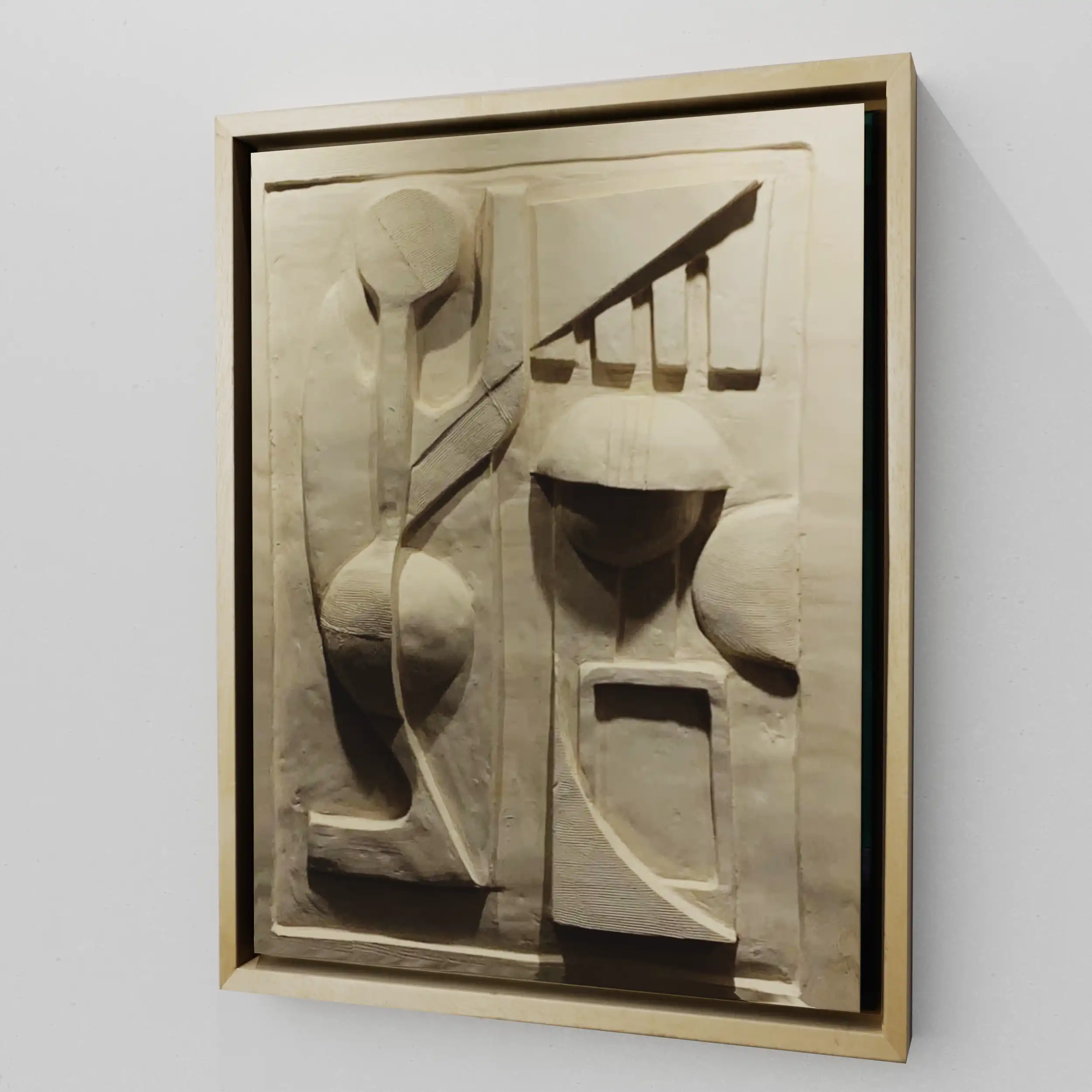
This bas-relief captures Ramón's moment of reckoning—a reminder that true beauty often lies in the imperfect, in the natural disorder that gives life its charm.
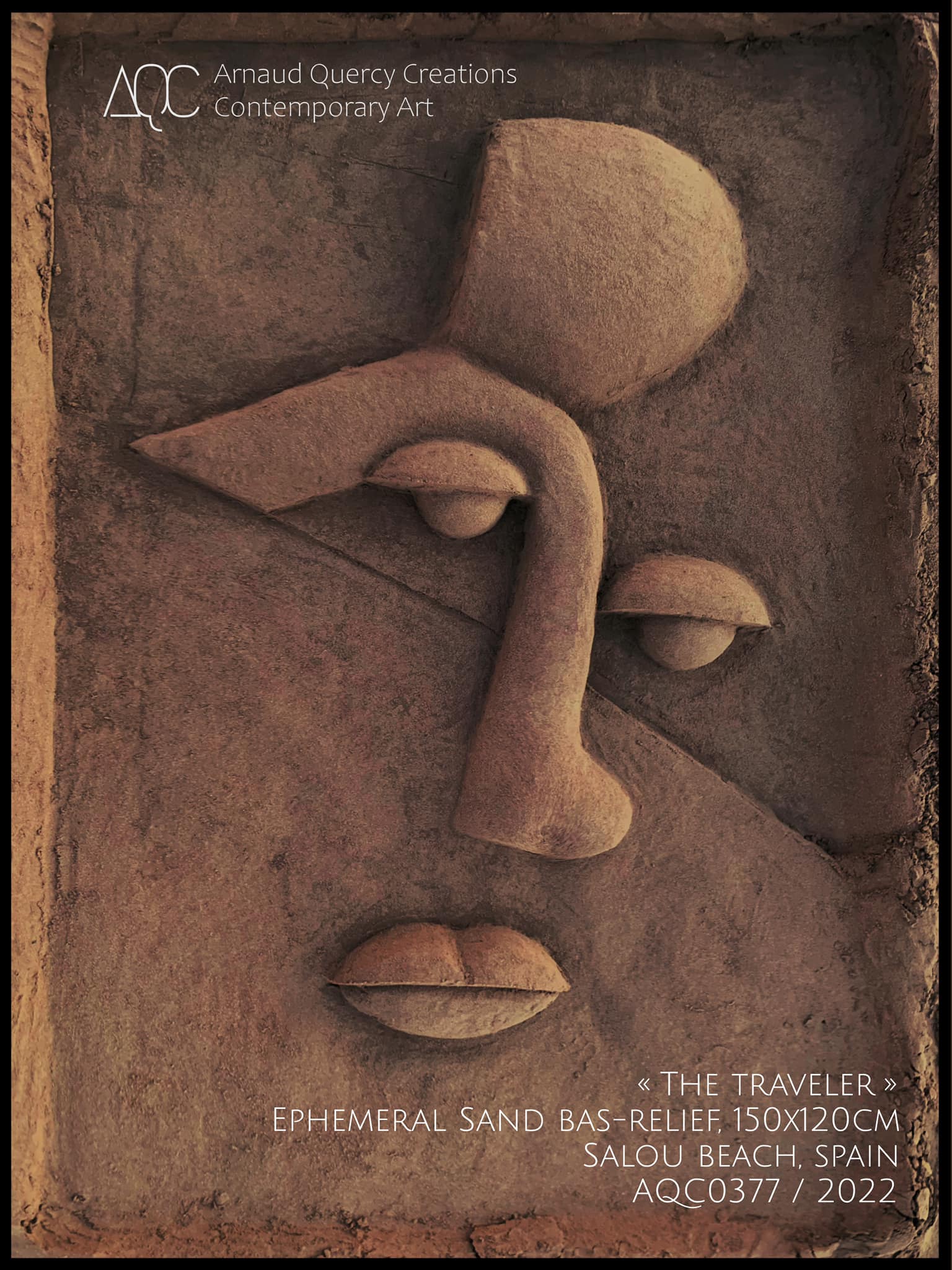
I created "The Traveler" in August 2022 on Salou Beach as part of my ephemeral sand sculpture series, knowing the tide would erase it within hours. This 120 × 150 cm bas-relief transforms impermanence from limitation into essential meaning—the beach became my collaborator, tidal rhythms the final curator. What remains now is only photographic documentation of a work that existed briefly before the Mediterranean reclaimed it.
The composition presents a stylized face in profile, gazing toward an unseen horizon with geometric clarity. I replaced the figure's hair with a rounded solar form, creating a traveler-as-sun icon that merges adventure symbolism with abstraction. Despite the geometric treatment, the face remains clearly recognizable through its prominent eye, angular nose, and softly curved lips—preventing full abstraction while elevating the portrait to archetypal register.
Warm earth tones in deep browns and sandy ochres emerged naturally from the beach sand itself, creating chromatic unity between sculpture and shore. The work appeared to rise from the coastal environment rather than be imposed upon it, embodying the contemplative spirit of Mediterranean travel that defines the series. Like the journey it represents, the sculpture existed as fleeting presence—witnessed, documented, then surrendered to the sea.
# The Sailer — Artwork Description
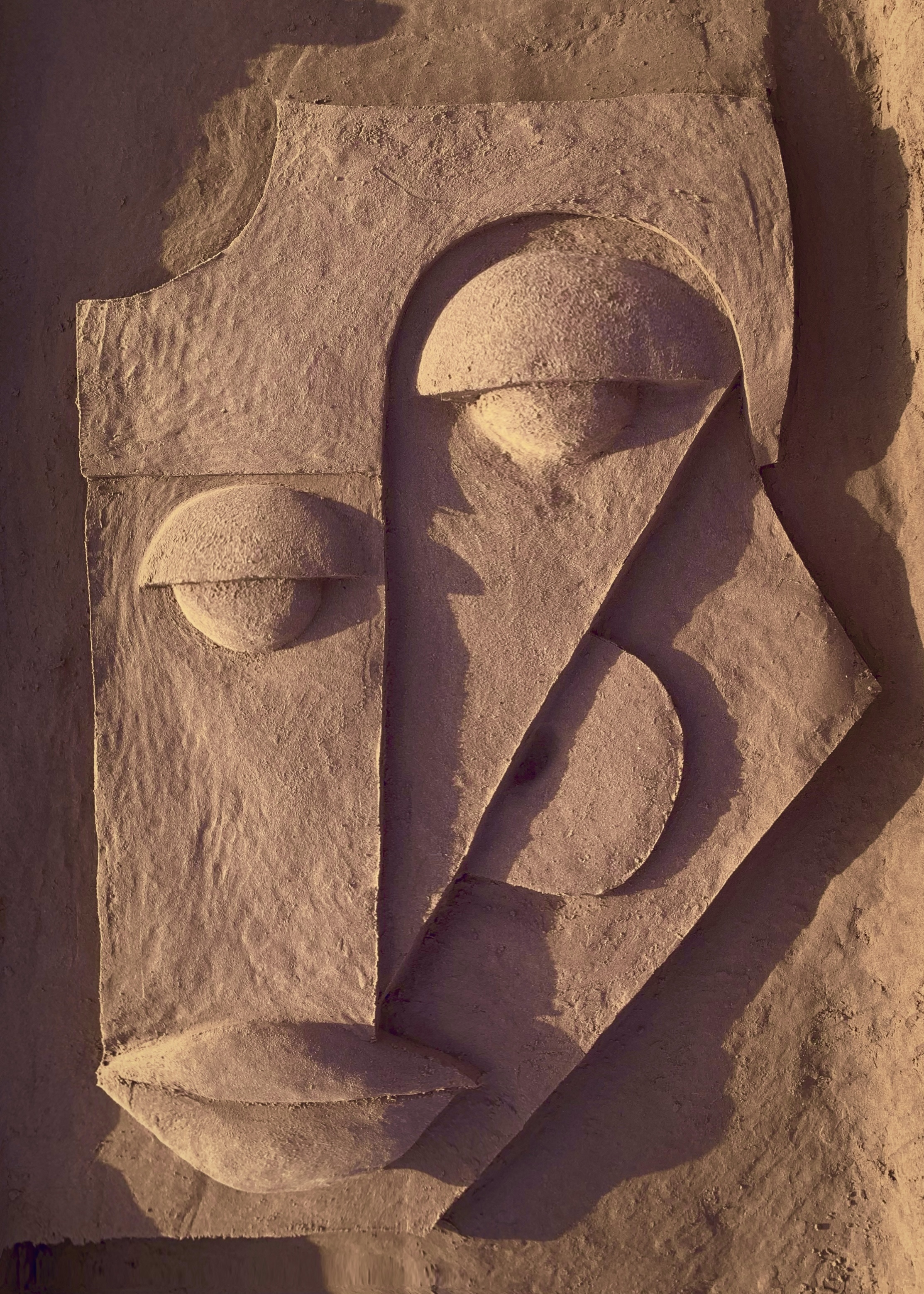
Carved into Mediterranean beach sand, "The Sailer" emerges through geometric reduction: two triangular forms function simultaneously as eyes and as the sails of a vessel, while angular planes suggest a face turned toward the horizon. The modernist vocabulary—sharp edges, planar cuts, minimal forms—creates a figure that refuses singular interpretation. Face, sails, journey: all three readings coexist in the same carved geometry.
The work existed for hours before tide and wind reclaimed it. This impermanence isn't limitation but intention—the sailor doesn't anchor, the vessel doesn't stay. The sculpture enacted its meaning by returning to the beach, dissolving back into undifferentiated sand. What persists is this photographic trace, afternoon light casting shadows that articulated depth the material alone couldn't provide.
Created in Spain as part of the Mediterranean Echoes collection, the piece sits outside the traditional sculptural economy of permanence and preservation. There is no object to conserve, no artifact to sell. The work happened, was witnessed by passing beachgoers, and returned to the elements—leaving only documentation and the question of what continues to create once the physical form dissolves.
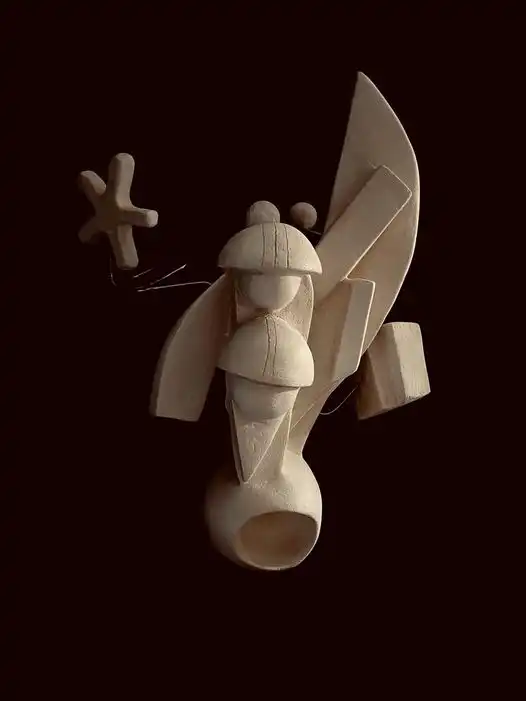
The Alchemist (2023) embodies the eternal quest for transformation through the language of elemental symbols. Four geometric forms—cube, two spheres, and star—radiate from a hooded figure on slender metal rods, each representing one of the classical elements fundamental to alchemical cosmology: earth, water, air, and fire. These forms orbit the central figure without touching it, suspended in a careful balance that suggests both connection and impossible distance. At the heart of the composition, the alchemist's face emerges not as smooth portraiture but as complex, faceted planes—a mind actively interrogating mysteries that resist resolution.
The technical execution reinforces this conceptual tension between earthbound matter and transcendent aspiration. Hand-formed in terre de petite chamotte and fired at 980°C, the sculpture's porous earthenware body accepts a traditional beeswax finish that darkens its natural tones and creates a warm, tactile surface. The metal rods—inserted after firing through precisely planned sockets—allow each element to hover in its own orbital relationship to the seeker below. Where the figure reads as organic, grounded, worked by hand, the geometric forms catch light with geometric precision, remaining forever just beyond the alchemist's grasp.
Within the "Spells and Magic" collection, The Alchemist stands alongside works exploring forbidden knowledge and mythical power, but here the emphasis shifts from external forces (dragons, grimoires) to the internal condition of seeking itself—the mind that pursues mastery over nature while remaining perpetually bound to material existence, reaching toward transmutations that remain, by definition, impossible.
Animals, Totems, Companions
The animal has always been one of sculpture's most serious subjects — from the cave paintings of Lascaux to Gaudier-Brzeska's Vorticist carvings. In my work, animals are neither decorative nor sentimental. They are presences — beings whose forms carry meaning beyond representation.
« Gus », the Shih Tzu reimagines a beloved companion through Cubist geometry, every plane a decision between likeness and truth. The Cat of Istanbul captures the quiet authority of the street cats that own that city more than any human does. Archimedes, the Owl takes its name from the wise companion of legend — a form that watches more than it speaks. The Seagull of Montparnasse suspends a bird in steel far from the sea, perfectly at home above the streets of Paris, a meditation on belonging and displacement.
And then there are the mythic creatures. Dragon and Dragon Breeder enter the territory of ancient narrative — fire, power, the relationship between human will and untameable force. Murmuration captures something no single bird can achieve alone: the fleeting, collective beauty of hundreds moving as one, a moment of structured chaos rendered in sleek, imposing steel.
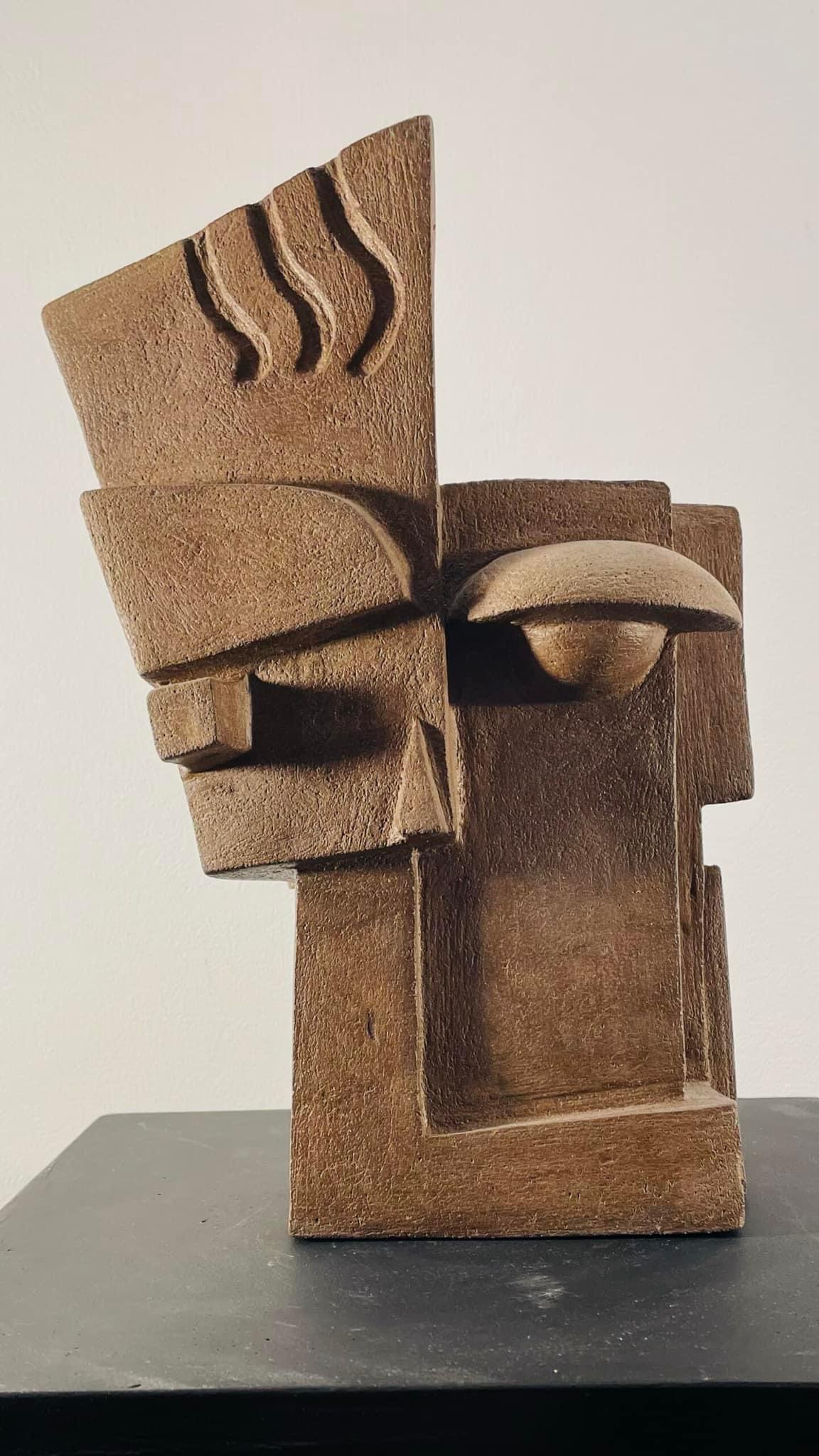
This Cubist-inspired sculpture abstracts the form of Gus, the beloved Shih Tzu of Isis Gondoin, Arnaud Quercy's master at the Paris Profils et Reliefs workshop.
Regularly accompanying Isis, Gus's essence is captured through geometric planes and angular facets. The interplay of textured surfaces and earthy patina adds depth and character, inviting viewers to explore its dynamic structure from multiple perspectives.
Arnaud Quercy's modernist approach blends organic inspiration with geometric abstraction, making Gus a vivid presence in the sculpture.
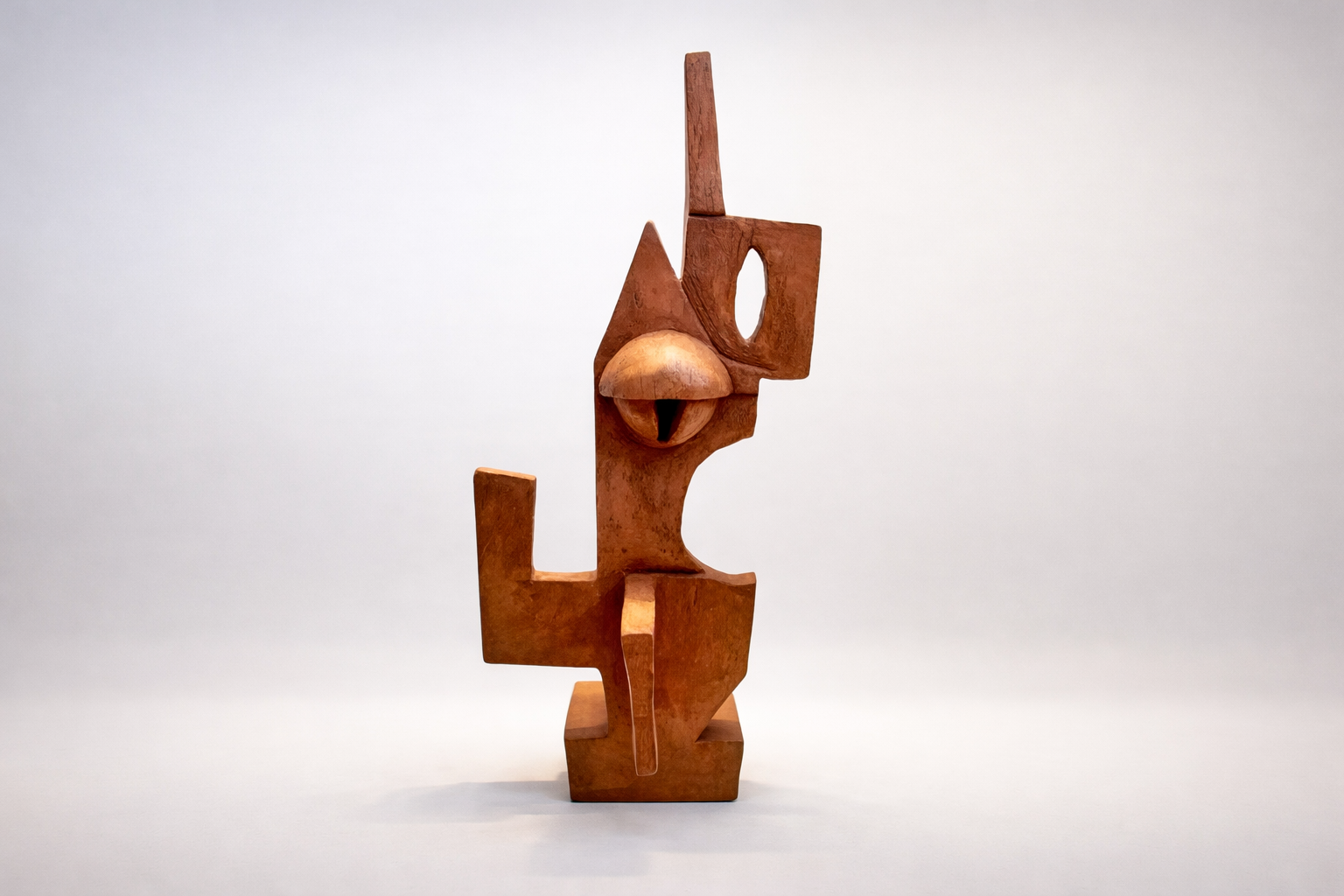
The Cat of Istanbul - Variations 2 captures the inseparable relationship between Istanbul's ubiquitous street cats and the city's architecture. These felines inhabit every street not as strays but as integrated residents—neither wild nor domesticated, but something merged with the urban fabric itself. Through cubist geometry, I dissolve the distinction between organic feline form and angular architectural planes, using the same formal language to express both cat and city.
The sculpture pushes ceramic's structural limits with daring verticality—40cm height on a narrow 16cm base, with angular protrusions extending into space. Thin walls and precarious projections risk collapse during firing, mirroring the cats' own grace as they balance on ledges and navigate vertical surfaces throughout Istanbul. The wax patina with pigments over terracotta evokes the warmth of the city's aged stone and weathered brick.
Created in 2023 as part of the "Nature in the City" collection, this work translates travel observations into sculptural form, documenting moments where the boundary between natural and built environments becomes productively ambiguous.
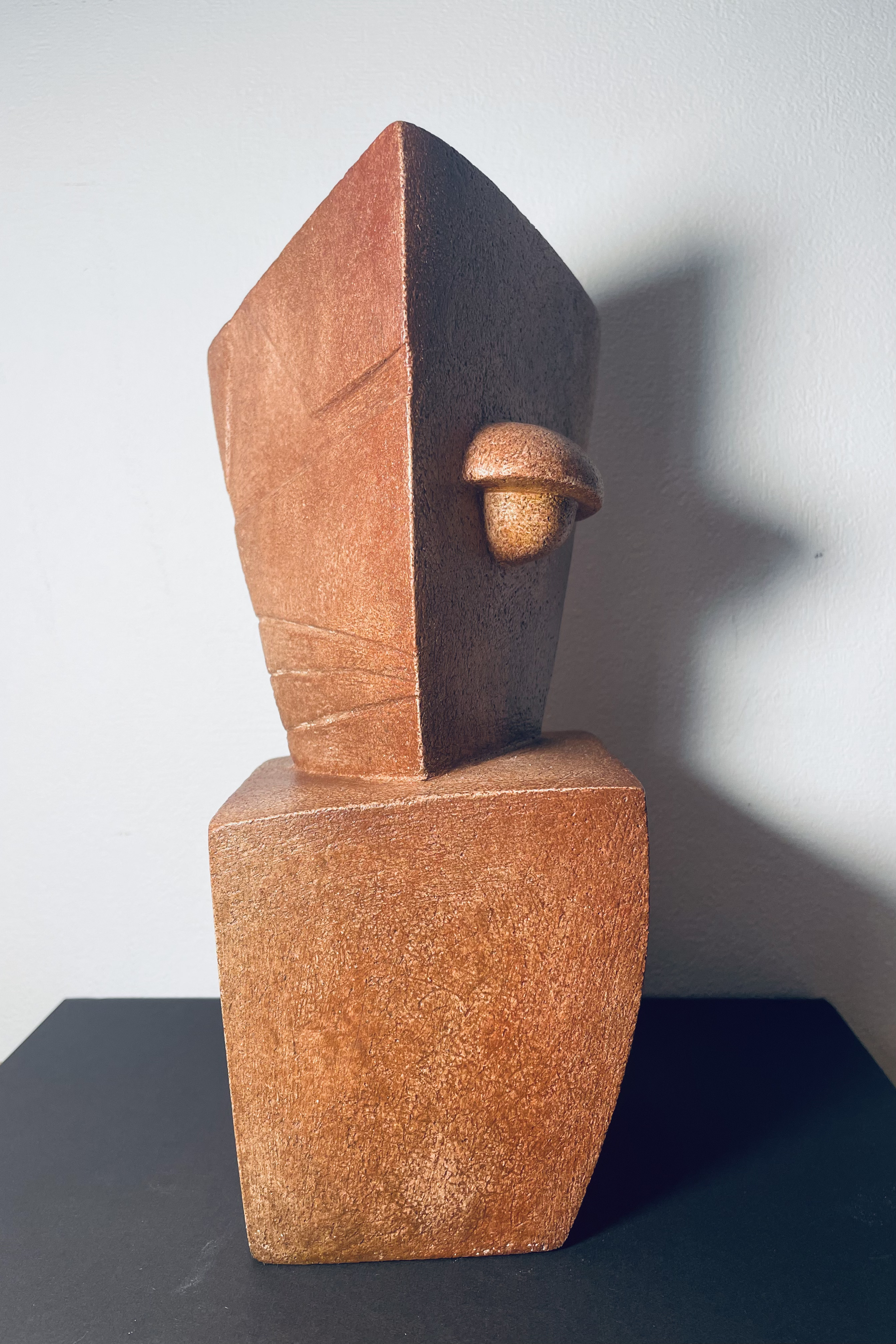
This sculpture reduces the cat to essential geometric volumes—a stable columnar body supporting an angular triangular head with a single circular opening suggesting eye or aperture. The work combines cubist simplification with minimalist restraint, maintaining just enough detail for recognition while pushing toward formal abstraction. No decorative surface, no anatomical modeling. Just volume, angle, and the minimum necessary for legibility.
The piece uses ancestral ceramic techniques: terre petite charmotte (grogged clay) for structural stability, brou de noix (walnut stain) for the warm brown-orange surface coloration, and cire d'abeille (beeswax) as protective finish. Two distinct clay bodies create the dramatic color contrast between stained and natural fired surfaces. These are traditional materials and methods—clay, fire, walnut, wax—executed with minimalist directness.
At 11×10×27 cm, the sculpture balances between object and presence. Small enough to hold, substantial enough to read as sculpture rather than maquette. Created in 2024 at Profils et Reliefs workshop in Paris under master ceramicist Isis Gondoin.
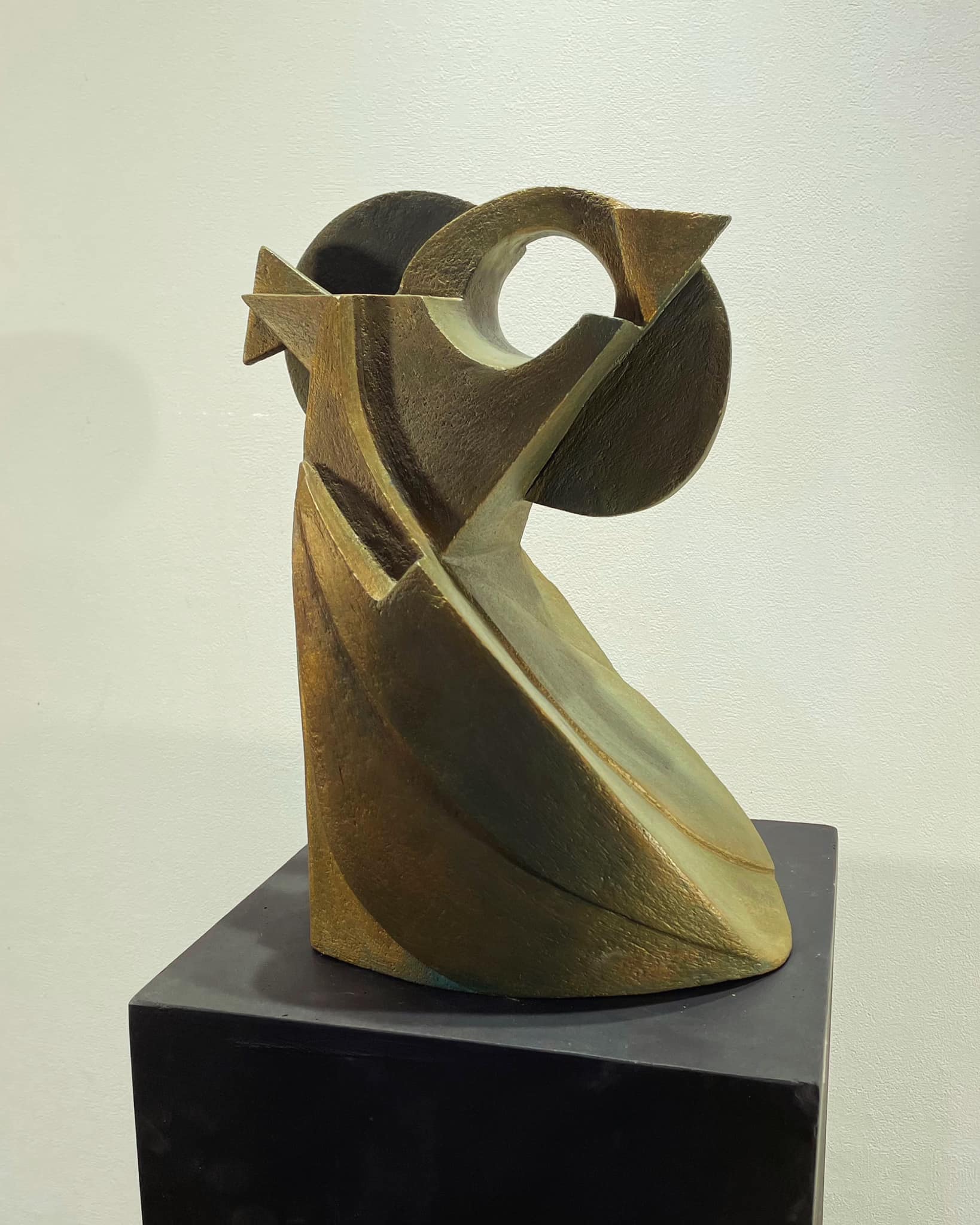
This ceramic sculpture presents Archimedes, the owl, as a study in cubist abstraction. I translated Disney's scholarly owl character into geometric language—two large circular apertures suggest watchful eyes, long leaf-like planes evoke wings or feathers, and paired ear forms establish the recognizable silhouette. The decomposition is playful rather than symbolic, using familiar pop-culture iconography as scaffolding for formal exploration within my "Spells and Magic" collection.
The sculpture's complex geometry required specific technical solutions. I engineered internal chimneys to prevent thermal fracture during firing, used petite chamotte in the clay body for structural integrity, and applied beeswax and pigments to achieve the tonal differentiation visible across surfaces. Yellow-green patina dominates most planes, while darker brown tones mark recessed areas and interior voids, helping each geometric element read as distinct within the unified form.
At 28×34×17 centimeters, the work balances recognizability with pure sculptural presence—viewers can identify the owl while simultaneously experiencing an arrangement of curvilinear planes, volumes, and voids in space.
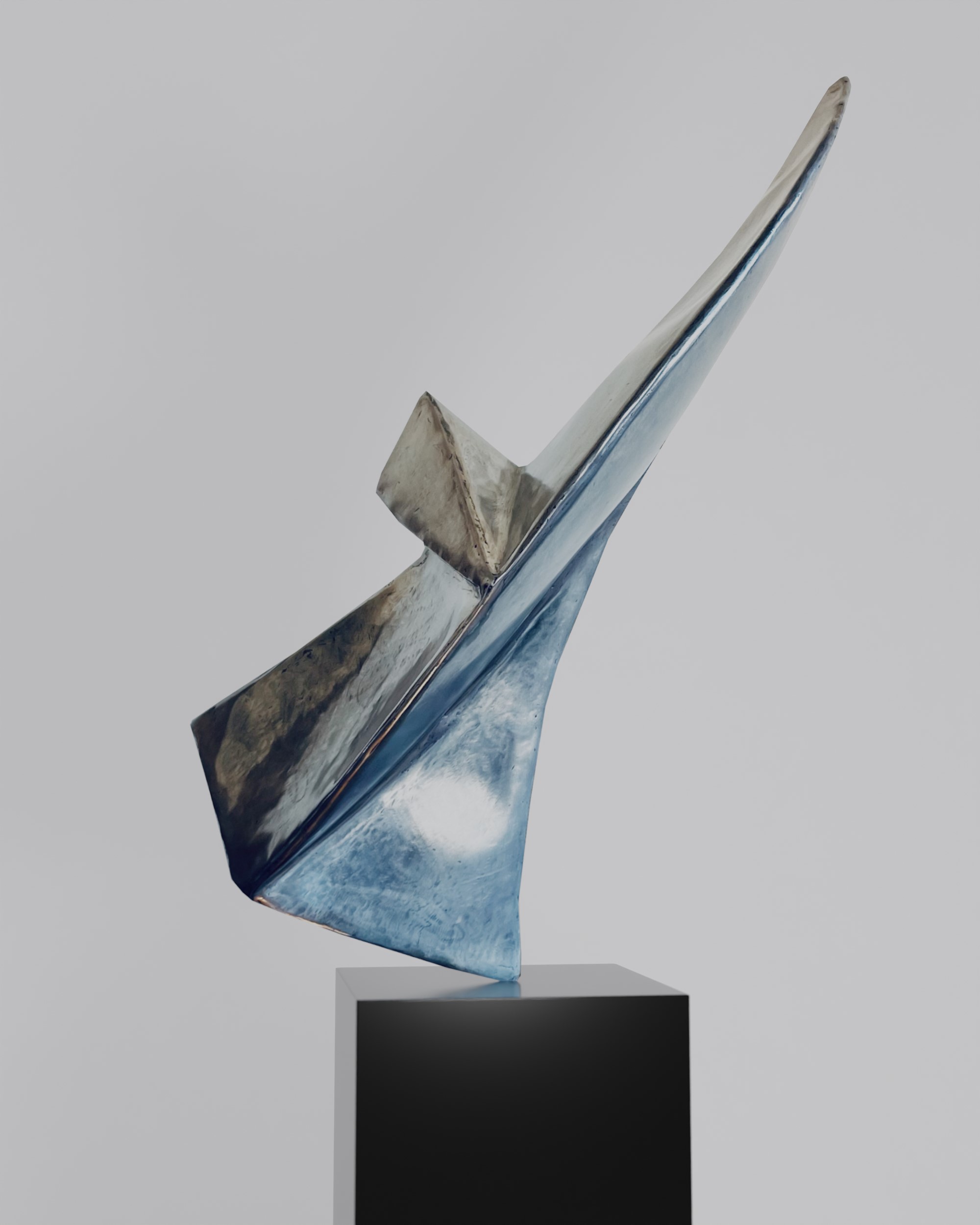
La Mouette de Montparnasse — Artwork Description
"La Mouette de Montparnasse" is a steel sculpture that captures the paradox of a seagull hovering against the wind — that singular moment where flight and stillness become indistinguishable, the bird held motionless in the air by the very force it flies against.
The gulls of Boulevard Edgar Quinet are not lost visitors. They are wild coastal predators that have extended their territory inland, claiming the rooftops and market stalls of the 14th arrondissement with the same confidence they show on Atlantic cliffs — loud, assertive, entirely uninterested in human approval. This sculpture is a portrait of that claiming: a wild creature asserting its presence in a space we assume belongs entirely to us.
The choice of steel is deliberate. The bird is forged from the same material as the girders, railings, and frameworks of the city it inhabits — literally made of Montparnasse. The polished and patinated surfaces shift between silver-blue brightness and darker oxidized tones, reading as feathers catching light from one angle, folded sheet metal from another. The boundary between creature and infrastructure dissolves, because for this bird, no such boundary exists.
At 86 centimeters tall and mounted vertically on its dark wood block, the sculpture enacts the very territorial gesture it depicts. It occupies space with the same upright assertiveness as the bird itself — present, unapologetic, with no intention of leaving. The viewer encounters the piece the way a pedestrian encounters a gull on Boulevard Edgar Quinet: with a slight surprise at its boldness, followed by recognition that this creature was here before you and will be here after you leave.
Part of the "Nature in the City" collection, "La Mouette de Montparnasse" answers the collection's central question — is the city a place where nature fights to exist, or has it merely become another environment for life to reimagine itself? The seagull answers with its body, by simply being there, unhesitant and untamed.
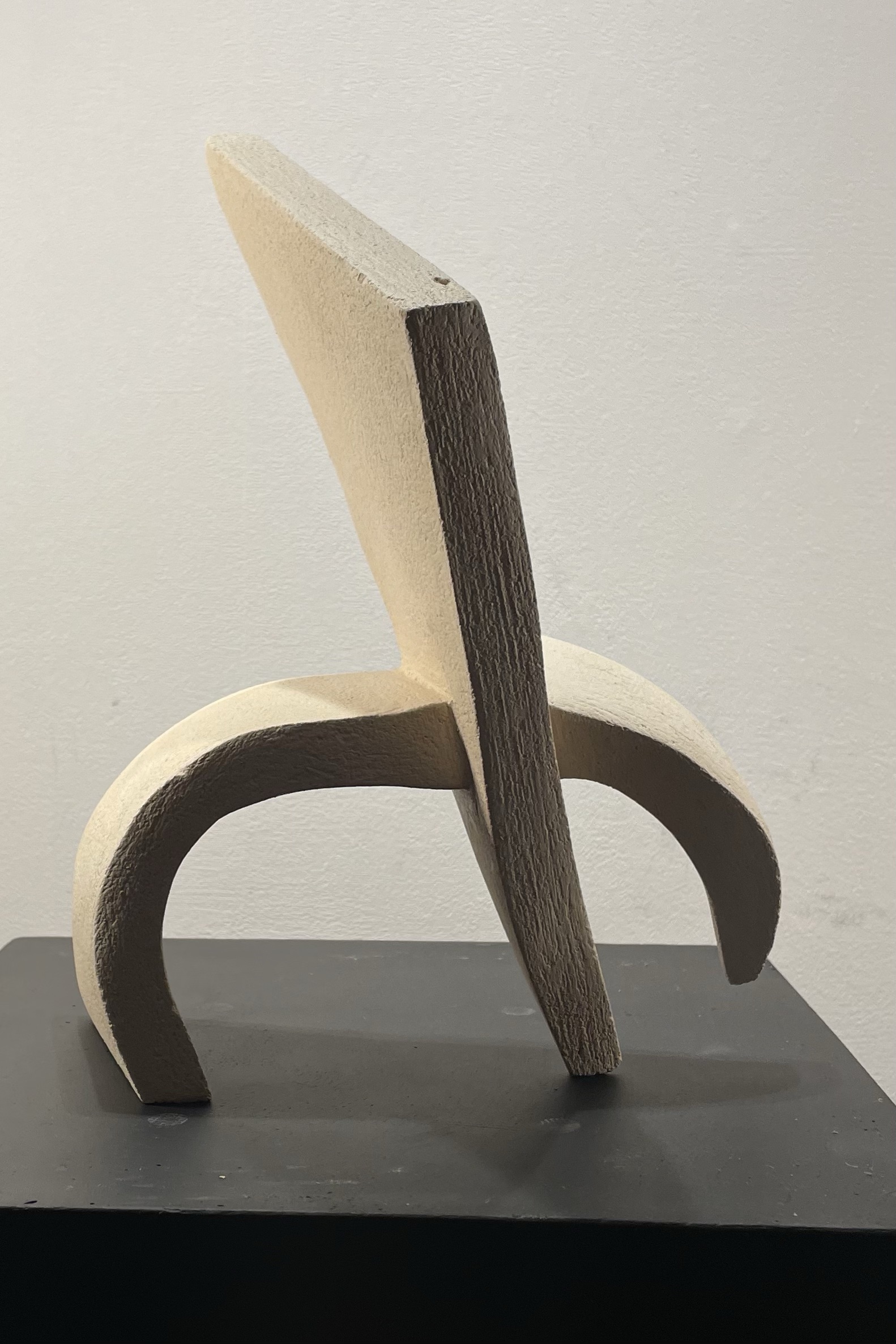
In a forgotten realm, where myths intertwine with reality, stands a dragon, sculpted by the hands of Arnaud Quercy. This rare sight captures the essence of a creature born from fire and shadow, its form both majestic and menacing.
With sinuous curves and intricate details, the dragon embodies an ancient power that commands awe and respect. The patina finish adds an aura of timelessness, as if this legendary beast has emerged from the depths of time to remind us of the mysteries and legends that still linger in our world.
This sculpture was created as part of a diptych with the “Dragon Breeder,” both pieces telling a story of ambition, power, and the enigmatic bond between the breeder and his dragon. Together, they evoke a world where the fantastical becomes real, and ancient myths breathe anew.
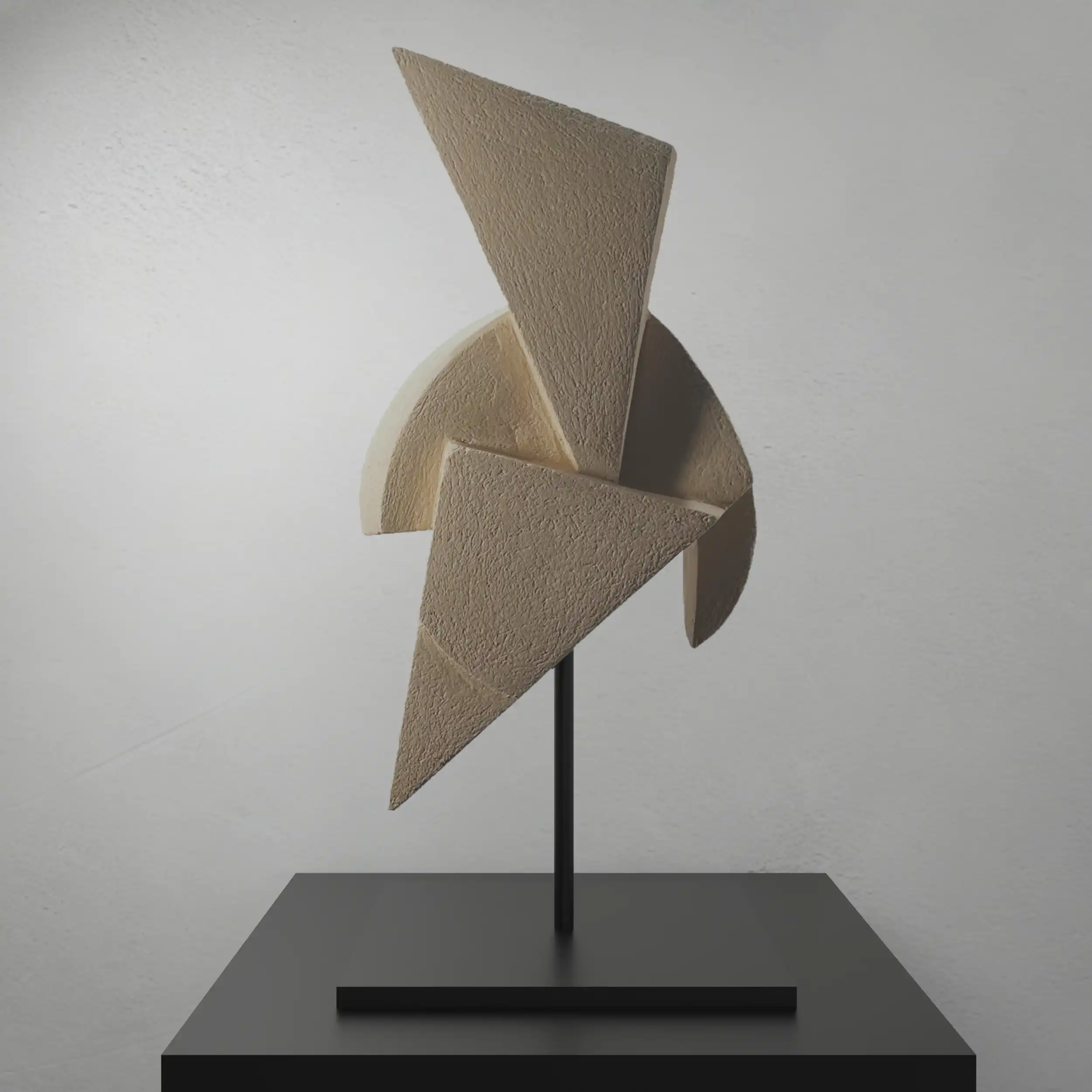
In a shadowed kingdom, a secretive dragon breeder stumbled upon an egg. From this mystical vessel emerged a fearsome dragon. Harboring dark ambition, the breeder meticulously trained the dragon, plotting to overthrow the tyrant king. This sculpture was created as part of a diptych with the “Dragon,” both pieces telling a story of ambition, power, and the enigmatic bond between the breeder and his dragon. Together, they evoke a world where the fantastical becomes real, and ancient myths breathe anew.
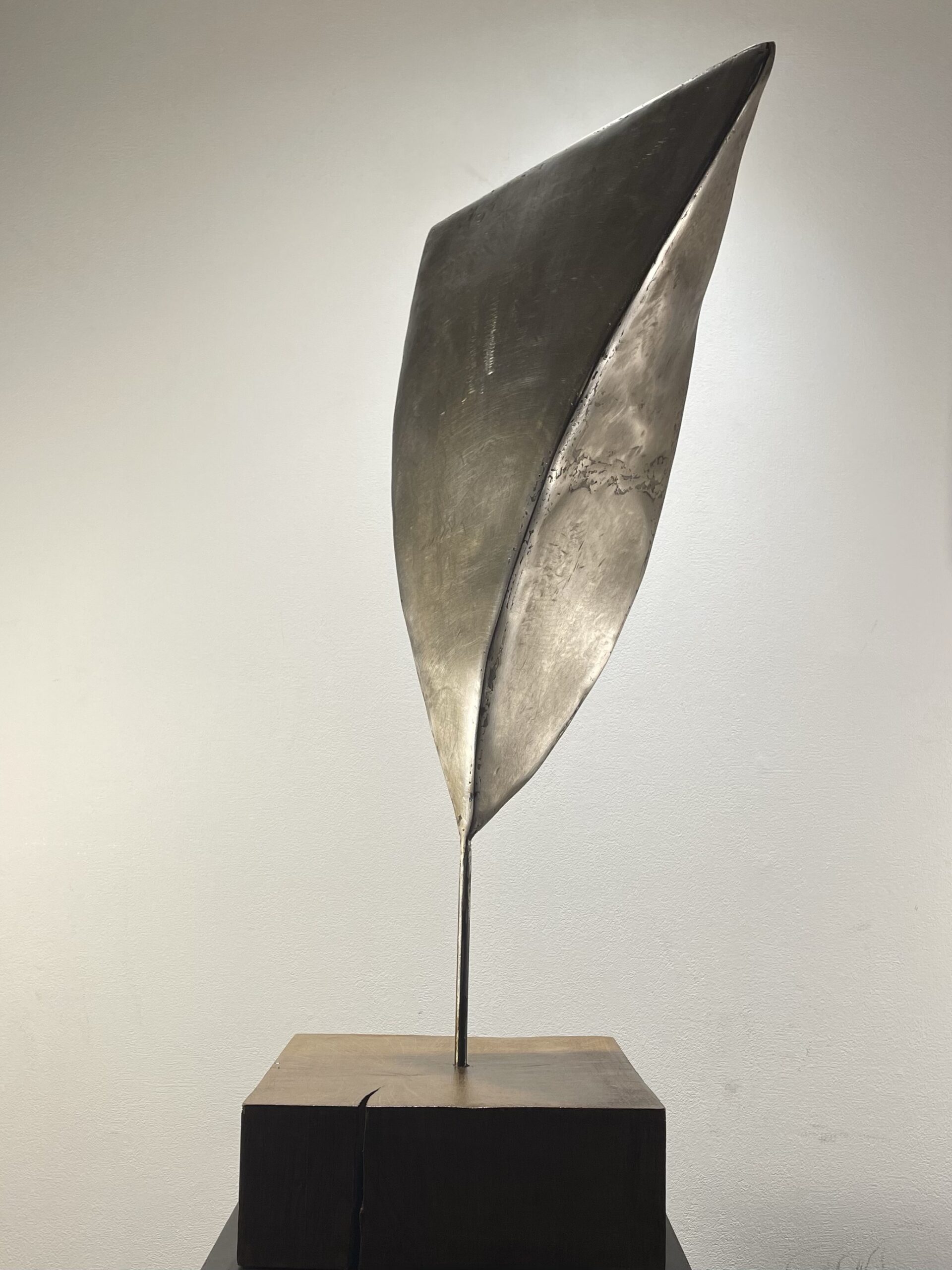
'Murmuration' captures the fluid grace of motion in a form that is both elegant and imposing. Drawing inspiration from the mesmerizing patterns created by flocks of birds in flight, this steel sculpture mimics the organic yet structured movement of nature.
The sleek, curved shape suggests a moment of suspended motion, a single point within the swirling, ever-changing formation of a murmuration.
The raw texture of the steel contrasts with its aerodynamic form, grounding the piece in the industrial, while evoking the lightness of a bird in flight.
Each angle offers a new perspective, inviting the viewer to consider the duality of strength and delicacy, the rigid and the fluid.
Through 'Murmuration,' I explore the harmony between nature and structure, questioning whether these elements are as distinct as they appear. Is the beauty of nature found in its chaos, or is it the invisible structure that guides it?
Literature, Philosophy, Myth
Several sculptures emerge directly from texts — literary, philosophical, mythological — that have shaped my thinking. Ariel – The Spirit and Ariel – The Tempest are two explorations of Shakespeare's most enigmatic creation: the spirit who serves Prospero, who is neither fully free nor fully bound, who embodies the air itself. Two works, two states of the same being — one contemplative, one unleashed.
Noppera-bo – The Mujina of the Akasaka Road draws from the Japanese ghost story collected by Lafcadio Hearn — the faceless spirit that reveals the terror of encountering a being stripped of identity. Dasein, taking its title from Heidegger's concept of "being-there," confronts the most fundamental philosophical question: what does it mean to exist, to be thrown into a world not of one's choosing?
Pythagoras – Research on Tensions #41 belongs to a broader investigation into the mathematical structures that underlie both harmony and form — the same inquiry that drives my synesthetic painting practice. Grimoire evokes the alchemist's book of secrets, an object that holds knowledge not yet revealed.
The Dance of the Siblings – The Dualism of Apollo and Artemis explores the tension between two complementary forces: reason and instinct, sun and moon, the measured and the wild. Two figures in dialogue, neither complete without the other.
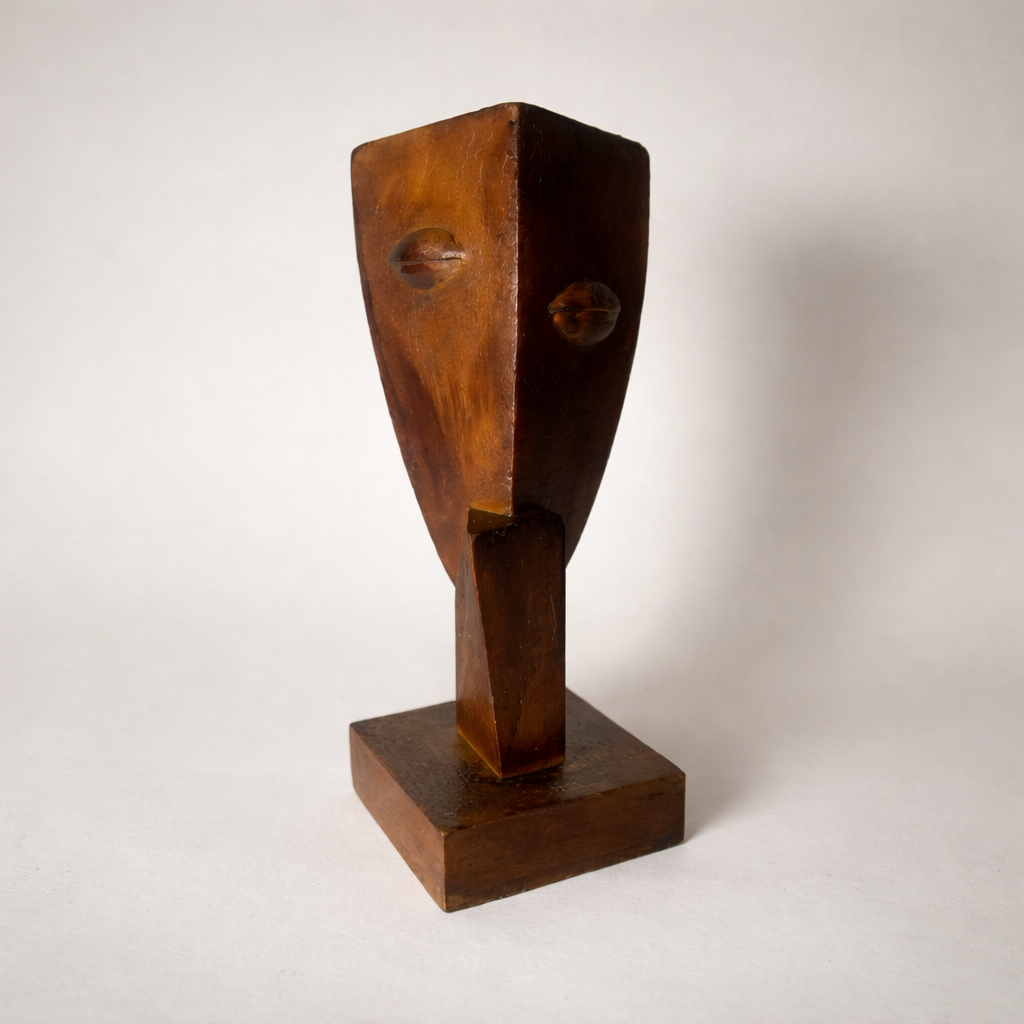
Ariel - The Spirit is a 3D printed wood PLA sculpture inspired by Shakespeare's enigmatic air spirit from The Tempest. The piece presents a simplified, geometric face—two eyes, a suggestion of nose and mouth—carved into an elongated, angular form that evokes the character's paradoxical nature: a powerful spirit bound to servitude, an invisible shapeshifter forced into visible acts.
The sculpture exploits Wood PLA filament's unique properties through a technical innovation: by orienting the model non-horizontally during printing and curving all faces, the extrusion layers flow diagonally across the surface, creating organic grain-like patterns that reference natural wood without imitating it. This material choice—plastic simulating wood—parallels Ariel's own condition as ethereal essence forced into material form.
The enigmatic face is deliberately abstracted, neither fully present nor fully revealed, inviting viewers to project their own interpretations onto its minimal features. Like the spirit who takes many forms in Shakespeare's play, the sculpture exists in the space between recognition and mystery, substance and suggestion.v
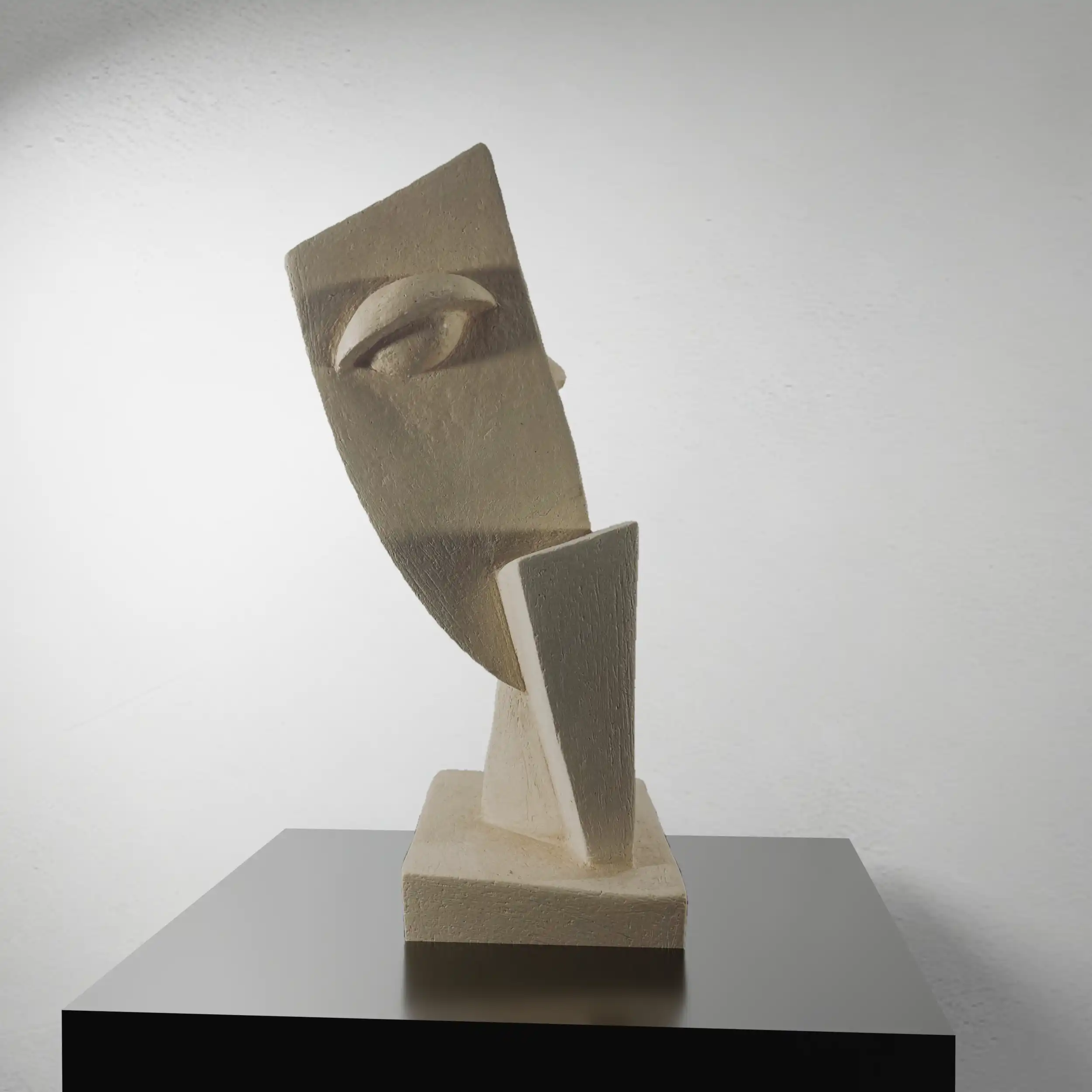
This ceramic sculpture represents a material and formal evolution from my 2022 work "Ariel - The Spirit," deepening the exploration of Shakespeare's air spirit through elemental transformation. Hand-formed in petite chamotte terra and high-fired, the piece binds the ethereal character in the heaviest element—earth itself—then seals it with beeswax using an ancient protective technique. Where the earlier Wood PLA version employed hybrid materiality (real wood particles in plastic), this ceramic iteration intensifies the paradox: an air spirit not merely contained but transmuted into pure earth and fire, with no organic traces remaining except the final wax seal, itself a product of another creature's labor.
The form abandons the minimal face of the 2022 work entirely, fragmenting instead into faceted geometric planes that capture Ariel's shapeshifting nature through cubist spatial decomposition. Rather than depicting a spirit bound into singular form, the sculpture presents a spirit arrested mid-dispersal—scattered across angular breaks and sharp edges that suggest both the violence of containment and the impossibility of full dissolution. A single hollow opening in the upper portion serves as the last vestigial trace of identity, a gap through which the spirit might escape or which admits the sculpture's own incompleteness.
The vertical composition thrusts upward from a wider base, encoding aspiration toward air and freedom even while bound in earthen weight. The diagonal lean suggests temporary equilibrium, a configuration that might at any moment collapse back into constituent fragments or reconstitute into some other form—the essential paradox of Ariel rendered as arrested motion in fired clay.
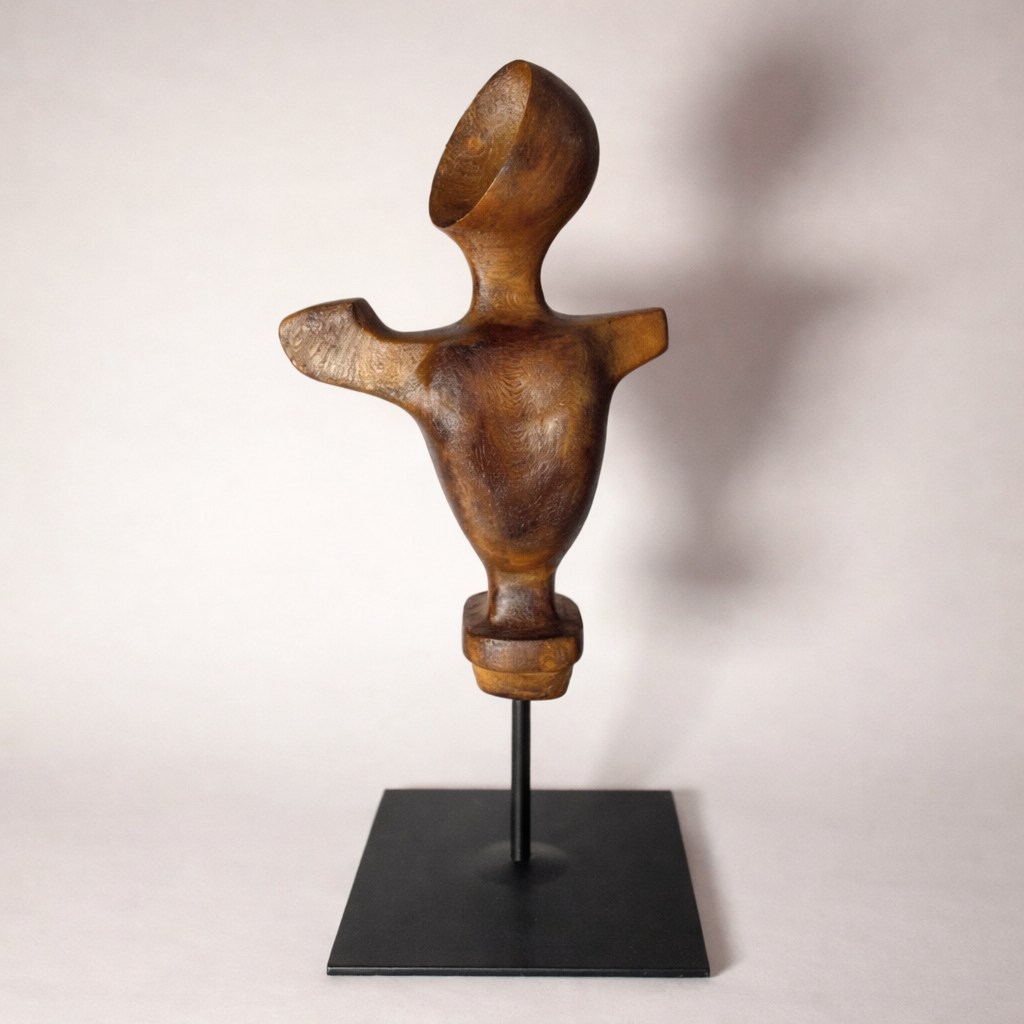
Noppera-bo - The Mujina of the Akasaka Road translates Japanese folklore through systematic material transformations. The faceless yōkai from Lafcadio Hearn's ghost story becomes a study in geometric volumes: smooth ovoid head, simplified torso, extended arms. The absence of facial features is not lack but sculptural subject—a void that confronts the viewer where recognition should occur.
Created using wood PLA filament and 3D printing, the sculpture inhabits a liminal material state between plastic and wood, echoing the yōkai's ontological uncertainty. Hand-polished surfaces and applied wood patina bridge digital fabrication with traditional craft finishing. The figure emerges from a black cylindrical base with metal support, anchoring supernatural subject matter in contemporary industrial materials.
Part of the "Spells and Magic" collection, this work applies cubist-influenced geometric reduction to mythological entities—rendering the invisible and immaterial through systematic formal constraints. The noppera-bō persists as cultural idea translated across dimensions: from oral tradition to literary account to digital model to physical sculpture, with the essential invariant—faceless encounter—surviving each transliteration.
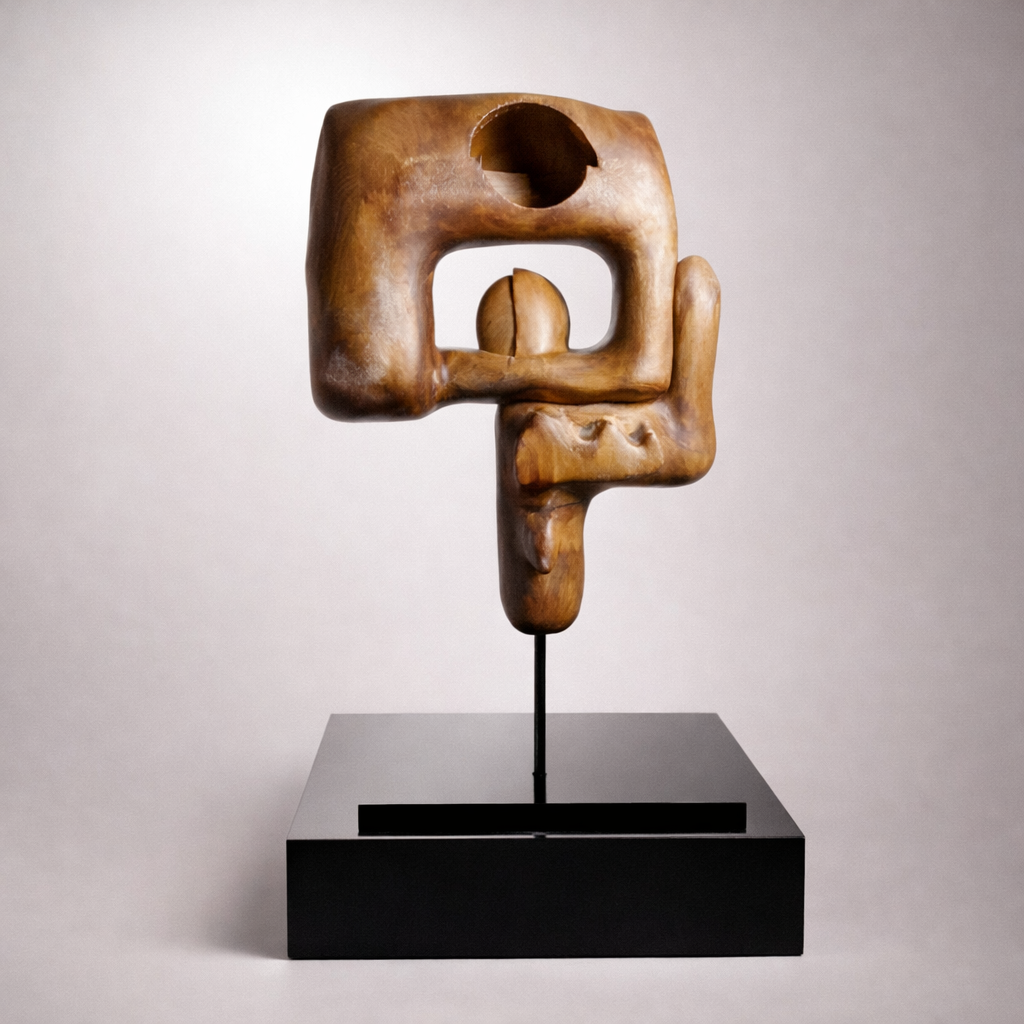
Dasein embodies Heidegger's concept of being whose existence is its own question. The sculpture's looping, self-referential form creates a structure that interrogates itself through negative space—solid and void defining each other in mutual necessity. This translates the philosopher's "ontological difference" into spatial experience: the sculpture is neither the wood form nor the empty curve, but the relationship between them, the tension that makes meaning visible.
The organic wood-grain form emerging from industrial metal support materializes Heidegger's "thrownness"—we find ourselves already embedded in conditions not of our choosing, yet must make something of this givenness. The sculpture cannot exist independently; it requires grounding, constraint, situatedness. At 40×30cm, "Dasein" represents an advancement in 3D printed wood PLA research, solving challenges of warping, support structure design, and surface refinement at sculptural scale while maintaining the honest evidence of additive fabrication.
The flowing curves suggest motion arrested mid-transformation—becoming rather than being, projection rather than settlement. Like Dasein itself, the form is always "on the way," demanding temporal engagement as the viewer circumnavigates to understand its continuous self-questioning geometry.
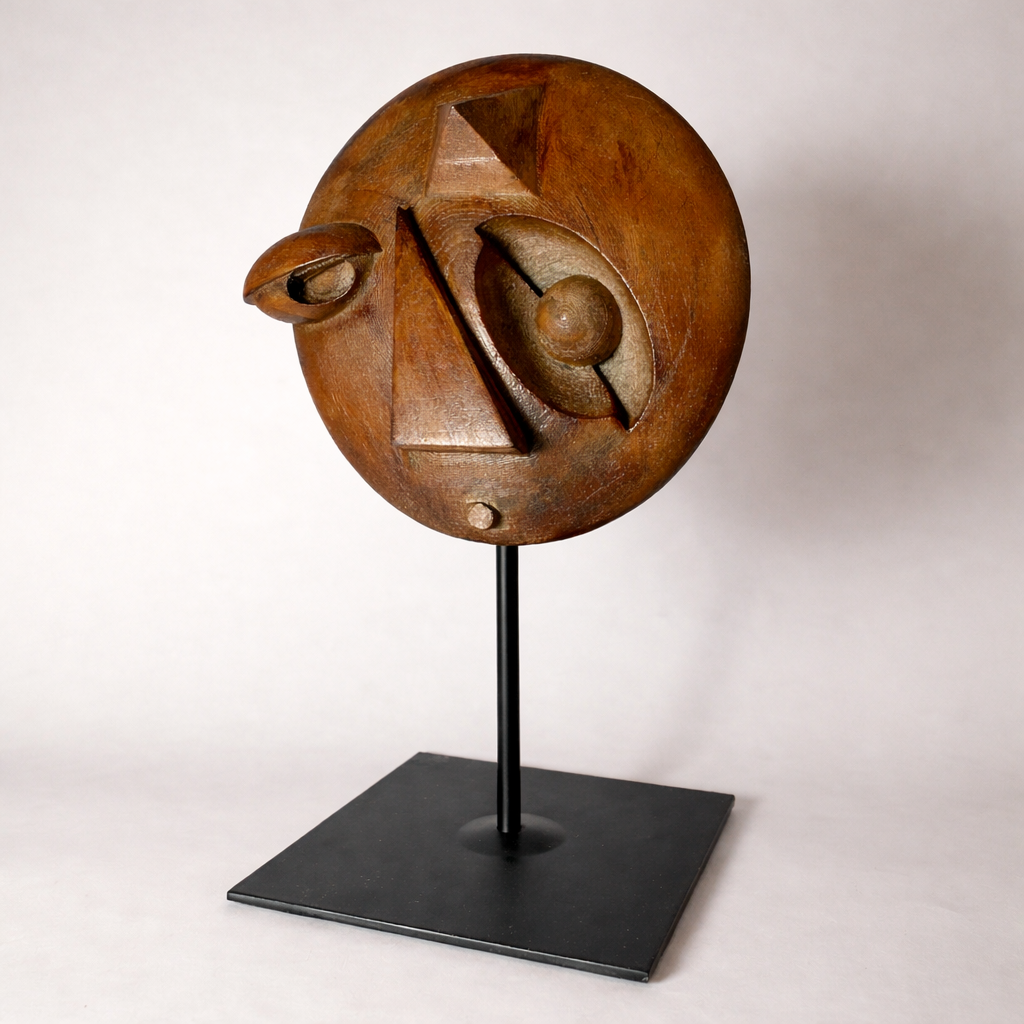
Pythagoras believed that all things were made of numbers. The number one (the monad) represented the origin of all things, manifested here as the dot and sphere. The number two (the dyad) represented matter, appearing as linear elements extending into space. The number three was an "ideal number" because it had a beginning, middle, and end - the smallest number of points that could be used to define a plane triangle, which the Pythagoreans revered as a symbol of the god Apollo. The number four signified the four seasons and the four elements, represented as the pyramid.
The concept of the "music of the spheres" incorporates the metaphysical principle that mathematical relationships express qualities or "tones" of energy which manifest in numbers, visual angles, shapes and sounds - all connected within a pattern of proportion. Pythagoras first identified that the pitch of a musical note is in inverse proportion to the length of the string that produces it, and that intervals between harmonious sound frequencies form simple numerical ratios.
This sculpture translates Pythagorean cosmology into three-dimensional geometric form through ideamorphic transliteration, where philosophical concepts preserve their structural relationships while moving from abstraction to spatial embodiment. The circular disc establishes a bounded cosmos within which the fundamental forms interact and nest - monad, dyad, triad, and tetrad made visible and tactile.
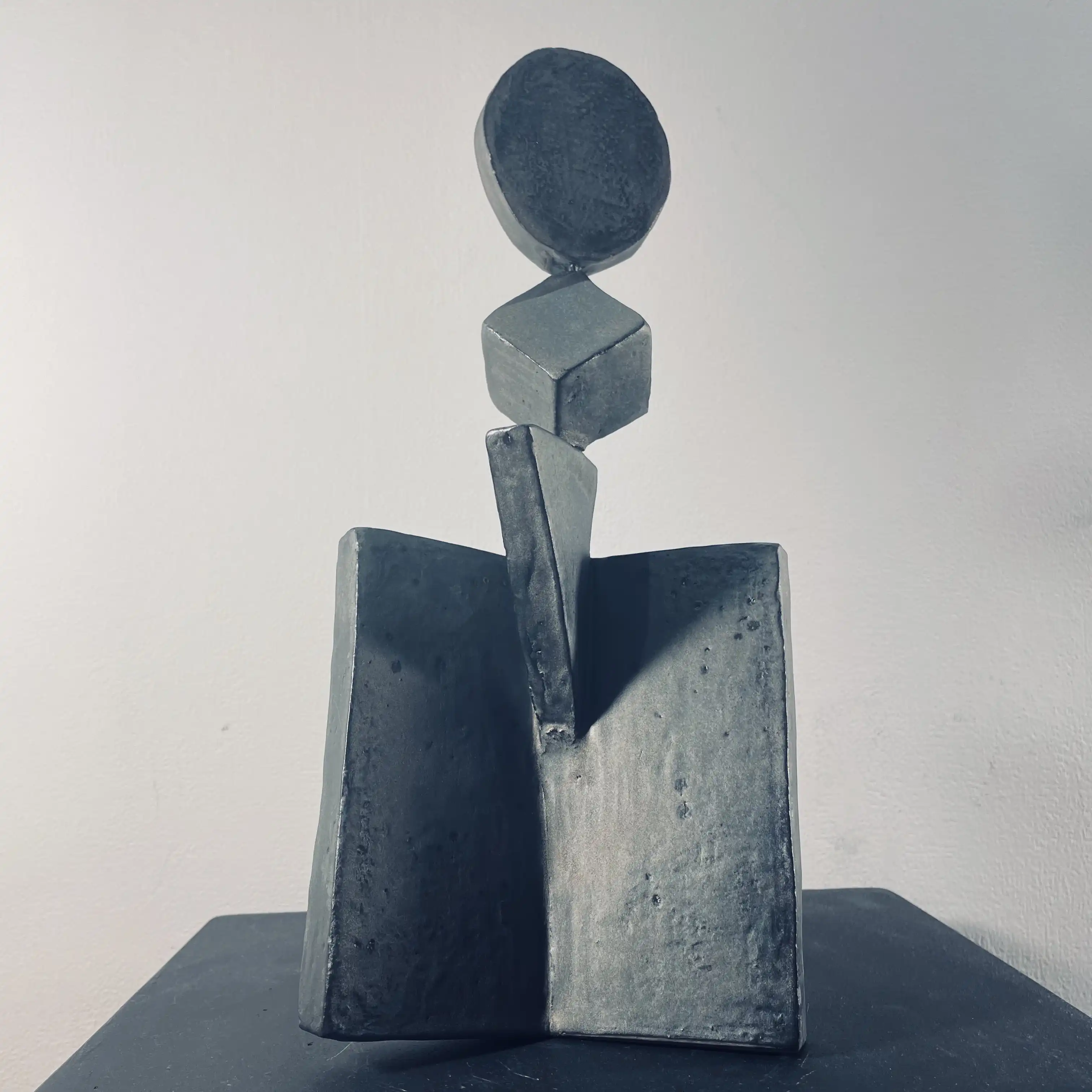
The piece features a balanced arrangement of geometric shapes, with a solid base supporting a dynamic stack of a cube, a prism, and a circle.
These shapes symbolize the spell, the magical words emerging from the book. The use of rhodium enamel gives the surface a reflective, metallic finish, enhancing the sculpture's modern aesthetic.
The juxtaposition of sharp edges and smooth curves evokes a sense of harmony and tension, representing the duality of knowledge and mystery often associated with grimoires.
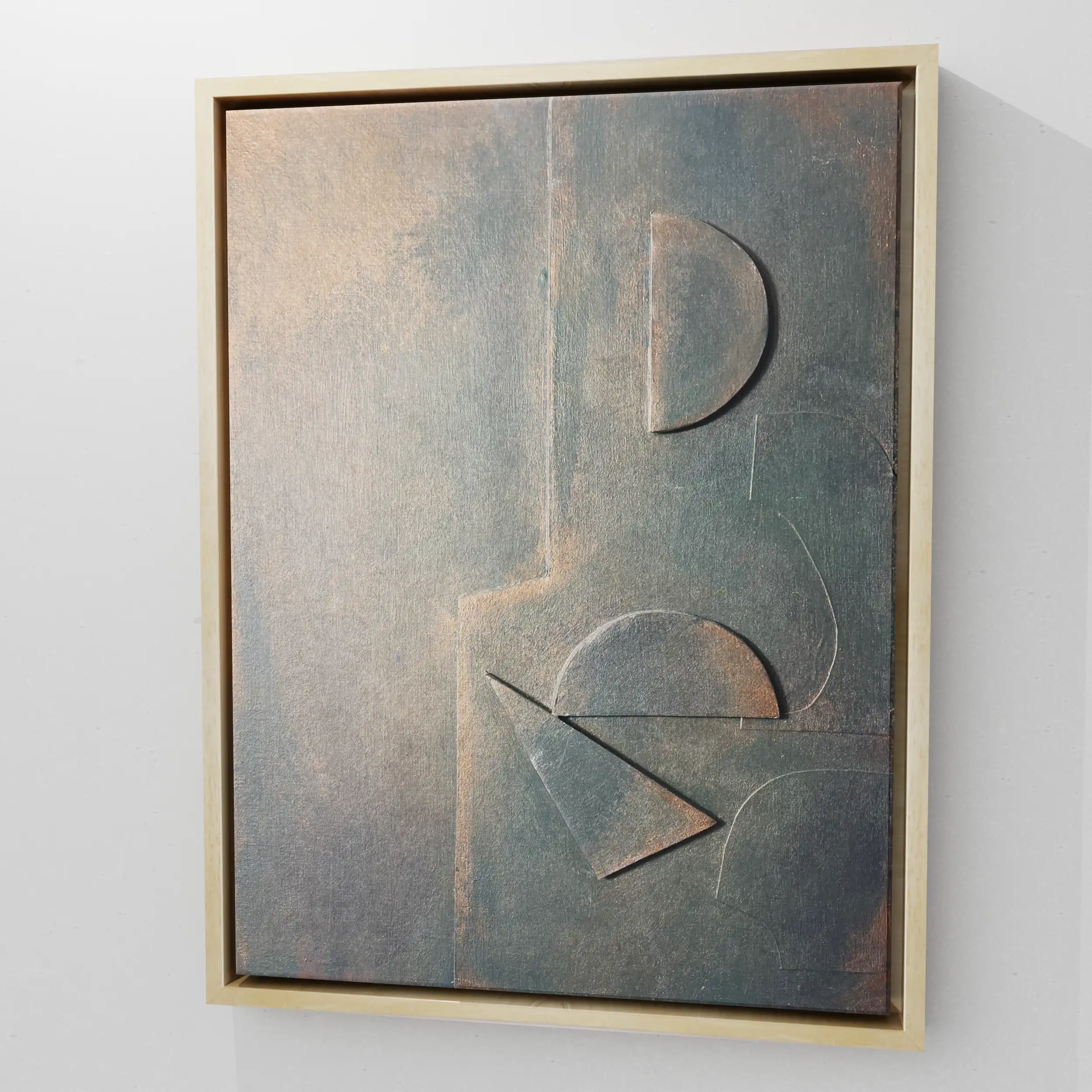
The Dance of the Siblings - The Dualism of Apollo and Artemis explores the complementary relationship between twin deities through stark compositional division. The left half remains empty—a field of light representing Apollo as pure illumination without form. The right half concentrates three geometric elements (semi-circle, circle, triangle) that together embody Artemis as material presence. The vertical axis enacts their sibling relationship: two halves of one whole, complementary rather than opposed.
This prospective work tests polystyrene as a sculptural substrate, layering fabric, plaster, gesso, and acrylic paint to create dimensional surface quality that bridges sculptural and painterly approaches. The multi-layered technique allows the mythological framework to exist as spatial structure—the viewer encounters division, geometry, emptiness, and presence as formal relationships before (or without) knowing the mythological reference.
Part of the Mediterranean Echoes collection, the work translates ancient Greek mythology into contemporary geometric language, where void and form enact the eternal dance between clarity and embodiment, light and matter.
Self-Portrait and the Artist Inside
Selfie on Oak Log stands apart — a rare self-portrait in the sculptural body of work. It is a deliberately wry gesture: the artist rendered in three dimensions, perched on a raw log of oak. Neither heroic nor ironic, it acknowledges the fundamental strangeness of making a sculpture of oneself — the hand that shapes also being the subject it shapes.
This piece connects to the broader Art Quam Anima philosophy of the "Artist Inside" — the idea that the creative process is not hidden but shared, that visitors to the gallery at 28 rue du Dragon can watch the work being made in real time. The artist is always present, always inside the work.
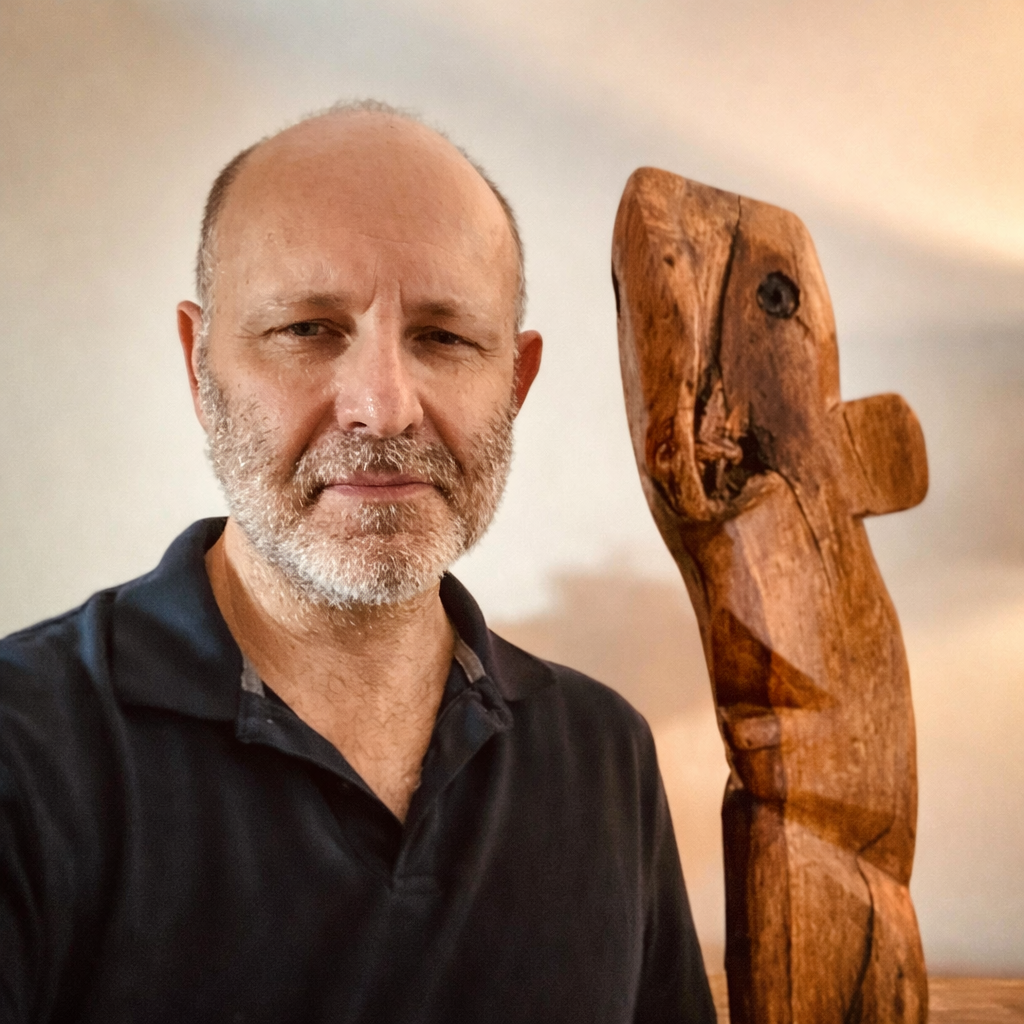
Selfie on Oak Log emerges from the artist's dialogue with found material rather than predetermined design. Working with the oak log's natural grain and form as collaborator, Quercy carved a self-portrait that amplifies rather than corrects facial asymmetries—eyes at different heights, elongated proportions, a semi-detached ear. The wood's existing structure suggested possibilities; knots became features, grain patterns emphasized irregularities. The process was playful extraction of "most obvious traits," translating face to sculpture through material constraint.
This piece refuses the idealizing tendency of traditional self-portraiture. Where classical approaches seek harmony and proportion, this carving exaggerates asymmetry and unconventional features with confident self-awareness. The result radiates assurance not through beautification but through honest observation—a face that owns its irregularities. Self-derision and humility operate through this choice: amplifying what others might minimize requires both humor about one's appearance and refusal of vanity. The oak's warmth softens what could be harsh self-assessment, lending dignity to the amplified imperfections.
Belonging to the "Untamed Creations" collection, the sculpture sits outside Quercy's systematic chromesthetic translation work, representing free artistic expression without codified constraints. Where the "Synesthetic Explorations" follow explicit rules (circle of fifths to color wheel, harmonic structure to spatial composition), this piece allowed the material itself to determine the outcome—great fun, and proof of the artist's willingness to play without the game.
Materials and Process
The sculptures in this catalog are made in two primary mediums: ceramic (created at the Atelier Profils et Reliefs in Paris under the mentorship of Isis Gondoin) and steel (welded and patinated in the studio). The ceramic works are built through slab construction, carving, and surface treatment — a methodology rooted in the profile and relief traditions that give the atelier its name. The steel works are cut, welded, ground, and finished to achieve surfaces that range from raw industrial texture to polished luminosity.
In both mediums, the process is direct and irreversible. There is no mould, no edition, no safety net. Each cut, each weld, each compression of clay is a commitment. This is what gives the work its charge — and what makes each piece unrepeatable.
Viewing and Acquisitions
All sculptures can be viewed in person at Art Quam Anima, 28 rue du Dragon, Saint-Germain-des-Prés, Paris 6e. The gallery is open every day from 11am to 8pm. Coffee is offered. Prices are displayed openly. Private viewings for architects, interior designers, and collectors can be arranged.
For acquisitions, commissions, or to discuss site-specific sculptural projects: 📩 contact@artquamanima.com
© 2026 Arnaud Quercy
Documentation published by Art Quam Anima Publishing New York, LLC
Artwork presented by Art Quam Anima, 28 rue du Dragon, Paris
All rights reserved. Reproduction prohibited without written permission.