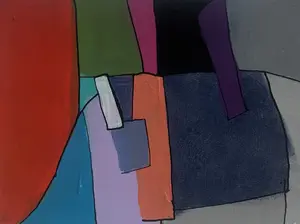
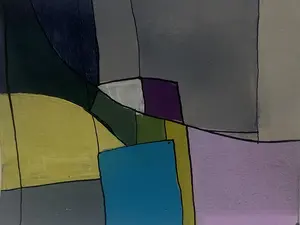
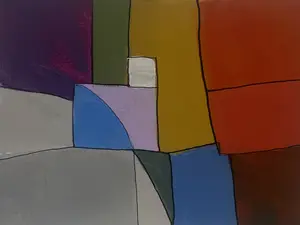
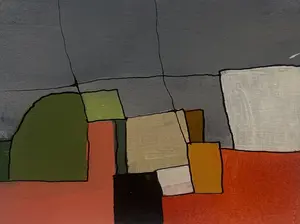
72 Facets of Paris collection — 72 Artworks in 11 Series by Arnaud Quercy


72 Facets of Paris is a collection of 72 works across 11 series. All works in this collection are held in private collections (Paris, France).
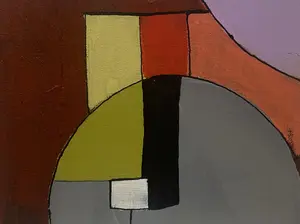
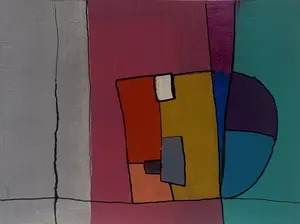
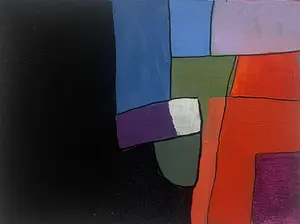
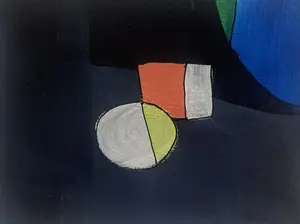
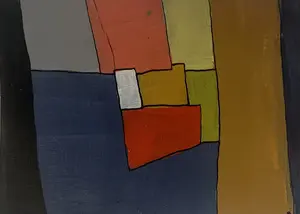
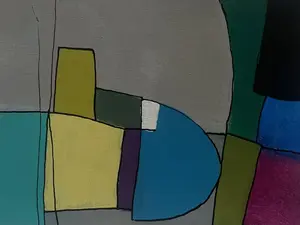
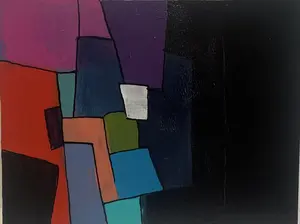
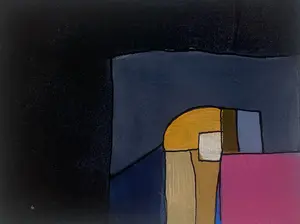
72 Facets of Paris is a single work in seventy-two parts — a piano waltz of the same name turned into a painted portrait of the city across a full day. The artist began from a stroll through Paris, gave each of the waltz's seventy-two measures the harmony of a particular place at a particular hour, composed the music, then painted each harmony into colour and form through his ideamorphic method. Music, map and clock are one: every measure is a place, every place an hour, every chord a palette.
The cycle runs from midnight to midnight, one facet every twenty minutes. It opens with an eight-measure prelude played ad lib — soft, mysterious, suspended — then settles into the waltz's three-time (160 to the bar) as the city wakes, rising through the morning to a luminous midday peak and easing back, measure by measure, into the night: a full bell-curve of light and intensity. Geographically it traces a loop through eleven of the city's grandest arrondissements — the 1st, 2nd, 3rd, 4th, 5th, 6th, 7th, 16th, 17th, 8th and 9th — beginning in the historic heart at the Louvre and closing near the Opéra, where the 9th touches the 1st and the day begins again.
Harmony is the hinge. Grave, archaic chords — minor-major sevenths, half-diminisheds — fall on the oldest and most sacred Paris and translate to near-black and stone; extended minor ninths take the old residential streets, and in the 16th the Art Nouveau of Guimard, into clouded jewel tones; major sevenths and ninths light the haussmannian boulevards in warm ochre and red at the height of the day; dominant sevenths carry the cafés and markets; a lydian eleventh is kept for the great public edifices — the Panthéon at nine in the morning, the Opéra Garnier at night. The colour is never arbitrary: it is the sound of the place, made visible.
Each of the seventy-two is a small painting — acrylic on paper, eighteen by thirteen centimetres — and each is also a single tile. Arranged nine columns wide and eight rows tall, in the order of the score, they assemble into one large mosaic: an abstract portrait of Paris over twenty-four hours, dark at its nocturnal edges, blazing warm at its midday centre. Read alone, each facet is a place and an hour; read together, they are the city breathing through a day.
Conceived and painted as a single commission, the seventy-two facets — and their eleven arrondissement-series — belong together to one Paris collection: a waltz, a city, and a day, held in seventy-two colours.
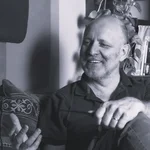
Arnaud Quercy is a Parisian artist working across painting, music, and sculpture. His practice is grounded in Ideamorphism — the principle that a work of art does not carry meaning, but triggers it. Each piece is engineered to diffract differently through each person who encounters it.
He creates and exhibits at Art Quam Anima, his gallery-atelier at 28 rue du Dragon, Saint-Germain-des-Prés, Paris.
Series — 72 Facets of Paris