Paris 3rd arrondissement, before dawn series — 6 Paintings by Arnaud Quercy
ART-SER0066


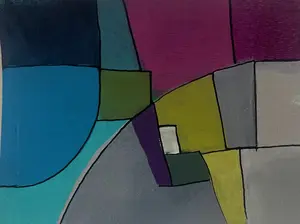
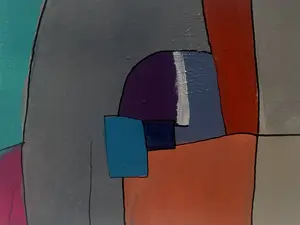
Paris 3rd arrondissement, before dawn is a series of 6 paintings by Arnaud Quercy, created in 2026 in acrylic on paper. Format: 18×13 cm. All 6 works in this series are held in private collections (Paris, France).
The third arrondissement-series of 72 Facets of Paris belongs to the hour before dawn. Its six facets cover the Haut-Marais between twenty past four and six in the morning, when the sky has begun to pale and the waltz, after the suspended prelude, quickens into its three-time turning. This is the Paris of old hôtels and narrow trade-streets caught between night and the working day — the covered market not yet open, the bakery's oven already lit, the haussmannian stone taking its first grey light. The cycle's slow nocturnal breath is over here; the dance has found its pulse and the city is about to wake.
The harmonies gathered in the 3rd are richer and more mobile than the prelude's archaic chords. Three minor-ninth sonorities — B♭−9 and a pair of E♭−9 — carry a cool, expectant tension; two dominant sevenths, A♭7 and G♭7, push the music forward with restless colour; and the luminous D♭maj9, sounded twice, opens the daylight that the others have been promising. Translated through the artist's ideamorphic method, these harmonies render as fields of grey and blue-lavender broken by warm accidents — red-orange, magenta, lime — and increasingly by arcs of teal and blue: the very gesture of light arriving on stone, the palette tilting from the held breath of night toward the first clear morning.
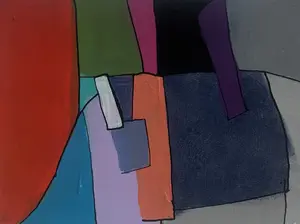
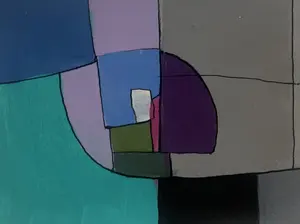
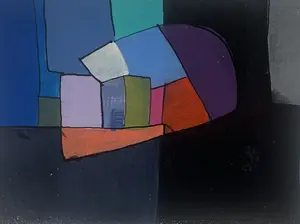
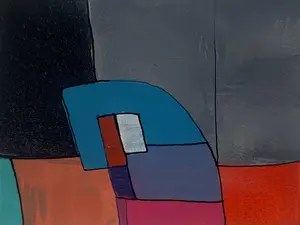
The six places trace a short circuit through the quarter. The old hôtels of rue de Saintonge open the series at twenty past four under B♭−9, red-orange, green and purple blocks over a grey field and a white square — the first paling of the sky. At twenty to five rue de Poitou answers in E♭−9, teal and lavender with a purple arc, the Marais holding its breath. At five the Marché des Enfants Rouges on rue de Bretagne — the oldest covered market, waking to its first deliveries — sounds E♭−9 against A♭7 in blue and lavender, a magenta arc, orange and olive. Then the daylight chord arrives: rue de Turbigo, the haussmannian cut, at twenty past five in D♭maj9, greys opened by a blue arc and a flash of red. A bakery on rue de Turenne follows at twenty to six on G♭7, a teal arc with magenta and lime-green over grey — the oven lit before the street. And at six the haussmannian blocks by the Square du Temple close the series in D♭maj9: a broad grey disc, a purple block, blue and red-orange — railings at dawn.
Seen together, the six compose a field on the turn — grey and blue-lavender grounds shot through with warm sparks and, as the hour advances, with widening arcs of teal and blue, the colour of light spreading over stone. They are the cycle's first quickening, the moment the day begins to assert itself in the mosaic. Like the full cycle of seventy-two, these six facets were commissioned together and now belong to a single Paris collection.
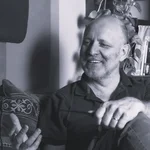
Arnaud Quercy is a Parisian artist working across painting, music, and sculpture. His practice is grounded in Ideamorphism — the principle that a work of art does not carry meaning, but triggers it. Each piece is engineered to diffract differently through each person who encounters it.
He creates and exhibits at Art Quam Anima, his gallery-atelier at 28 rue du Dragon, Saint-Germain-des-Prés, Paris.
Works — Paris 3rd arrondissement, before dawn