Paris 6th arrondissement, toward noon series — 7 Paintings by Arnaud Quercy
ART-SER0069


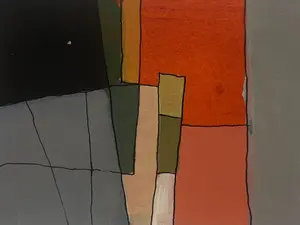
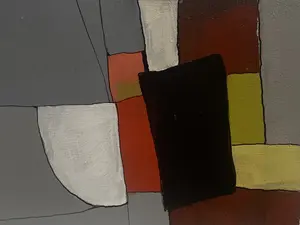
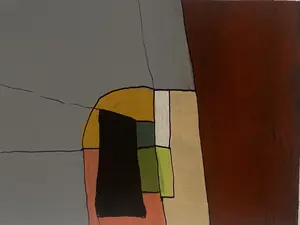
Paris 6th arrondissement, toward noon is a series of 7 paintings by Arnaud Quercy, created in 2026 in acrylic on paper. Format: 18×13 cm. All 7 works in this series are held in private collections (Paris, France).
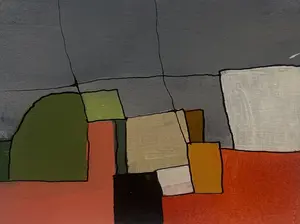
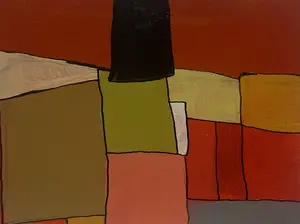
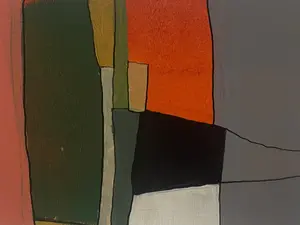
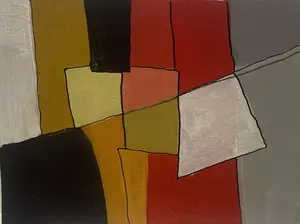
The midday peak of 72 Facets of Paris — the moment the whole cycle has been climbing toward. Where the prelude lay in near-darkness and the earlier series rose measure by measure into the day, these seven facets stand at the summit: section B of the waltz, played at its warmest and most luminous height, between twenty to eleven and twenty to one. They cover the 6th arrondissement, the heart of Saint-Germain-des-Prés, when the sun is overhead, the long façades are in full light, and the city is at its busiest and most golden hour.
Their harmonies are the open, radiant major sevenths of high noon. Every facet rests on FMaj7 or GMaj7 — bright, unshadowed chords with none of the prelude's grave ambiguity, the sound of a day at its broadest. Translated through the artist's ideamorphic method, these luminous harmonies pour into warm light: ochre and tan, gold and yellow-green, coral and red-orange, with olive uprights and white squares breaking across the grey of stone. Where the 1st was a wall of black and blue, the 6th is colour brought to its height — the canvases open, sunlit, alive.
The seven places trace the late-morning surge of the quarter. The boulevard Saint-Germain opens the series at twenty to eleven, GMaj7 drawing grey into green and olive, coral and ochre, a white square — the warm flow of late morning. The Carrefour de l'Odéon follows at eleven on FMaj7, ochre and tan, olive and yellow, a black block and red at the crossroads' busiest. At twenty past eleven the rue de Rennes rises on GMaj7 in olive-green uprights and orange, long façades in full light; then the Place Saint-Sulpice at twenty to noon, FMaj7 in gold and yellow-green, the fountain square at its brightest. At noon itself the boulevard Raspail holds the height of the day on stone, GMaj7 in grey, olive and red-orange. The haussmannian block at 47 rue de Sèvres answers at twenty past twelve, FMaj7 tracing a white arc and noon light across the façade; and at twenty to one the rue de Médicis, facing the Luxembourg, closes the peak on GMaj7 — a golden arc, olive and coral, lunch beside the garden.
Seen together, the seven compose the cycle's brightest and warmest field — a band of ochre, gold and coral lit by white squares, the visual summit toward which the prelude held its breath. It is midday made colour: the moment the day and the waltz reach their full light before the long descent begins. Like the full cycle of seventy-two, these seven facets were commissioned together and now belong to a single Paris collection.
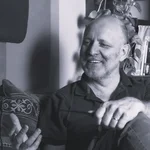
Arnaud Quercy is a Parisian artist working across painting, music, and sculpture. His practice is grounded in Ideamorphism — the principle that a work of art does not carry meaning, but triggers it. Each piece is engineered to diffract differently through each person who encounters it.
He creates and exhibits at Art Quam Anima, his gallery-atelier at 28 rue du Dragon, Saint-Germain-des-Prés, Paris.
Works — Paris 6th arrondissement, toward noon