Paris 9th arrondissement, nightfall series — 6 Paintings by Arnaud Quercy
ART-SER0074


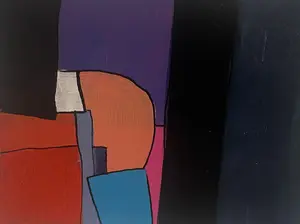
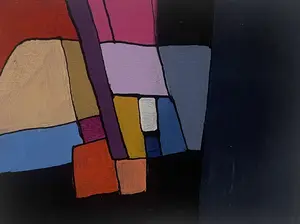
Paris 9th arrondissement, nightfall is a series of 6 paintings by Arnaud Quercy, created in 2026 in acrylic on paper. Format: 18×13 cm. All 6 works in this series are held in private collections (Paris, France).
The closing series of 72 Facets of Paris — and the work's last word. After ten arrondissement-series have carried the waltz across a full day and night in strict three-time, these six facets bring it home: night has fallen over the 9th arrondissement, and between ten and twenty to midnight the dance slows, gathers itself, and circles back toward the prelude. This is the Paris of the great lit theatres and the romantic hill — the Opéra Garnier and the Nouvelle Athènes, Pigalle and the Grands Boulevards — the city at full nocturnal pitch, even as the music begins, measure by measure, to fade back into the dark from which it first rose.
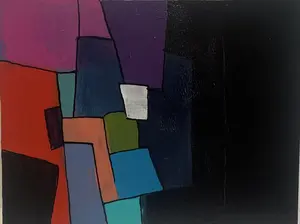
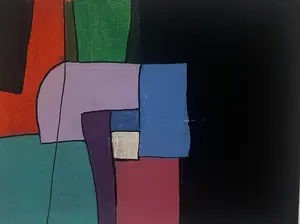
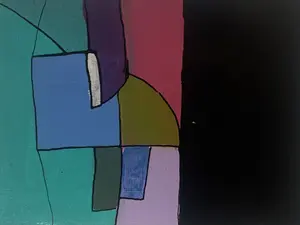
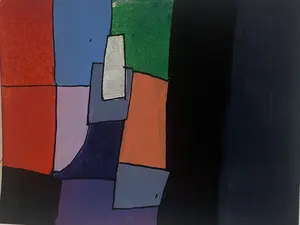
The harmonies of this final stretch are rich and worldly, dominant sevenths and lush ninths gilded with tension. Two facets turn on altered dominants (A♭7, E♭7♯11), the bright glare of late-night neon; others lean on the warm ninth (B♭−9, D♭maj9) and on the smoky minor seventh (E♭−7, F−7), with B♭7 driving the cadence at the very end. Translated through the artist's ideamorphic method, these chords blaze out of the night: magenta and orange, lavender and purple, teal and votive red, all surging from wide fields of black and deep navy — the city's lights burning against the dark, form emerging only where the colour catches fire.
The six places trace a last nocturnal circuit. The place Saint-Georges, heart of the Nouvelle Athènes laid out in 1824, opens at ten on B♭−9, its romantic façades in magenta and blue, navy and green, orange and teal, a white square against black. Twenty minutes on, the Opéra Garnier rises on E♭7♯11 — the great lit public palace, red and green, lavender and purple, blue and white surging from the night. At twenty to eleven the rue des Martyrs in SoPi answers on E♭−7, the village street alive with teal and a blue square, purple and an olive half-disc, lavender against black; then the bars of the place Pigalle at eleven on A♭7, green and red, blue and orange, purple over deep navy at full tilt. The boulevard des Italiens follows at twenty past eleven on D♭maj9, purple and an orange arc, red and blue, magenta on a wide field of dark navy. And at twenty to midnight the Théâtre des Variétés on the boulevard Montmartre closes the cycle on F−7 and B♭7 — tan and magenta, purple and orange, blue and grey edging into black: the last facet, the curtain falling as the day returns to night.
Seen together, the six compose the cycle's most luminous nocturne — a dark field shot through with theatre-light and neon, the warm chords flaring where the still, grave canvases of the prelude held only a single lamp. Where the 1st was a held breath at the bottom of the night, the 9th is the dance spending its last brilliance before the bar dissolves and the music turns back to its opening. The curtain falls; the prelude waits to begin again. Like the full cycle of seventy-two, these six facets were commissioned together and now belong to a single Paris collection.
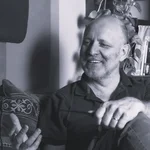
Arnaud Quercy is a Parisian artist working across painting, music, and sculpture. His practice is grounded in Ideamorphism — the principle that a work of art does not carry meaning, but triggers it. Each piece is engineered to diffract differently through each person who encounters it.
He creates and exhibits at Art Quam Anima, his gallery-atelier at 28 rue du Dragon, Saint-Germain-des-Prés, Paris.
Works — Paris 9th arrondissement, nightfall