Paris 16th arrondissement, the waning afternoon series — 7 Paintings by Arnaud Quercy
ART-SER0071


Paris 16th arrondissement, the waning afternoon is a series of 7 paintings by Arnaud Quercy, created in 2026 in acrylic on paper. Format: 18×13 cm. All 7 works in this series are held in private collections (Paris, France).
A series of seven facets from 72 Facets of Paris, the cycle born of a piano waltz of the same name: the artist gave each of its seventy-two measures the harmony of a Parisian place at a given hour, then painted each harmony into colour and form through his ideamorphic method. These seven cover the 16th arrondissement across the waning afternoon, from twenty past three to twenty past five — the dance still full and warm at first, then easing measure by measure as the light declines over Passy and Auteuil. It is the quietest, most patrician quarter of the western city, and its residential genius is architectural: the Art Nouveau of Hector Guimard and the Modernism of Robert Mallet-Stevens, an arrondissement that reads less as monument than as a museum of the dwelling itself.
Their harmonies are the cycle's richest and most clouded. Five of the seven rest on extended minor ninths — E♭−9 and B♭−9 — luminous yet shadowed chords whose added tension never quite resolves; the two earliest lean on FMaj7 and on the warmer pairing of F−7 and B♭7, the last full breath of the afternoon before the turn. Translated through the ideamorphic method, these sonorities fall to jewel tones: magenta and purple, teal and lavender, deep blue threaded with sudden olive, ochre and a burning orange — colours that glow against grey-blue stone the way stained glass glows against late light, the canvases growing more interior and more saturated as the hour wanes.
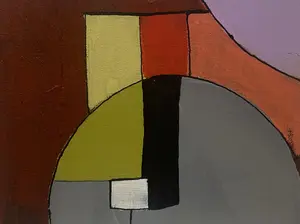
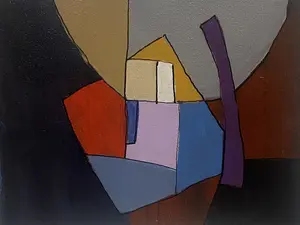
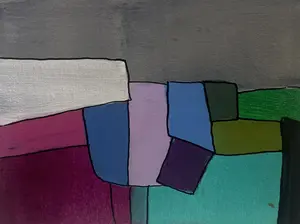
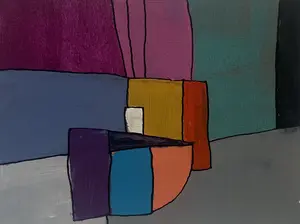
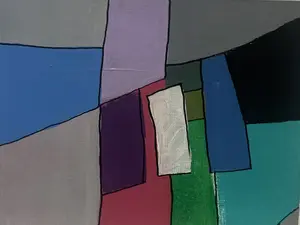
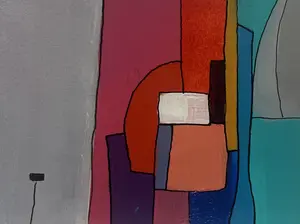
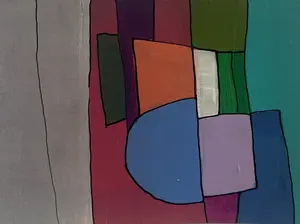
The seven trace a slow westward circuit through the quarter. From FMaj7, the grand bourgeois avenue Georges-Mandel opens at twenty past three — maroon and yellow-green, red and black, a grey disc and lavender, wide stone in the waning light; from F−7 and B♭7, the village high street of rue de Passy answers at twenty to four, red-orange and blue, a purple upright among the shops of the old Passy lane. Then Auteuil and the Art Nouveau: at four, E♭−9 draws Guimard's Castel Béranger on rue La Fontaine — Paris's first Art Nouveau apartment building (1898) — in white, magenta, blue, purple, green and teal, restless interlocking forms; at twenty past four, B♭−9 gives Guimard's Hôtel Mezzara on the same street, grey-blue and magenta, ochre and red, purple and an orange arc; at twenty to five, E♭−9 renders Guimard's buildings at 8–10 rue Agar (1911), blue and lavender, purple and magenta, a white bar over teal. At five, B♭−9 turns to Guimard's own Hôtel Guimard on avenue Mozart — grey and magenta, a burning orange disc, white, blue and teal, the architect's house in the failing light. At twenty past five, E♭−9 closes on the Modernist rue Mallet-Stevens (Robert Mallet-Stevens, 1927): grey and magenta, olive and orange, a blue arc and lavender, a single white square — clean geometry holding the last of the afternoon.
Seen together, the seven compose a field of clouded jewel tones over grey-blue stone — the broad avenues warm at the edges, the Auteuil interior deepening toward magenta and teal as the waltz settles. It is the visual equivalent of an afternoon letting go: the architectural quarter of Paris, its curves and its clean lines alike, caught in the harmony of the easing hour. Like the full cycle of seventy-two, these seven facets were commissioned together and now belong to a single Paris collection.
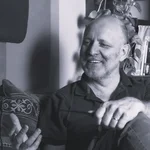
Arnaud Quercy is a Parisian artist working across painting, music, and sculpture. His practice is grounded in Ideamorphism — the principle that a work of art does not carry meaning, but triggers it. Each piece is engineered to diffract differently through each person who encounters it.
He creates and exhibits at Art Quam Anima, his gallery-atelier at 28 rue du Dragon, Saint-Germain-des-Prés, Paris.
Works — Paris 16th arrondissement, the waning afternoon
Related hubs
Catalogue raisonné entries 7
- Avenue Georges-Mandel - Paris 16, 15h20
- Rue de Passy, commerces - Paris 16, 15h40
- 14 rue La Fontaine — Castel Béranger - Paris 16, 16h00
- 60 rue La Fontaine — Hôtel Mezzara - Paris 16, 16h20
- 8 rue Agar — ensemble Guimard - Paris 16, 16h40
- 122 avenue Mozart — Hôtel Guimard - Paris 16, 17h00
- Rue Mallet-Stevens — ensemble Art déco - Paris 16, 17h20