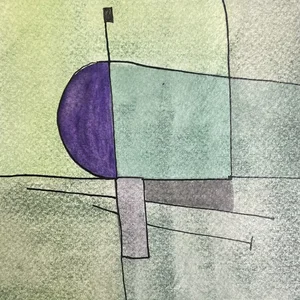
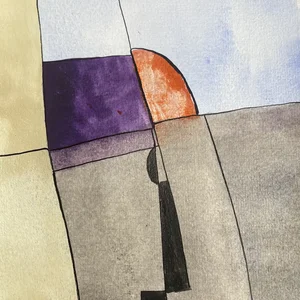
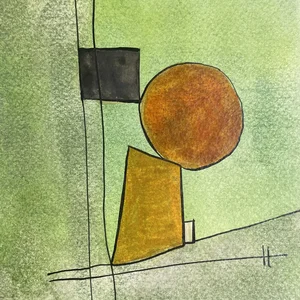
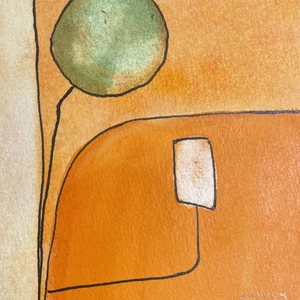
G Minor - Variation 8 — Watercolor on Paper by Arnaud Quercy
Watercolor on Paper, 10.0×15.0cm
Arnaud Quercy, 2025 — France
Where Mozart's melancholy G minor becomes visible through color.
Technical Specifications
- Medium: Watercolor on Paper
- Dimensions: 10.0×15.0cm
- Weight: 0.1 kg
- Created: 2025, France
- Certificate: 20250125-0062
- SKU: Arnaud Quercy Creations / AQC0866 / 2025
- ✓ Original artwork, hand-painted by Arnaud Quercy
- ✓ Certificate of authenticity included

Arnaud Quercy is a Parisian artist working across painting, music, and sculpture. His practice is grounded in Ideamorphism — the principle that a work of art does not carry meaning, but triggers it. Each piece is engineered to diffract differently through each person who encounters it.
He creates and exhibits at Art Quam Anima, his gallery-atelier at 28 rue du Dragon, Saint-Germain-des-Prés, Paris.
About This Artwork
This watercolor translates the G minor chord into visual form through harmonic-chromatic mapping, converting musical notes into color relationships based on the circle of fifths. By assigning red-orange to G, purple to B-flat, and orange to D, the artist bridges sound and sight in a ten by fifteen centimeter composition that makes Mozart's melancholy G minor visible through color.
Warm orange tones fill most of the surface, with goldenrod appearing most prominently alongside rich chocolate orange. Violet colors create substantial presence throughout, including medium purple, slate blue, and deeper violet tones that establish the harmonic structure. Yellow-orange provides bright accents, while red-violet adds depth in scattered areas. The watercolor medium allows these colors to layer and blend, creating smooth transitions where geometric shapes meet organic color flows.
The compact format requires close viewing to perceive how the G minor chord manifests through these color relationships. As Variation 8 in the Harmonic Crossing collection, this piece demonstrates how harmonic-chromatic mapping converts specific harmonic structures into corresponding visual form. The work connects to famous G minor compositions including Mozart's Symphony No. 40 and Joseph Kosma's jazz standard "Autumn Leaves."
The work includes certificate of authenticity number 20250125-0062 and bears the artist's signature at the bottom right. Created in France in 2025, this piece represents contemporary exploration of cross-modal sensory translation through watercolor on paper.
Where this work lives
Provenance
- Origin: Arnaud Quercy, Paris, France, 2025
- Acquired: 2025-10-18 — Private collection — USA during Permanent Collection 2025 – Resonance in Form
- Series: G minor
- Collection: Harmonic Crossing
- Technique: Watercolor
Exhibitions 5
- Permanent Collection 2025 – Resonance in Form (2025-01-01 → 2025-12-31, arnaudquercy.art, Paris)
- Paris Studio Visit (2025-02-18 → 2025-02-18, Artist's Studio, Paris)
- Marché d'Art Contemporain – Seine Port (2025-05-17 → 2025-05-17, MAC Seine-Port, Seine-Port)
- Nuit des Artistes, St Germain-en-Laye, France (2025-05-24 → 2025-05-24, La Nuit des Artistes, Saint-Germain-en-Laye)
- Marché de l'Art de Saint-Germain-en-Laye, 17ème édition – France (2025-06-14 → 2025-06-14, Marché de l'Art, Saint-Germain-en-Laye)
Other works in this series 15
- G minor - Research on Harmony
- G minor - Research on Harmony - Variation 1
- G minor - Research on Harmony - Variation 2
- G Minor - Research on Harmony - Variation 3
- G Minor - Research on Harmony - Variation 4
- G Minor - Research on Harmony - Variation 5
- G Minor - Research on Harmony - Variation 6
- G Minor - Research on Harmony - Variation 7
- G Minor - Research on Harmony - Variation 10
- G Minor - Research on Harmony - Variations 11
- G Minor - Research on Harmony - Variations 12
- G Minor - Research on Harmony - Variations 13
- G Minor - Research on Harmony - Variations 14
- G Minor - Research on Harmony - Variations 15
- G Minor - Research on harmony - Variation 16
Documented at 2
Thematic Elements 10
Testimonials
Genuine reactions from collectors and viewers around the world
Viewer noted that major keys are often described as luminous and festive, characterized by simplicity of tonality. This principle applies effectively to the simplicity of this contemporary artwork, generating strong enthusiasm.
Follower observed that developing narrative through complex color relationships represents an effective approach to visual presentation.
Visitor expressed strong aesthetic appreciation for the composition and subtle color harmonies present in the work.
Gallery professional responded positively to the execution quality and visual impact of the harmonic-chromatic translation approach.
Collector noted the distinctive integration of musical structure into visual form, finding the approach both intellectually engaging and aesthetically satisfying.