Caroline Lopez — A moment with you
At the Luxembourg, empty chairs are the most inhabited.
A Moment with You — Caroline Lopez
The Empty Chair as Philosophical Subject
There is a temptation, when encountering Caroline Lopez's A Moment with You, to reach immediately for Van Gogh. The empty chair is one of the most loaded motifs in the Western tradition, and Van Gogh is its most famous practitioner: his 1888 paintings of his own rush-seated chair and Gauguin's more elaborate armchair were understood from the beginning as portraits of absence, each chair standing in for a person who was not, or would not be, there. The comparison is not wrong. But it is incomplete, and Lopez's series does something more systematic, more architecturally conceived, and ultimately more philosophically rigorous than the tradition it inherits. Van Gogh's chairs are portraits of specific individuals. Lopez's chairs are a portrait of gathering itself — of the structure of human proximity, the fact of people sitting near one another in a public garden, the residue that remains when they leave. She is not mourning a person. She is investigating what presence leaves behind, and what it means to keep returning to the place where it was.
The Series and Its Architecture
A Moment with You unfolds in four distinct movements, each representing a methodological shift as much as a stylistic one.
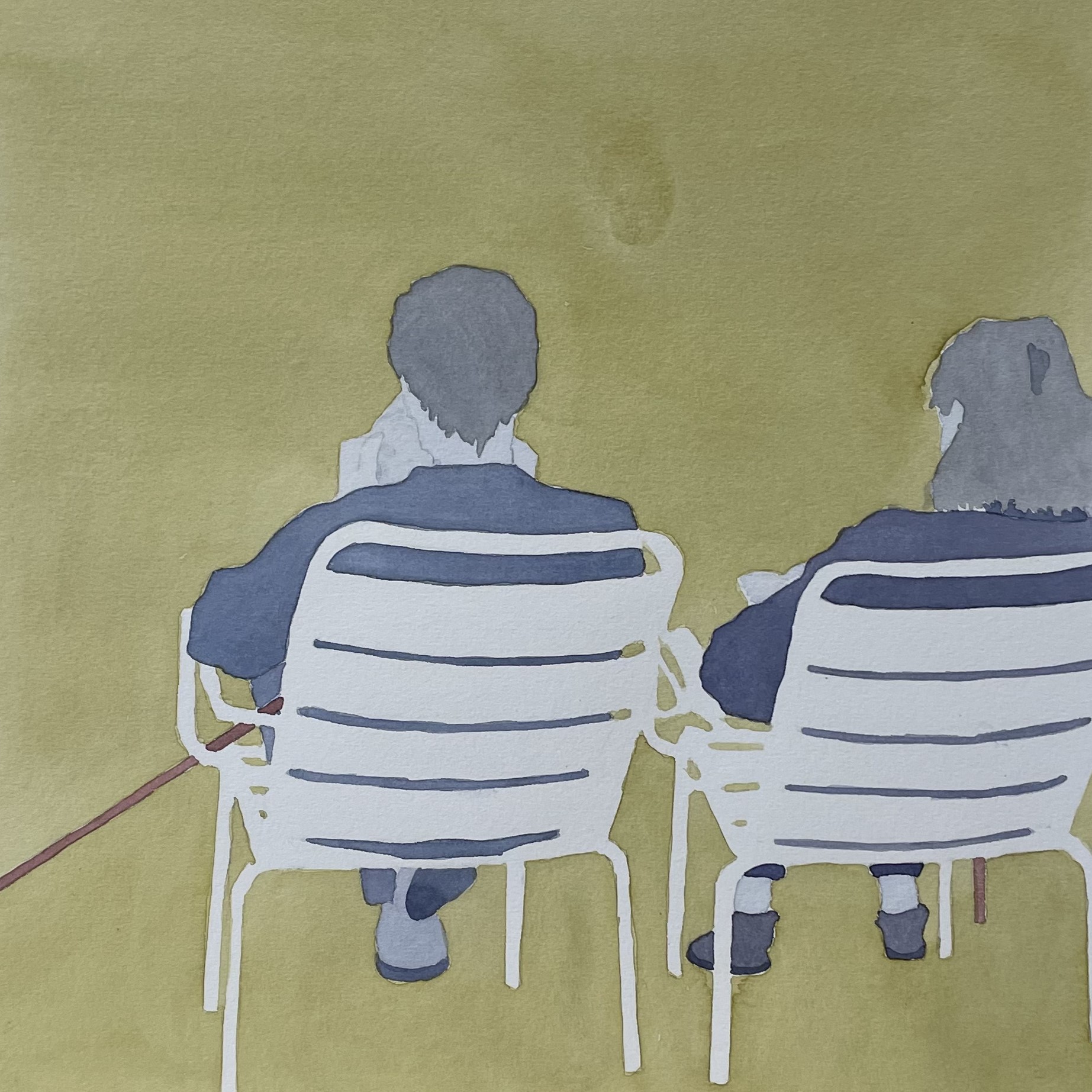
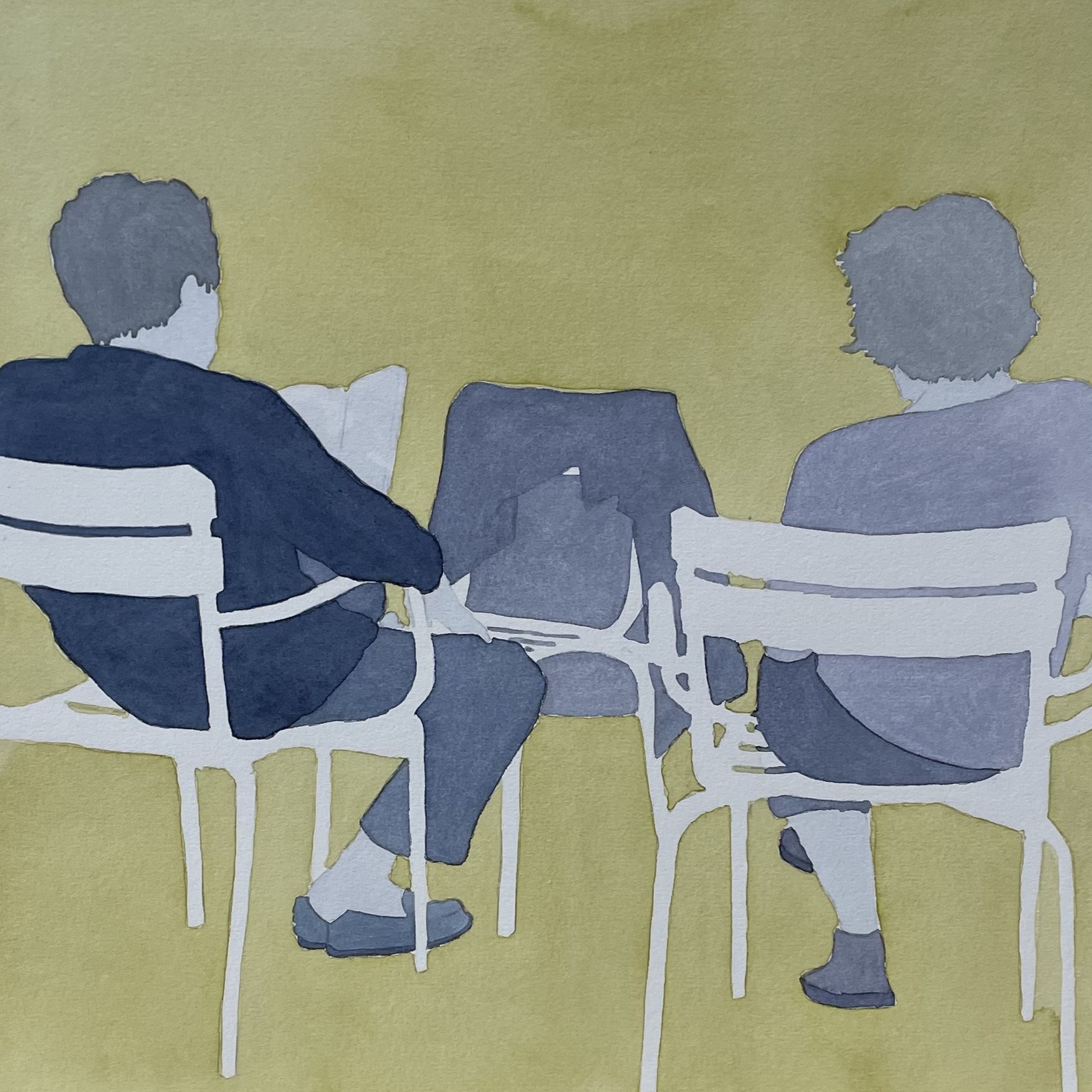
The first movement — Échanger au Luxembourg, Lire au Luxembourg, Se Reposer au Luxembourg (all 2025) — establishes the series' grammar while figures are still present. Two people exchange words. Two people read, turned inward. Two elderly figures rest side by side, canes at their sides, facing the same undifferentiated olive-green ground with the equanimity of those who have long since stopped needing to explain their presence to each other. Lopez renders them from behind, always from behind — we never see faces, never know names. The backs are enough. They establish what the chairs contain before the chairs are asked to contain it alone.
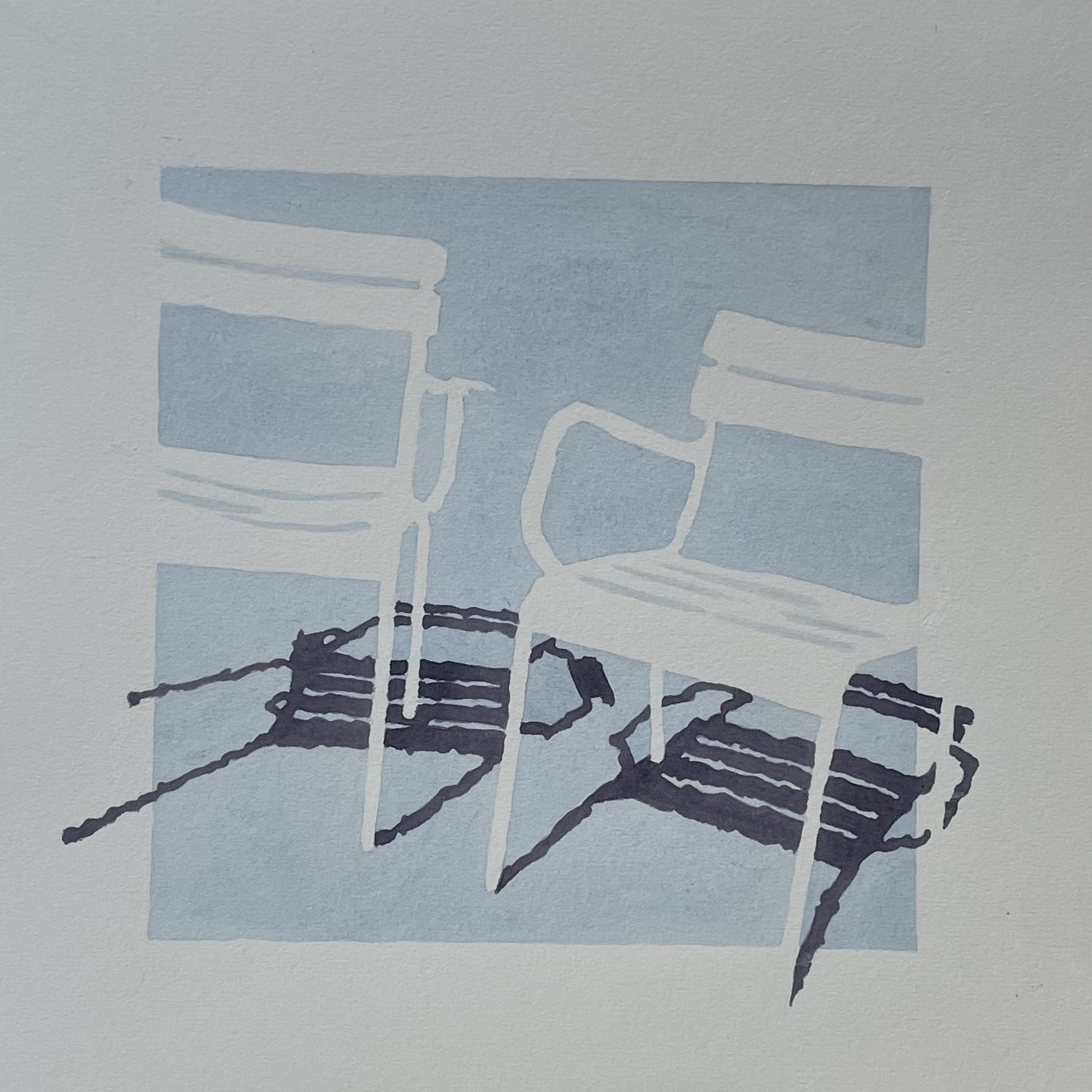
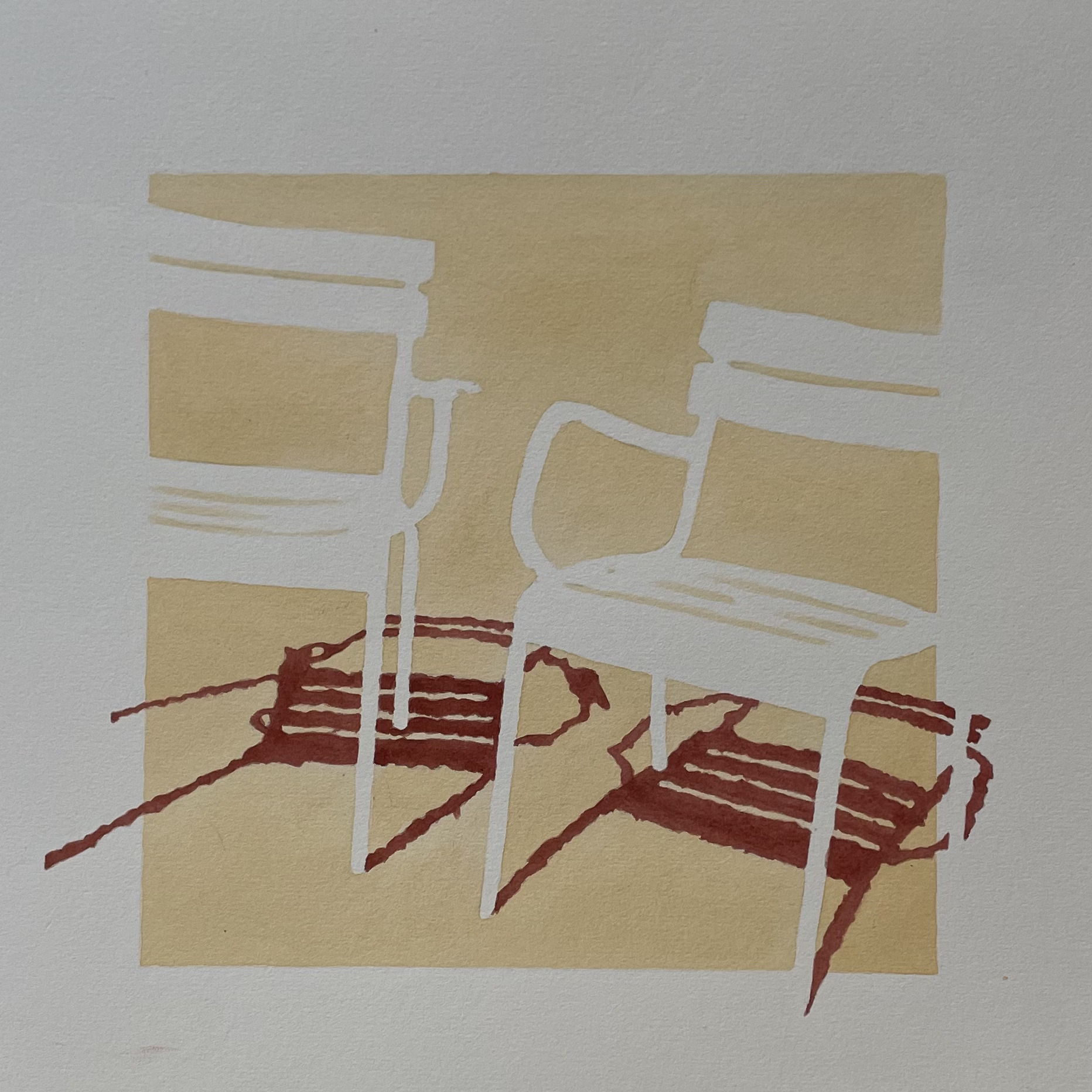
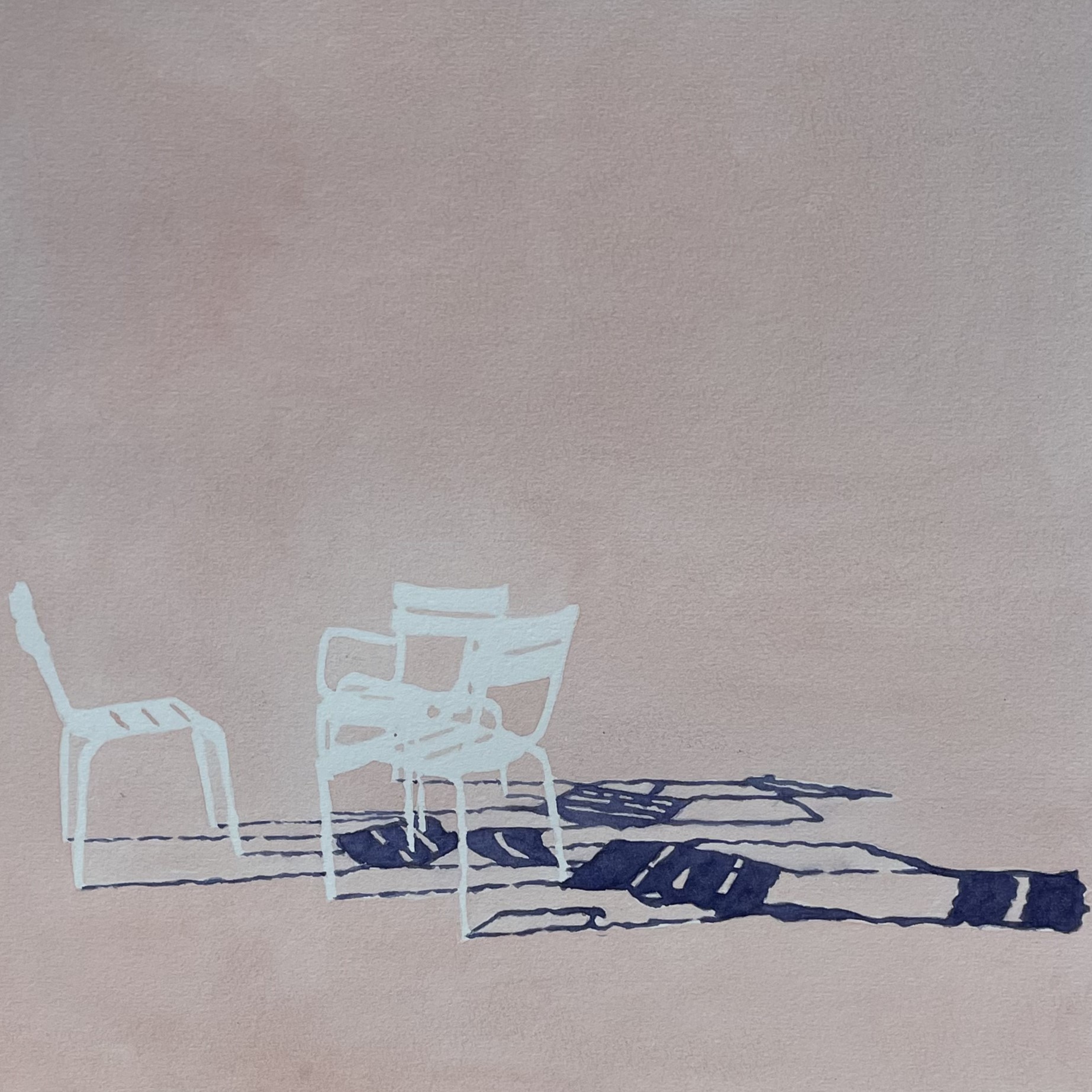
The second movement — five works titled by timestamp, 9h17, 10h51, 10h54, 10h55, 10h56 (all 2026) — removes the figures and replaces them with clocks. The title is now an hour of observation, a notation that fixes each work in the temporal arc of a single morning in the Luxembourg garden. What replaces the body is shadow: cast across ochre grounds in terracotta, in indigo, in steel blue, the shadows track the sun's movement with the precision of a sundial. The question Where are you? — implicit in the series title from the beginning — acquires for the first time its full weight. It is addressed to an absence. The chairs are empty. The hour is recorded. Someone was expected, or has left.
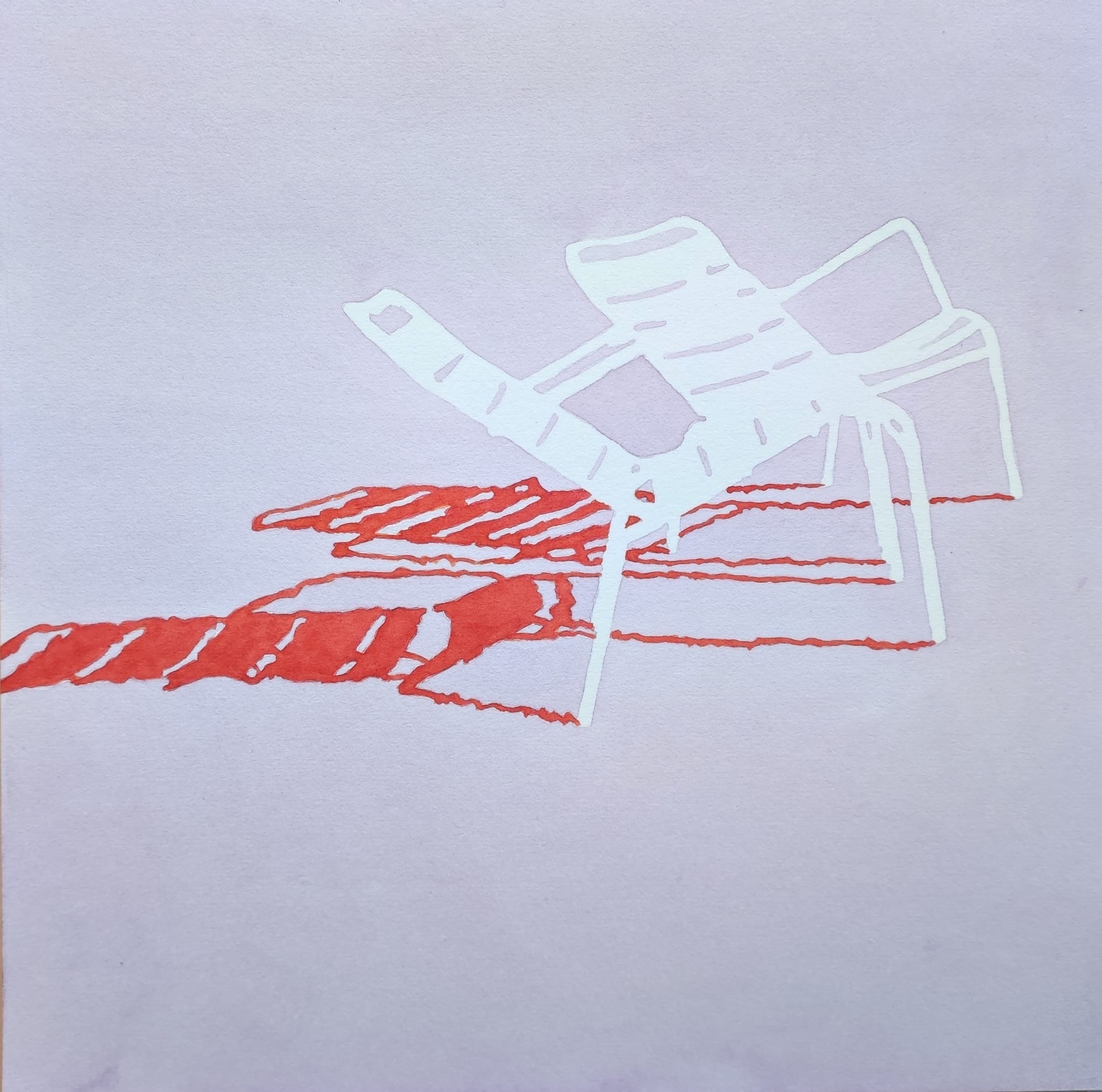
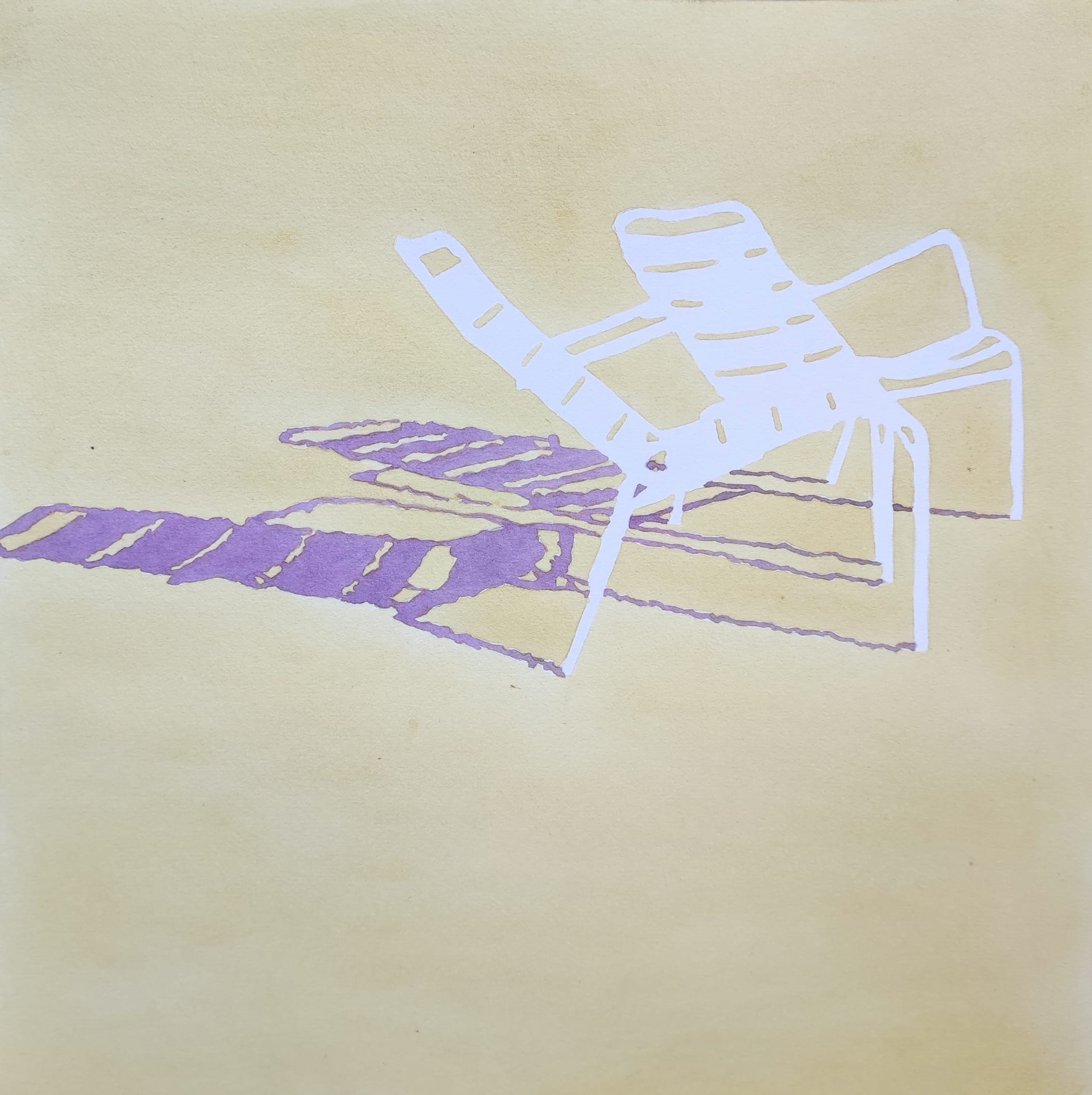
The third movement introduces a conceptual rupture that distinguishes A Moment with You from virtually all precedent in the tradition of serial observation. Lopez abandons the timestamp and replaces it with a compass bearing. Luco 107° and Luco 132° (both 2026) give not the hour of observation but the angle of the sun — the precise degree of its position as it falls across the terre battue, casting the shadows that have been the series' true subject from the beginning. Lopez is a sailor by practice, and the navigator's notation is not metaphorical for her: it is a specific technical claim, a coordinate that positions the light with the same precision a chart positions a vessel. The garden is no longer simply a place of leisure and observation. It has become a navigable territory, readable by angle and orientation. The chair has become a landmark. The shadow has become a heading.
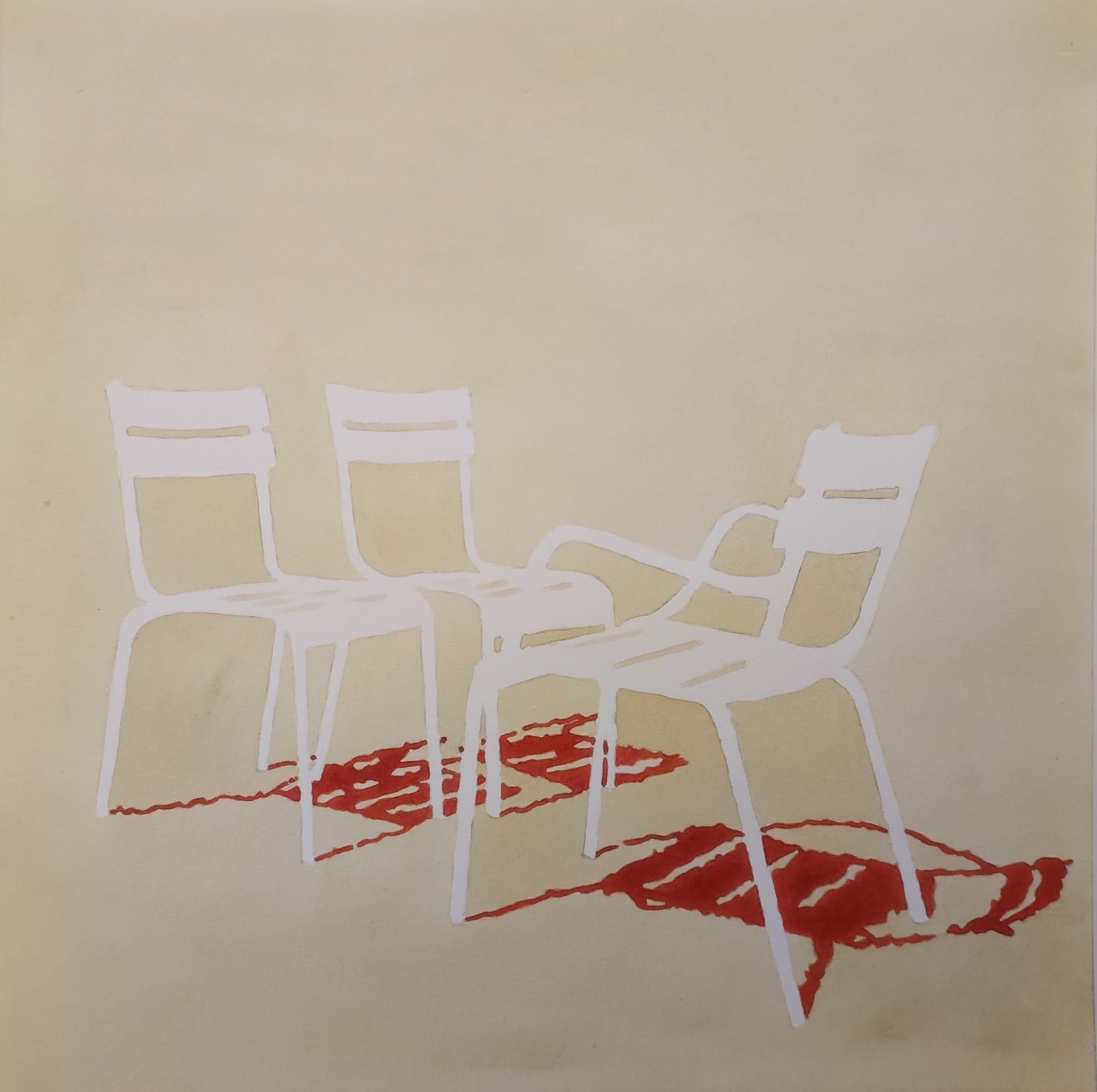
The fourth movement — Luco 132° — Variation 1 (2026) — is the series' most self-aware gesture. Lopez returns to the same bearing, the same chair arrangement, the same shadow geometry, and changes the palette entirely: from the red urgency of the original to a cooler, more elegiac rose-and-slate. The title announces the shift explicitly. This is variation form, borrowed from music — the thème et variations structure in which the same harmonic material is subjected to successive transformations without losing its identity. The Goldberg Variations use the same bass line through thirty transformations. Lopez uses the same compass bearing through different emotional temperatures. What the variation reveals is that coordinates are never merely technical. 132 degrees at one quality of attention is not 132 degrees at another. The navigator's notation, it turns out, was always also a state of mind.
Shadow as Subject
To follow A Moment with You in sequence is to watch shadow gradually displace every other element of the image. In the figurative works, shadow is incidental — it falls beneath the chairs, beneath the figures, a byproduct of the light. In the timestamped works, it becomes structural: the hour determines the shadow's length and direction, and the shadow becomes the only index of time the image retains. In the compass works, it becomes dominant — at Luco 107°, the shadow stretches across the lower third of the composition with the certainty of a bearing line, reaching nearly to the edge of the paper. At Luco 132°, it floods the ground in deep crimson, pooling organically beneath the chairs, spilling between their legs in forms that feel less optical than visceral.
The red shadow is the series' most arresting single image, and it earns comparison with a different tradition than Van Gogh — the metaphysical interiors of De Chirico, where shadows outlast or precede the figures that cast them, where the ordinary is made uncanny not by distortion but by the quality of attention brought to bear upon it. Lopez does not distort. She intensifies. The shadow at 132° is what a shadow looks like when you have been watching the same chairs long enough to feel what they are asking. In Variation 1, the shadow cools to blue-violet slate and does something compositionally precise: it breaks out of the bounded rose rectangle of the ground and continues across the cooler grey surround, as if the feeling cannot be contained within the stage that was set for it. This is not a decorative choice. It is a statement about the limits of framing.
The White Reserve One further technical observation deserves its place in any serious account of this series. Lopez works in the white reserve tradition: the white of the chairs is not painted white, it is the white of the paper itself, preserved against the wash. In practical terms, this means the chairs are not drawn but protected — kept clear of colour while the ground and shadow are laid down around them. The philosophical implication is quiet but precise. In these works, the chairs exist as absence within the image: they are the places where pigment has not gone, the ground held back, the paper saved. Their whiteness is not a positive mark but a preserved void. They are present in the image the way a person is present in a space they have occupied and vacated — by the fact of what surrounds them, by the shape of what would fill them. Lopez's technical method and her philosophical subject are the same gesture.
Situating the Series
A Moment with You belongs to a distinguished lineage of serial observation in European painting — Monet's systematic investigation of Rouen Cathedral and the haystacks, in which a single subject observed across varying conditions of light reveals not the motif but the act of perception itself. But where Monet's series are essentially additive, accumulating light conditions without narrative direction, Lopez's series has an argument. It moves from presence to absence, from time to space, from observation to reflection, from measurement to feeling. It does not simply accumulate. It develops.
It also belongs — less obviously but no less genuinely — to a conceptual tradition that treats the artwork's title as a coordinate rather than a name. Sol LeWitt's instruction-based works, the Land artists' precise geographical notations, the Conceptualists' interest in measurable, reproducible positions in space: Lopez's compass bearings participate in this language while inverting its logic. Where Conceptualism used the coordinate to make the work replicable and impersonal, Lopez uses it to make the work irreducibly specific — this precise angle of light, this precise pooling of shadow, this precise quality of absence, which cannot be reproduced because the person who was meant to be sitting there is gone.
The question Where are you? is, in the end, unanswerable. Lopez does not answer it. What she offers instead is a series of increasingly precise descriptions of the place where someone was — the hour, the angle, the colour of the shadow they cast. It is the most exact form of not knowing: to measure everything that remains, and find that what remains is not the person, but the light they left behind.
A Moment with You comprises twelve works on paper, 30 × 30 cm, watercolor, produced between 2025 and 2026. The series is represented by Art Quam Anima, Paris.
Contact
Works available at Art Quam Anima, 28 rue du Dragon, Paris 6e.
For enquiries: 📩 contact@artquamanima.com
© 2026 Arnaud Quercy
Documentation published by Art Quam Anima - Paris
Artwork presented by Art Quam Anima, 28 rue du Dragon, Paris
All rights reserved — Artworks reproduced with the artist's authorization