Passé-Future collection — 29 Œuvres dans 0 série d’Arnaud Quercy


Passé-Future est une collection de 29 œuvres réparties en 0 série.
What happens when classical music becomes visible? The PASSÉ-FUTUR Art Show explores this fundamental question through fifteen original 3D animations and visual compositions created to accompany live musical performances. Presented at the historic L'Auguste Théâtre in Paris, this groundbreaking multimedia experience transforms concert performance into immersive artistic journey, where sound and sight unite in unprecedented dialogue.
Each visual piece functions as a harmonic-chromatic translation, converting musical structure, emotion, and narrative into dynamic digital art. The collection spans classical, romantic, and jazz traditions, with each composition demanding its own unique visual language and technological approach.
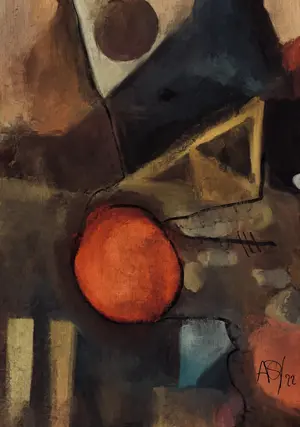
Debussy's "Beau soir" becomes a meditative 360-degree visual poem, where warm and cold tones alternate to reflect the text's oscillation between life's beauty and mortality's inevitability. The camera moves around a deconstructed abstract painting reshaped in three-dimensional space, with a fish-eye effect that responds to the piece's ascending and descending harmonies, creating organic inflations and deflations that mirror Debussy's harmonic flow.
Bill Evans' "Peace Piece" transforms into a Zen-inspired dry garden, where traditional stone arrangements meet moving grass that sways with the music's gentle ostinato. Dark stones gradually defy gravity as Evans introduces musical dissonances, before disappearing as the composition returns to its original simplicity, leaving the grass free to balance in white space—a perfect visual metaphor for the pianist's technique of reconciling complexity with underlying unity.
Bach's Cello Suite No. 1 in G Major emerges as continuous intertwining lines created through fractal mathematics. Five successive layers of mathematical equations applied to a single string create multitudinous shapes that mirror the prelude's melodic lines, demonstrating how one voice can generate complete harmonic worlds—a visual representation of Bach's contrapuntal genius.
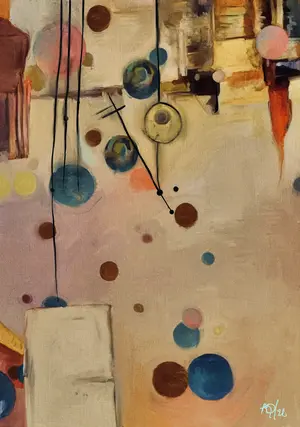
Tchaikovsky's "Valse sentimentale" manifests as flying spheres moving through a night sky, each connected within an intricate web. The spheres symbolize love's universality and infinite potential, while the web represents the bonds and reciprocity that sustain emotional connection over time. As daylight emerges and the composition develops, the density and complexity intensify, yet the cycle continues—love and its web persisting through temporal change.
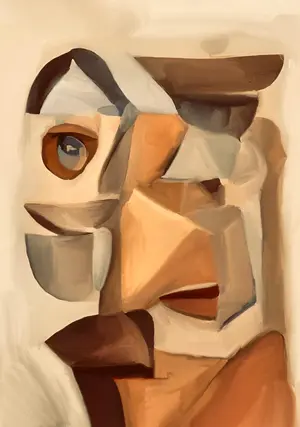
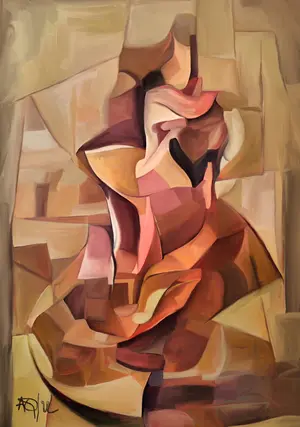
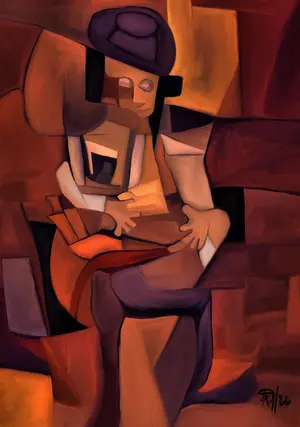
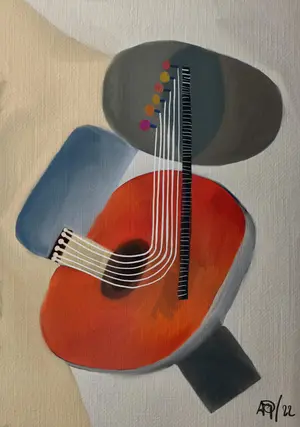
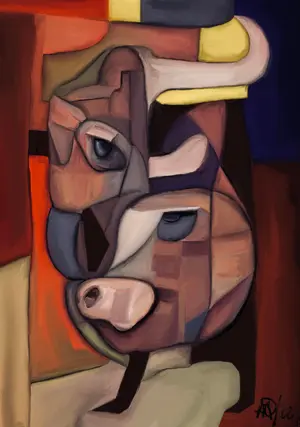
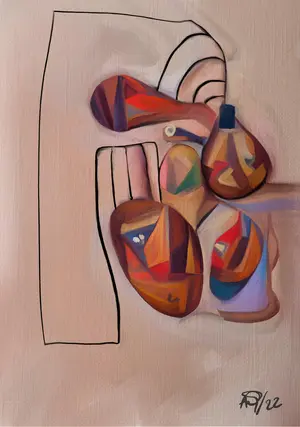
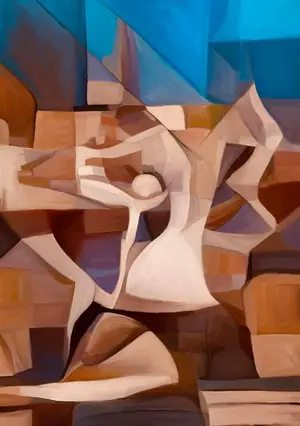
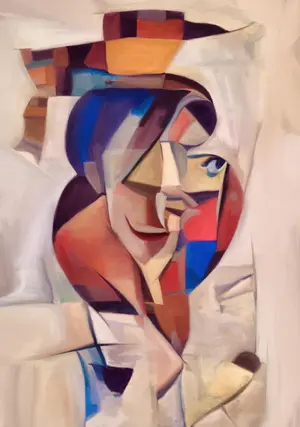
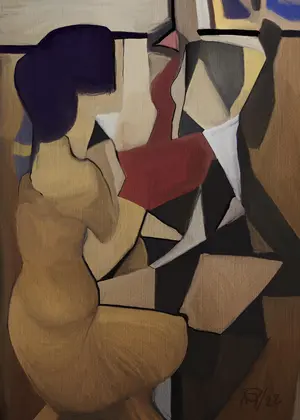
Granados' "Andaluza" explodes into eight cubist paintings depicting the rhythm of daily life in Granada. Spanish folklore performers—dancers, musicians, even a bull—engage in dialogue with traditional practices through geometric deconstruction. The exploration of three-dimensional space through cubes and cones, interwoven with vibrant colors, creates an ahistorical realm that captures the syncretism of Spanish subcultures and the warmth of Andalusian summer evenings.
Bloch's "Jewish Song" unfolds in symbolic black and white landscapes punctuated by meaningful color. Doors represent thresholds and freedom, trees embody life cycles, and colored spheres move according to Jewish cultural symbolism—white for purity, gold for joy, blue for Judaism itself. The visual traces left by these elements connect to deep spirituality, creating a surreal pairing of sacred and secular worlds that addresses the fundamental human experience of faith.
The performance featured accomplished musicians Marion Hedin on cello and David Erhard on piano, whose live interpretations provided the emotional foundation for each visual creation. Their expertise in classical repertoire created perfect counterpoint to the digital artistry, making the experience simultaneously aural and visceral.
Organized by IESA art school students, the PASSÉ-FUTUR Art Show represents a new model for collaborative artistic creation, where traditional performance meets cutting-edge digital art. The project demonstrates how technology can enhance rather than replace classical music presentation, creating immersive experiences that speak directly to contemporary audiences while honoring musical traditions.
The collection stands as testament to the power of interdisciplinary collaboration, proving that the boundaries between art forms are more fluid than traditionally assumed. These visual compositions reveal hidden dimensions within familiar musical works, inviting audiences to experience classical repertoire through entirely new sensory pathways while deepening appreciation for the original compositions' emotional and structural complexity.
Arnaud Quercy est un artiste parisien dont la pratique traverse la peinture, la musique et la sculpture. Son travail est ancré dans l'Idéamorphisme — le principe selon lequel une œuvre d'art ne porte pas de sens, mais le déclenche. Chaque pièce est conçue pour diffracter différemment à travers chaque personne qui la rencontre.
Il crée et expose à Art Quam Anima, sa galerie-atelier au 28 rue du Dragon, Saint-Germain-des-Prés, Paris.
Séries — Passé-Future
Aucune série.
Hors série